GEOL 102 Historical Geology
Spring Semester 2012
Introduction to the Precambrian, The Hadean Eon, & the Archean Eon: Strange Aeons
That is not dead which can eternal lie
And with strange æons even death may die -- "The Call of Cthulhu" (1928), H.P. Lovecraft
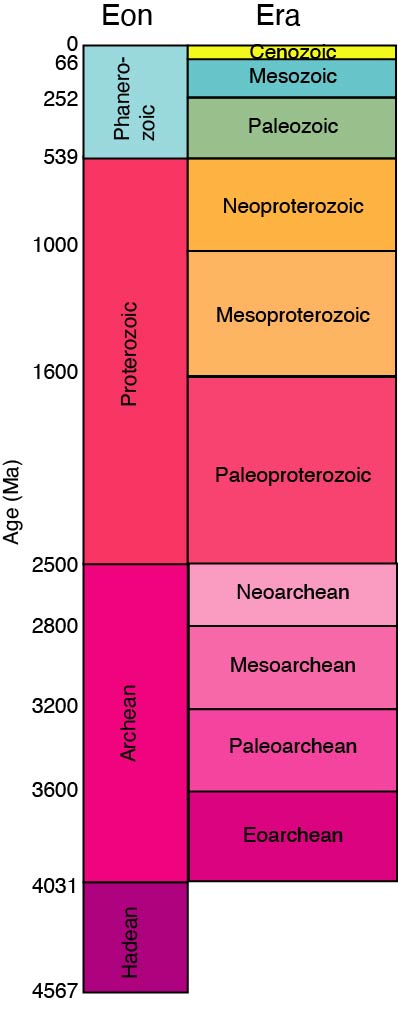
Precambrian: general term for all time before the Phanerozoic Eon.
Other names for Precambrian: Azoic (lifeless) or Cryptozoic (hidden life).
Special terminology for Precambrian rock exposures and distributions:
- Precambrian Shield: Exposed surface of Precambrian bedrock
- Platform: Shield covered by post-Precambrian rocks
- Craton: Precambrian Shield + Platform
- Orogen: Material accreted onto margins of craton by later orogenic episodes
Standard international stratigraphic nomenclature does not recognize a formal
"Precambrian". Instead, uses three divisions: the Hadean (of Hades), Archean (ancient),
and Proterozoic (earliest life) Eons.

Before The Hadean Eon: >4.56 Ga
Formation of Proto-Earth (& the Rest of the Solar System):
Solar system coalesces out of remains of dust clouds produced by earlier generations of supernovae. Particles clump together to form planetessimals,
which are comprised of various combinations of:
- Ices (frozen gasses, including water)
- Organics (carbon-rich compounds)
- Silicates ("rock")
- Metals
As these lump together, they become more massive and exert more gravitational pull, attracting more material, becoming more massive, exerting more
gravitational pull, etc. Soon the vast majority of this material is clumped into the various large bodies of the Solar System, with a tiny fraction
left over to form today's asteroids, comets, and Kuiper Belt Objects. The Proto-Earth (called "Tellus" by some) is one of the largest bodies in the interior part of the Solar
System.
A Star Is Born: However, the VAST majority of the Solar System's mass is in the Sun. Gravitational forces of this mass starts fusing
hydrogen into helium, and the Sun ignites. Originally it was dimmer than today, but still it shone. Solar wind and photon pressure began to sweep
the Solar System clear of much debris.
Hadean Eon:
- That time period before the oldest known rocks on Earth
- A "zen" time period, in that it is defined by absence, and one which will always shrink
as new discoveries of ever-more-ancient rocks are made.
- Based on estimates of the age of the Earth, the Hadean begins 4.56 Ga. It ends
4.03 Ga (in terms of whole rocks) or 4.40 Ga (in terms of oldest individual zircon crystals)
as of February 2001
- Not (quite) yet a formal unit under the International Commission on Stratigraphy, although this is expected to change soon
- By definition cannot be represented by rocks!
The Iron Catastrophe: Although the Earth is not a star, it (or at least the Proto-Earth) too went through a profound change in its
earliest history. Originally the ices, organics, silicates, and metals would have been randomly mixed together, but a combination of gravitational
heating, heating from impacts of planetessimals, and radioactive heating from some of the isotopes found in the silicates and metals caused the
material of Proto-Earth to melt. The heaviest materials (mostly metals, especially iron and nickel) sank to the interior to form the core; the
silicates "floated" on top to form the mantle. Ices melted into gasses and liquids, and they and organics got mixed in with other material. With
a metallic core, Earth now had a magnetosphere.
The Primordial Atmosphere: Proto-Earth's original atmosphere would have mostly been hydrogen and helium, like the gas giants. However, it
lost much of this atmosphere to a number of factors:
- Its lower gravitational field than the gas giants
- Solar wind would have stripped much of the atmosphere, at least until the magnetic field became strong enough
- Energy from planetssimal impacts would send some of that gas into space
- (And one impact that did much more than ALL the others...)
Bad Moon Rising: About 4.533 Ga, a Mars-sized planet (called "Theia" by some)
collided into the Proto-Earth ("Tellus"). Theia and a substantial fraction
of the Earth's mantle was vaporized. The matter that remained in orbit around the Earth coallesced to form the Moon; the rest rained back down to the
surface of the Earth. (So the matter of Proto-Earth + Theia became redistributed to form today's Earth + Moon).
As a result of the birth of the moon:
- Earth's mantle was turned molten to a great depth: a magma ocean.
Partial melting of this ocean began to separate out certain lighter minerals, and Earth's crust (originally all oceanic) becan to form.
- Although Earth's primordial atmosphere was lost, degassing from the magma ocean (and additional material from comets) produced Earth's water
oceans (once the magma ocean had cooled down!) and the second (reducing) atmosphere.
- The water oceans would originally have been much deeper than today's, as there was no (or very little) continental-scale rock to sit above sea
level, and before the rise of subduction not much way of pulling water out of the oceans and mixing it into mantle silicates.
- The reducing atmosphere would have resembled that of Saturn's moon Titan: mostly methane, carbon dioxide, nitrogen, ammonia, water vapor.
Archean Eon:
- 4.03 (or 4.40) - 2.5 Ga
- By definition, the oldest rocks known
- Recently subdivided into the Eoarchean (> 3.60 Ga), Paleoarchean (3.60 - 3.20 Ga),
Mesoarchean (3.20 - 2.80 Ga), and Neoarchean (2.80 - 2.50 Ga). These boundaries are arbirtrarily
defined, and do not correspond with particular correlative phenomena (although the upper boundary
of the Neoarchean is close to the origin of modern plate tectonics).
Record of the oldest rocks is very poor: because of great age, is often buried and/or has
been recycled (metamorphosed, melted, etc.) over the last few billion years.
(Note: Archean (-EAN) refers to a part of Earth history; archaean (-AEAN) refers to a type of prokaryotic organism, and is thus a branch of
the Tree of Life.)
During Archean:
- Atmosphere extremely different: little free oxygen
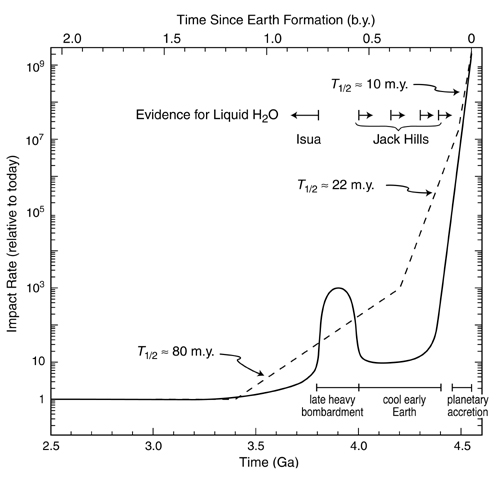
- Impacts common early on, drop off by around 3.8 Ga
- No large continental masses known (however, new very old zircons indicate continental-type
crust present by at least 4.40 Ga!)
- Vastly more geothermal energy: radioactive materials had not decayed as much
Find unusual lithologies and suites of rocks in Archean:
- Komatiite: Ultramafic volcanics, very common in Archean, very rare afterwards.
Require temperatures of greater than 1600 ºC (modern lavas max out at 1350 ºC). Hint at
the extreme activity of Archean mantle.
- Banded Iron Formations (BIFs): Interbedded layers of chert and iron-rich
minerals (iron sulfides, iron carbonates, etc.). Cannot form under modern levels of
oxygen: indicate low levels in Precambrian. First appear 3.8 Ga; much more common in
Proterozoic. Rare after 1.9 Ga, last appear c. 720 Ma. Major iron ore.
- Granitoid-Greenstone Complex:
- THE typical Archean lithological suite.
- Pods of metamorphosed granitic rock (now gneisses) separated by greenstone belts:
bands of sequences of weakly metamorphosed komatiites -> basalts -> felsic volcanics ->
marine sediments (turbidites, cherts, banded iron formations, etc.).
- Oldest 4.03 Ga, disappear around 2.5 Ga.
- Cratonic Complexes: "Modern" style shallow marine and terrestrial siliciclastic
deposition.
- First appear c. 3.1 Ga; common 2.5 Ga.
- Indicate presence of sizeable land surfaces produced by suturing together of island arcs
- Some evidence (common age, shared position in younger land masses) that cratons in South Africa, Madagascar, Sri Lanka, India, western Australia, and
parts of East Antarctica that all date from about 3.1 Ga formed the first continent: Ur
- Additionally, some evidence that various Archean provinces had actually united to form a decent-sized supercontinent Kenorland (comprised of
Ur, parts of what would become Baltica (northwestern Europe) and parts of what would become Laurentia (North America plus Greenland) by 2.7 Ga
- During Archean and Paleoproterozoic, contain detrital uranite and
pyrite (unstable under higher levels of oxygen).
Note that there does seem to be a form of mineral evolution: not minerals
descending from earlier minerals, but rather large scale changes in the chemical conditions of the Earth (and before that, the
proto-Earth) that allow for different suites of minerals to be formed at different periods.
Some famous localities:
- Acasta Gneiss:
- Oldest known rocks in the world (4.03 Ga)
- Granitoid-greenstone complex, NW Territories, Canada.
- Isua Formation: In Greenland, extremely ancient rocks containing oldest
evidence of life.
- Pongola Supergroup:
- Oldest well-known cratonic complex.
- Sits conformably on top of greenstone belt, changes to shallow marine and
non-marine sediments. (Non-marine include common gold deposits).
- Southern Africa.
- Jack Hills
- Metasediments containing oldest known terrestiral minerals (zircons dated at 4.40 Ga)
indicating incredibly ancient continental rock
- Western Australia
Where did granitic material come from, if midocean ridges only produce mafic materials?
A "hot topic" in historical igneous studies, but seems to be related to partial melting
and recycling of materials near ancient subduction zones: as material is subducted and
remelted in the presence of water, produces lots of felsic materials. These bubble up
as a sort of "scum". Comparable granitic material is present in modern Iceland.
To Next Lecture.
To Previous Lecture.
To Syllabus.
Last modified: 19 January 2012