GEOL 102 Historical Geology
Spring Semester 2011
The Cenozoic Era I: Paleogene Geology
Phanerozoic Eon: 542 - 0 Ma
Cenozoic Era: 65.5 - 0 Ma
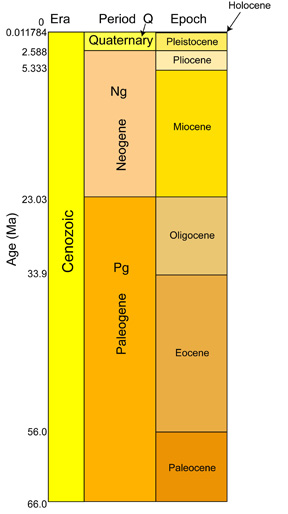
Although stratigraphers agree upon the names and dates of the Epochs of the Cenozoic,
there has historically been considerable disagreement on the Periods of the Cenozoic:
- American (Traditional) 2-Period Model (still used by US researchers who haven't been paying attention...):
- Quaternary Period (comprising Pleistocene & Holocene)
- Tertiary Period (comprising Paleocene to Pliocene)
- European 2-Period Model (until 2007 the formal, internationally-recognized model):
- Neogene Period (comprising Miocene to Holocene)
- Paleogene Period (comprising Paleocene to Oligocene)
- Hybrid 2-Period Model:
- Quaternary Period (comprising Pleistocene & Holocene)
- Tertiary Period
- Neogene Sub-period (comprising Miocene & Pliocene)
- Paleogene Sub-period (comprising Paleocene to Oligocene)
- 3-Period Model: The Current Official Version of the International Commission on Stratigraphy:
- Quaternary Period (comprising Pleistocene & Holocene)
- Neogene Period (comprising Miocene & Pliocene)
- Paleogene Period (comprising Paleocene to Oligocene)
This is the version shown in the graphic above. The "Quaternary" is formally reinstated
as a "Period" that contained the Holocene and Pleistocene (and the latter has absorbed what was formerly the last stage of the Pliocene!)
This follows an unsuccessful bid to create a "Quaternary Sub-Era". The "Tertiary" thus remains in limbo.
Cenozoic is by FAR the best known Era, representing only 1.4 % of Earth History, yet the
most commonly encountered rocks on the Earth's surface and on the sea floor.
Paleogeography and Geology of the
Paleogene:
Paleocene-Eocene: continuation of
Laramide Orogeny in Cordillera (began in Maastrichtian, Late Cretaceous).
Uplifted blocks and down-dropped basins in central west (Utah, Colorado, etc.): very
large lake deposits of
oil shales. Beginning of Yellowstone volcanism (a mantle plume
underneath the American West)
Last epicontinental sea of North America (Cannonball Sea) in Paleocene: interior
of continent has been fully emergent since then.
Paleocene-Eocene climates very warm, comparable to Cretaceous.
The Paleocene-Eocene Thermal Maximum:
- Short term (<10 kyr) temperature increase of carbon dioxide levels by 3-4x
- 4-5 degree temperature increase in surface tropics, 6-8 degree at poles, 4-5 degree even in deep seas
- Extinction of many planktonic groups, including within forams
- Plant damage by insects increases about 3x background level for 10 kyr
- For a few kyr, dwarfing of terrestrial animal species
- High polar temperature allows spread of animals once isolated: artiodactyls (even-toed ungulates),
perissodactyls (odd-toed ungulates), and advanced primates (possibly originating in India) spread across
Asia, Europe, and North America
- Likely due to a major degassing of methane hydrates
- Coincides with a flood basalt event at the breakup of the northeastern Atlantic (the Greenland-European
split)
- Coincides with a major regressions: perhaps oxidation of marine muds in exposed epeiric seas added to
carbon dioxide
Dramatic temperature drop during late Eocene:
- Extremely fast (less than 100,000 years)
- Drop in bottom water of 4° - 5° C; bigger changes on surface
- Generated by the break up of
Antarctica from Australia, forming circumpolar current and very cold bottom
water - First Antarctic glaciers
- Causes major changes to marine and terrestrial communities: an important extinction
event of mammals, forams, coccolithophorids. For mammals, called the "Grande Coupure" (big break):
replacement of many native European and North American clades with more specialized Asian ones
- Shift from wet forests to dry woodlands in North America and Europe
Late Eocene/Early Oligocene: rifting of Atlantic separates Laurentia from Europe and
Greenland from North America (end of Laurentia proper). Asia and North America remain
physically connected by Bering Land Bridge (periodically emergent or submergent)
During Late Eocene: Chesapeake Bay
impact:
- Large asteroid mass hit eastern North America
- Crater was later covered by Oligocene and Neogene coastal sediments, but subsurface
crater structurally controlled groundwater flow from then on
Starting in the Eocene, and continuing into the Miocene, the
Alpine Orogeny:
- Microplates, formerly part of northern Africa, raft across Tethys to collide with
then-southern Europe
- These microplates represent the modern southern European regions (Italy, Greece, etc.)
- Collision of these microplates caused major small-scale folding, called
nappes
- Later (Miocene) northward migration of Africa generates the Atlas Mountains and
closes off the Mediterranean
- Deposition of The Flysch and The Molasse (after which these lithological associations
are named)
Late Oligocene: as Laramide Orogeny ends, extensive erosion of upper surfaces of
Cordilleran Mountains and infilling of intramontane basins.
Throughout late Paleogene: Andean Orogeny (actually begins in Late K and continues
to today) and earliest stages of
Himalayan Orogeny.
To Next Lecture.
To Previous Lecture.
To Syllabus.
Last modified: 14 January 2011