
Hominid Evolution:
Primates
are one branch of the placental mammals. Primates appear during Paleocene.
Primates possess:
Widespread throughout North America, Eurasia, and Africa during early Paleogene; die out in North America but survive elsewhere.
Anthropoids: "higher primates" ("monkeys", "apes", and humans); proportionately larger brains. "Monkeys" are a paraphyletic grade (or more accurately, a paraphyletic grouping of two extant monophyletic clades (one South American, the other Eurasian-African) and various extinct clades). Monkeys move along the tops of branches.
Hominoids: "apes" and humans. Strictly Old World ("Eurasian-African") until Pleistocene. Move by swinging underneath branches: developed wide shoulders and wide-ranging arm motions. During Miocene many groups of "apes" throughout Eurasia and Africa. One Asian branch (pongids) contained Gigantopithecus (largest primate known) and the modern orangutan (Pongo).
In Africa: the hominids. Derived condition of knuckle-walking. Ancestrally were forest dwellers living in small communities, primarily herbivores with some meat, use wooden tools; gorillas (Gorilla) and chimps and bonobos (Pan) retain these habits.
At around 7 Ma, one lineage of hominids split from the ancestors of Pan. The first hominines ("hominids" in the old sense) primarily lived on edges of forest and grassland. New evidence showed that they could knuckle-walk. Omnivores with shorter faces and smaller canines. Evidence of stone tool use.
Recent field observations shows that some traits once thought to be exclusively human are widespread among hominids or among pongids+hominids:
On the other hand, modern humans have many distinctive traits among living forms:
In some of these traits, we seem more similar to baby apes than to their adults, suggesting that paedomorphosis played a role in our origins.
The fossil record of hominins (humans and extinct primates closer to us than to living apes) is actually not bad, and has greatly increased in the last decade or so. Depending on the taxonomy used, there are about 20-24 extinct hominin species, clustered into nine or so genera. Nearly all of these are limited to Africa, strongly supporting human ancestry in Africa.
Molecular evidence suggests a division between the line leading to Pan and the line leading to Homo at about 6-7 Ma. In that same time range is the oldest known hominin fossil: Sahelanthropus tchadensis (from Chad). Known only from a skull, its brain is no bigger than those of comparable-sized chimps and gorillas. The position of the occipital condyle suggest that it might still have been a knuckle walker.
Other early hominins from East Africa. They include 6 Ma Orrorin tugenensis (whose limb bones suggest that it was at least partially bipedal), Ardipithecus ramidus (from 5.8 to 4.4 Ma), and "Australopithecus" anamensis (4 Ma, and more likely belonging to Ardipithecus than to true Australopithecus). These forms appear to have lived on the margins of forests and grasslands. These taxa still retained divergent big toes, and thus were probably fairly good tree climbers.
From among these early fully-bipedal primates evolved the gracile apemen or "gracile australopithecines". (This is probably a paraphyletic group: a grade of forms including the ancestors of all later hominins). The two most famous species are:
Stone tools associated with basal hominins and gracile apemen are not much more advanced than those of modern chimps and bonobos.
Descendants of the gracile apemen include two major clades. The first is Paranthropus, the "nutcracker men". Once called the "robust australopithecines", these were more robustly built (duh!) hominins with massive jaws, huge molars, and extremely large jaw muscle crests. Their diet probably included a lot of tough plant matter, but apparently also included some meat. Fossils range from 2.7 to 1.2 Ma, and are found in both South and East Africa. They are currently divided into several different species.
The second clade descended from gracile apemen include humans and our closest relatives. The oldest representatives of this group have traditionally been included as species of Homo, but some researchers have split one or more of these species off as the East African genus Kenyanthropus. We can collectively refer to these as the "habiline" grade. The species K. platyops from 3.5-3.2 Ma, Homo rudolfensis from about 1.8 Ma and H. (or K.) habilis from 2 Ma may be their own clade, but might actually be direct human ancestors. (Their brains are larger still than gracile or robust apemen. Kenyanthropus employed a simple stone tool kit, the Oldowan. (Perhaps Australopithecus and Paranthropus did, too.)
Closer to modern humans than the habilines, but futher from us than the "pithecanthropines" (see below) are a pair of small-bodied Asian taxa: 1.8 Ma H. georgicus of Georgia and H. floresiensis of Indonesia. This latter species persisted until EXTREMELY recently: fossils are dated from 18 to 13 ka (making them far younger than Neanderthals!), and they may have overlapped with the first modern humans in the islands. H. floresiensis are nicknamed the "hobbits", but here I'll use that nickname for these two collectively.
Up until recently these were considered small descendants of pithecanthropines, but current analyses place them basal to the advanced members of Homo and they lack the advanced hindlimbs of our group. These represent the first hominins to make it out of Africa. "Hobbits" may represent a clade that all later hominins went through: alternatively, they may have been an exclusively Asian branch.
More advanced Homo is distinguished from earlier hominins because of our long legs, well adapted for long distance endurance running. Although humans cannot run as fast as many other plains species, we can cover the same amount of distance in a day because of our endurance.
The older representatives of Homo were originally put in the genus Pithecanthropus (literally "ape men"), and later all lumped as a single species Homo erectus. Current practice is in between: they are split out into several species, all within Homo. As a grade, however, we can call these the "pithecanthropines". Pithecanthropine brain size is larger still than habilines and hobbits.
Homo ergaster of Africa is the oldest, showing up at 1.9 Ma. They seem to have grown as tall as many modern humans. They are associated with a stone tool technology, the Acheulean, which shows up 1.75 Ma and persists in parts of the world until 200 ka.
Descendants of H. ergaster makes it out of Africa and spread into Eurasia both east and west.
The eastern population evolved into Homo erectus, found from China south to Indonesia. H. erectus first shows up at 1.6 Ma, and the last individuals may have been around 50 ka. However, those last forms may belong to a new cold-adapted East Asian species with larger body size. (Newly described is a 260 ka woman of this larger form.) H. erectus shows the oldest evidence of harnessing fire.
In the west (Europe and Africa) appeared very large brained hominins. Sometimes termed the "archaic Homo sapiens", these are now typically divided up into various species, such as H. cepranensis of 900 ka Italy; H. rhodesiensis of 200 ka Southern Africa; and H. antecessor of 800 ka Spain. From among this group of species evolved two major lineages, one European and northern African and one (initially) strictly African.
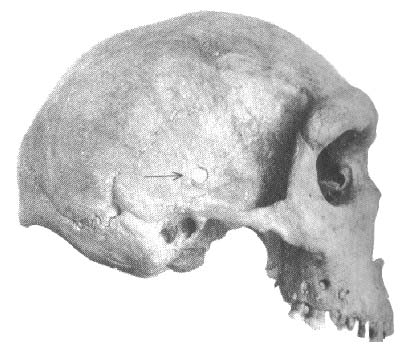
The first line is represented by H. heidelbergensis from 800 to 200 ka, and its descendant H. neanderthalensis from 200 to <28.5 (mabye even 25) ka. The latter has the largest brain size of all hominins (yes, bigger than ours) and were very powerfully built (body strength of a 19th Century weightlifter). They show many unique derived characters lacking in all modern humans, and are almost certainly not our ancestors (except for a few possible genes here and there). Neanderthals lived in Europe and the Mideast, in cold (but not glacial) conditions. Breaks in their bones match those found in rodeo performers, suggesting that they manhandled large animals. Their tool kit, the Mousterian, was far more sophisticated than the Achulean. However, it lacked apparent art, nor did it show much in the way of fine tools, nor did it change much over more than 150,000 years, nor did it vary much from region to region.
Overlap between modern humans and Neanderthals was very brief ( less than 6000 years). Some have suggested human-Neanderthal mating, but the evidence is highly problematic and is better explained as common juvenile traits rather than hybrid traits. At the end of their history Neanderthals improved their technology, producing Chatelperronian technology: finer than Mousterian, but still lacking in obvious art.
Neanderthals seem to have held out last of all in southern Iberia (including the rock of Gibraltar).
The oldest specimens of true Homo sapiens date to about 200 ka. Modern humans are present in Africa from 200 ka onward, but only outside of Africa at about 90 ka (the second "out of Africa" movement). Curiously, anatomically-modern human technologies are all pretty stable (and similar to Mousterian) until around 60-50 ka, when a series of shifts begin:
Some accomplishments of humans pre-Holocene:
This is what Jared Diamond's "Great Leap Forward". It may be associated with the evolution of complex symbolic language.
Genetic evidence suggests a population bottleneck (down to 10,000 individuals or so) at around 80 ka, prior to spread out of Africa.
ALL modern humans are descended from African populations; we are all the scatterlings of Africa. Some voyages (throughout Europe and continental Asia, into glacial lands, over the land bridge to the New World) were on foot. But H. sapiens seems uniquely to be a boating species. Modern humans reached Australia by 50 ka, but there was no land connection at the time; in contrast, the Neanderthals never made the much shorter crossing from Gibraltar to Africa. And boats may have helped humans colonize the New World: controversially as early as 30 ka, unquestionably by 13 ka, quite reasonably around 18-16 ka.
Arrival of modern humans (or at least modern humans equipped with certain levels of technology) seems to result in mass extinction of many local animals: around 46 ka in Australia; around 14 ka in glacial Eurasia; around 11-13 ka in the New World; and many, many times in islands around the planet.
From the point of divergence from the ancestors of chimps through all this times, humans seem to have lived in small bands. Comparisons with both non-agricultural human societies and with non-human hominids suggests these were almost all bands of about 30 or so at most, made up of closely related individuals: everyone would be a first or second cousin. There would be occasional exchange of genes between neighbors, but aggression between them would help maintain cultural and linguistic separateness. At the larger end would be tribes: units of a few hundreds, still closely related by birth and maintaining identity by means of unique customs, languages, and a near constant state of low-level "warfare" (although having far more in common with "drive-bys" than with later wars). The ability for any one band/tribe to conquer or absorb another would be relatively limited. Food acquisition would be various combinations of hunting and gathering, and at the most sophisticated end limited and primitive versions of animal husbandry and gardening.
Some accomplishments of humans pre-Holocene:
To Next Lecture.
To Previous Lecture.
To Syllabus.