GEOL 102 Historical Geology
Spring Semester 2014
Fossils and Fossilization
Some general ways of describing organisms' life habits:
Trophic Level: where is the organism in the food web?
- Producers: photosynthesizers (use sunlight) or chemosynthesizers (use chemicals)
- Equation of photosynthesis: sunlight + 6 CO2 + 6 H2O yields C6H12O6 + 6 O2
- Or, in other words, photosynthesizers convert sunlight, carbon dioxide, and water into carbohydrates (their bodies) and waste
oxygen
Nearly all of Earth's O2 is produced by photosynthesis
- Photosynthesizers and chemosynthesizers are collectively called autotrophs
- Consumers: 1rst order ("herbivores") vs. 2nd, 3rd, etc. order ("carnivores")
- Detritivores: suck up broken down organics in sediment
- Suspension feeders: suck up whole organisms and broken down organics in water column
- Decayers: break down organic material
- Collectively, consumers, detritivores, suspension feeders, decayers, etc. are all heterotrophs
- A primary way that heterotrophs feed is by aerobic respiration, which is the reverse of photosynthesis:
C6H12O6 + 6 O2 yields energy + 6 CO2 + 6 H2O
- Or, in other words, heterotrophs each organic carbohydrates and combine them with oxygen to produce energy and waste
carbon dioxide and water
Mobility: does the organism move?
- Sessile: immobile: can be attached or sediment sitter
- Motile: movable
If in water, where in the water/sediment column is it?
- Plantkon: floating on or near surface, does not move far under own power
- Nekton: free swimming in water column
- Benthic: bottom dweller.
- Epifaunal: lives on water-sediment interface
- Infaunal: lives in sediment
Fossils: The physical traces of past life.
Or, more fully, a fossil is any remain of an ancient organism or its behavior
preserved in the rock record.
Fossils are the only direct evidence of past life, although indirect evidence exists in
the form of the phylogenetic and biogeographic distribution of modern organisms.
The study of the preservation of fossils is called taphonomy.
Two major types of fossils:
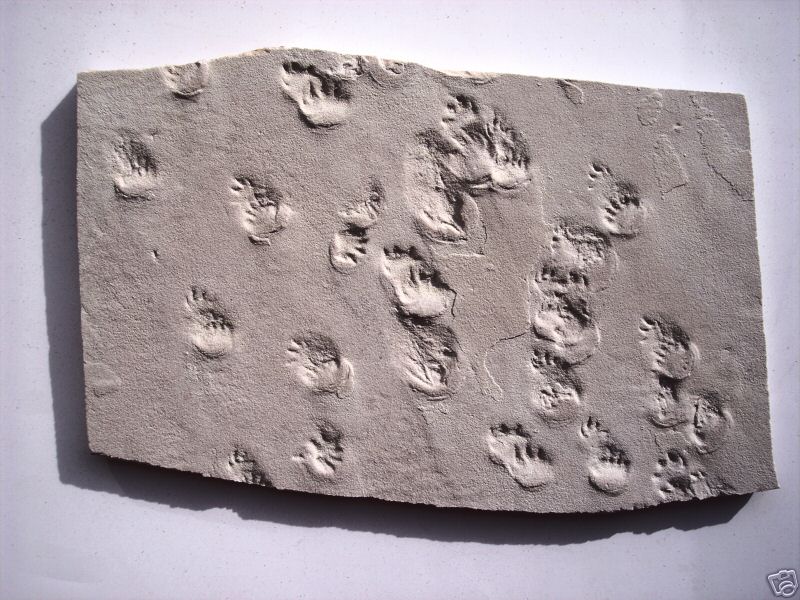
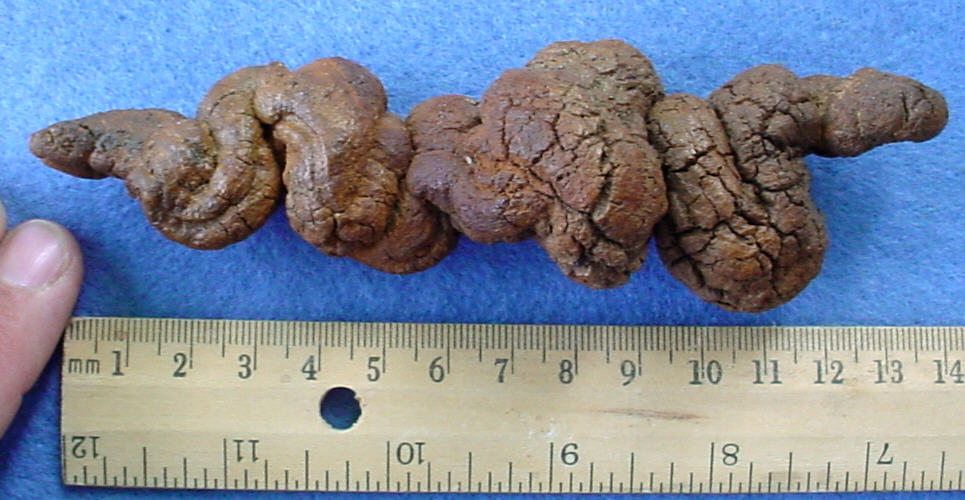
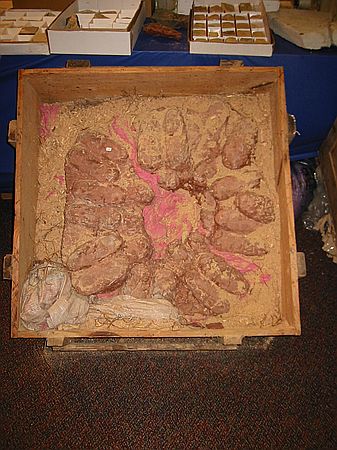
- Trace fossils: the record of organisms' behavior preserved in rock.
- Body fossils: the physical remains of an organism preserved in rock.
Trace fossils are, essentially, biologically-generated sedimentary structures.
They include:
They include:
Preservation of trace fossils is just like other sedimentary structures: must have rapid
burial, and preserved by lithification of the rock itself.
Body fossils: can be preserved in a variety of ways.
In general, only organisms with hard parts can be preserved: shells, bones & teeth,
wood, etc.
Main hard part mineralogies/biochemistries:
- Carbonate (calcite & aragonite): found in coccoliths, some multicellular
algae, forams, some sponges, corals, brachiopods, bryozoans, mollusks, trilobites &
other calcified arthropods, echinoderms, etc.: very easy for organisms to generate from
sea-water.
- Silica (normally cryptocrystalline quartz): diatoms, radiolarians, some sponges
- Calcium phosphates (including hydroxylapatite): some brachiopods,
vertebrate bones & teeth
- And various complex organics, such as:
- Cellulose: plants, some algae
- Chitin: arthropods
- Spongin: some sponges
But many organisms have NO hard parts, and are only preserved in rare instances.
Most hard parts are not solid material, but porous. Pore space is occupied by organic
material in life. Upon death, organic material begins to decay.
Modes of preservation:
- Unaltered: simple burial, some weathering. Becomes rarer (for stochastic
reasons) further back in fossil record.
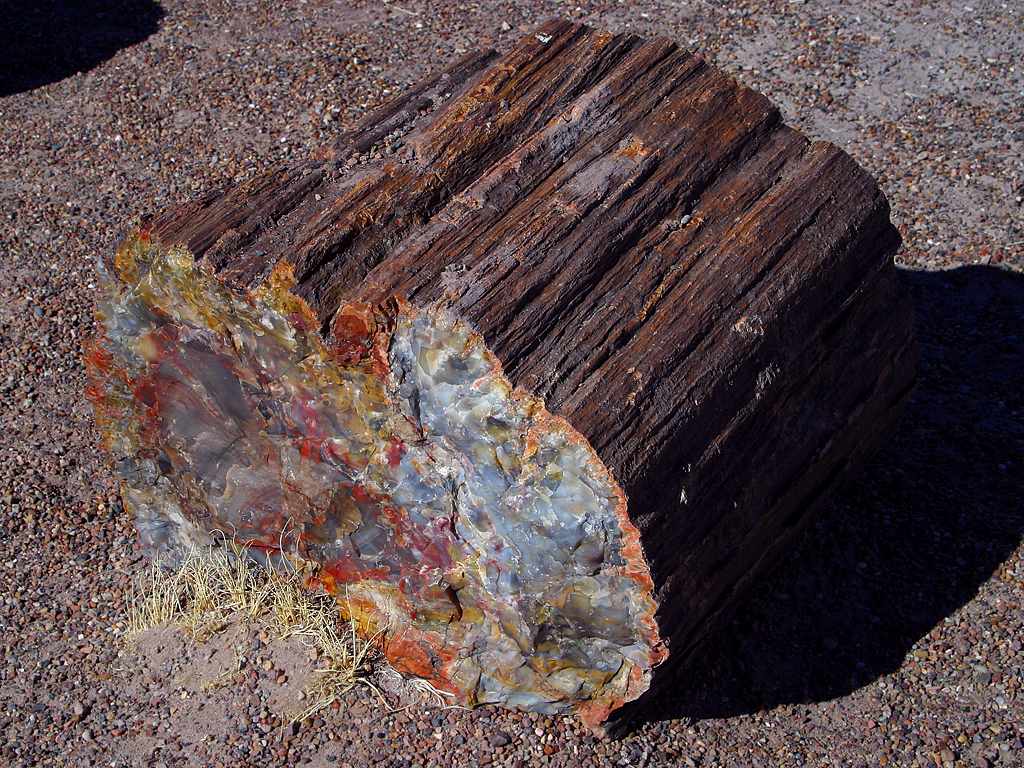
- Permineralized: very common mode.
- Pore space is filled in with ground water: some dissolved minerals precipitate in
pores (probably some contribution by bacterial activity).
- Common minerals found in permineralized fossils: silica; calcite.
- Original hard parts remain, but extra material added to pores.
- "Petrified" wood is actually
permineralized wood
- In some cases, soft tissues can be permineralized, but this
seems to be very rare
- Recrystallization: very common in calcitic fossils. After burial, calcite
crystals reorder and grow into each other. Original mineralogy remains, but structure is
lost.
- Replacement: grades from permineralization.
- Partial to complete replacement of crystals of one mineralogy with another, controlled
by hard part material and by dissolved material in ground water.
- Bone (hydroxylapatite) can be replaced with uranium-bearing minerals, for instance.
- Common forms of replacement: silicification; pyritization;
phosphatization.
- Carbonization: organic material is "distilled" under pressure. Many volatiles
lost: carbon film left behind.
- Mode of preservation of coal
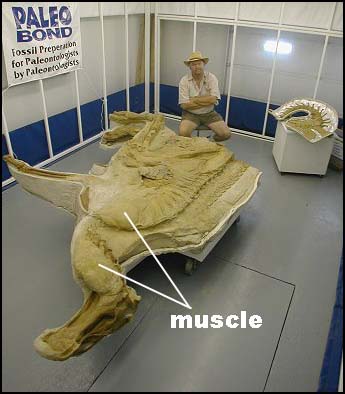
- Also preserves soft tissues of some animals
(like the feathers
of some dinosaurs or the body outline
of ichthyosaurs) and plants
- Bacterially controlled
Different organisms have different potential for fossilization.
- Hard parts vs. no hard parts
- Single hard parts (e.g., gastropods & cephalopods) vs. two hard parts (e.g.,
brachiopods & bivalves) vs. many well-connected parts (e.g., arthropods & echinoderms)
vs. many parts connected only by soft tissue (e.g., vertebrates)
- Microscopic to sediment-sized to immense
- Lived in erosive environments (e.g., mountains) vs. depositional environments
- Lived in accessible vs. inaccessible environments (e.g., continental shelves vs.
oceanic basins)
Plants a special case: different organs (leaves, stems, trunks, fruit, flowers, seeds,
pollen, etc.) are only very rarely preserved together. Each part generally given its
own species name!
Many fossils were transported by currents betweeen their death and their burial. These are said to be
allochthonous ("other [place] buried"). However, some organisms might get buried in place (in situ,
to use the Latin phrase), and are said to be authochthonous ("same [place] buried").
Once in awhile there are depositional settings which preserve extremely fine details or soft tissues
that are not commonly preserved in fossils. These are known by the German word for "bonanza":
Lagerstätten (singular "Lagerstätte"). Lagerstätten give us great insight
into the diversity and anatomy of past life.
To Next Lecture.
To Previous Lecture.
To Syllabus.
Last modified: 27 February 2014