GEOL 102 Historical Geology
Spring Semester 2012
The Proterozoic Eon I: Birth of Modern Geology
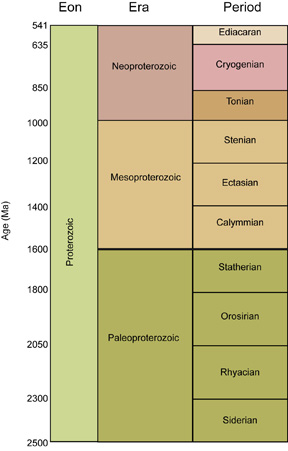
Proterozoic Eon: 2.5 - 0.542 Ga
| Era | Range
|
|---|
| Neoproterozoic | 1000 - 542 Ma
|
| Mesoproterozoic | 1.6 - 1.0 Ga
|
| Paleoproterozoic | 2.5 - 1.6 Ga
|
Proterozoic is distinct from Archean in:
- Clear evidence of "modern-style" (continent-scale) plate tectonics
- Decrease in abundance of komatiites & greenstone belts
- HUGE deposits of Banded Iron Formations during 1rst half of Paleoproterozoic
- Complex unicellular, and first multicellular life
- Indications of higher levels of oxygen
The 2.5 Ga boundary is somewhat arbitrary: shift from "Archean" to "Proterozoic"-style
crust begins at 2.95 Ga in southern Africa, but not until 2.6 in North Ameirca, and
after 2.45 in some other regions.
Lithologies of the Proterozoic:
- Stromatolites VERY abundant throughout
- BIFs VERY abundant during first half of Paleoproterozoic (92% of all BIFs deposited
from 2.5-2.0 Ga); reappear in brief intervals associated with Neoproterozoic
superglaciation
- Rare greenstone belts
- Paleoproterozoic glacial deposits, especially the Huronian Glaciations (at least 3 pulses between 2.45 and 2.2 Ga in central Canada):
- Some of the oldest known tillites deposited on striations is Gowganda Formation
(c. 2.3 Ga, Great Lakes region, Canada)
- Possible older one at 2.7 Ga in Bruce Formation of Ontario, and diamictite in 2.9 Ga Pongola Supergroup in southern Africa
- Also, some carbon isotope evidence for large scale glaciation in Paleoproterozoic
- Last of the detrital uranite & pyrite at 2.3 Ga
- First red beds (arkoses, reddish shales, etc.) at 2.0-1.8 Ga
The Great Oxidation Event: Prokaryotic photosynthesizers, included the newly-evolved cyanobacteria (and eventually eukaryotic algae) release more and more oxygen into atmosphere. Between 2.7 and 2.4
Ga, most of this oxygen got absorbed by the copious levels of dissolved iron in the ocean water. This produced "rust", which accumulated on
the sea floors as Banded Iron Formations (or BIFs).
When the dissolved iron was all used up, BIF production stopped and the oxygen began to add to the atmosphere (and as dissolved oxygen in the
water). Atmospheric levels of oxygen rises to about 10% of modern levels. The Great Oxidation Event produced the modern oxygen-nitrogen
atmosphere:
- Reducing components (methane, ammonia, etc.) were oxidized and scrubbed out of the skies
- On the surface of the land, iron-rich minerals rusted (which is why they turn red) and some material which was once stable became instable
- A curious side effect: the oceans would have been green with iron, and the skies orange with methane, prior to the Great Oxidation Event. After
the event, both skies and oceans turned blue
- Loss of greenhouse gasses result in lowering Earth's temperature, likely responsible for Huronian and related glaciations. Greatest of these,
at about 2.2 Ga, is the Makganyene event: oldest of the Snowball Earth events.
The Great Oxidation Event would have devastated anaerobic organisms, which from that point onward would survive only in "extreme" environments.
Paleoproterozoic saw the suturing together of many small Archean cratons to form much
larger continents: the formation of the large cratons of today:
- Kenoran Orogeny:
- Archean-Proterozoic boundary
- Evidenced only by granitic intrusives into granitoid-greenstone complex in Superior
Province (an Archean craton), Canada
- Oldest known evidence of major orogeny
- Wopmay Orogeny:
- In Slave Province (an Archean craton), Canada
- Oldest well-studied modern style orogeny with passive margin -> flysch -> molasse
-> passive margin sequence
- Caused by collision of Slave Province with some other craton, 2.0 Ga
Recent work has suggested the following Paleoproterozoic continents and supercontinents had formed by accretion and suturing of Archean provinces:
- 2.5 Ga: Arctica (perhaps associated with the Kenoran orogeny?): various northern and central Canadian, Greenland, and Siberian cratons
- 2.1 Ga: Baltica, northwestern Europe
- 2.0 Ga: Atlantica: various cratons in modern South
America and Africa, later incorporated into western Gondwana
- 1.8 Ga: Laurentia: the core of North America and
Greenland
- 1.6 Ga: Nena/Nuna/Columbia, fusion of Laurentia, Siberia, and Baltica (forshadowing later Laurussia and Laurasia).
- Many other cratons established during this Era
The Paleoproterozoic Era has recently been subdivided into the Siderian ("iron", after banded iron:
2.50 - 2.30 Ga), Rhyacian ("streams of lava": 2.30 - 2.05 Ga), Orosirian ("mountain building": 2.05 - 1.80 Ga),
and Statherian ("stabilization": 1.80 - 1.60 Ga) Periods.
The boundaries are arbitrarily defined, but their names are derived from prominent geologic processes
occurring at that time.
To Next Lecture.
To Previous Lecture.
To Syllabus.
Last modified: 19 January 2012