GEOL 102 Historical Geology
Spring Semester 2014
Geologic Time II
Search for some means by which strata in one region could be correlated with those at
another.
- Lateral continuity only worked within a depositional basin
- Lithology not helpful overall: same environmental conditions produce same rock types
throughout Earth history
Needed something that had a particular non-repeating, unique, global pattern.
William "Strata" Smith, creating first geologic maps
of southern England (and expanded out to include the Continent) observed that the pattern of fossils through the
strata was consistent from location to location. Developed this into a new stratigraphic
principle:
- Principle of Fossil Succession: there is a unique, non-repeating pattern
(history) of fossils through stratigraphic time.
- All rocks containing fossils of the same species were deposited during the duration of that species on Earth.
In order to be an index (or guide) fossil, the organism used must have
certain desirable features:
- Have been VERY common, so chances of individuals being buried is good
- Have hard parts, so chances of fossilization are good
- Have a wide geographic range, so that correlation over wide region is possible
- Lived in (or could be deposited in) different environments, so can be found in different formations
- Have some distinctive features, so it can be recognized from closely related
forms
- Have a short geological duration (a few million years at most), so finding a fossil of the species in a rock means it had to be deposited in those few million years
Here is an excellent
summary of biostratigraphic correlation.
In combination, the principles of stratigraphy were useful for determining a global
relative time scale, but questions of numerical time were still unresolved.
Discovery of radioactive decay at the dawn of the 20th Century gave the key:
- A way around the problem of Lord Kelvin's short physical estimate of Earth's age,
because a new natural heat source for keeping Earth's interior molten was now known
- Also, radioactive decay itself forms a "clock" usable for determining age of rocks.
Radiometric Dating: the single most important method of determining numerical rock
ages.
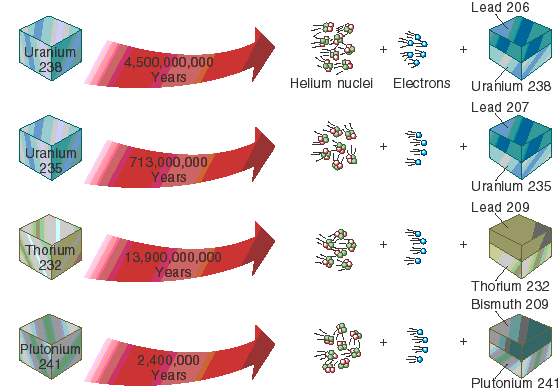
- Radioactive materials decay
at predictable rate, known as the half-life
- Atoms decay from one form (parent) to another (daughter product), releasing energy
and particles
- After one half-life has passed,
half the original parents in the material will have decayed into the daughter product;
after two half-lives, only one-quarter of the parent material remains, with three quarters
daughter product; after three half-lives, 1/8 to 7/8; after four half-lives, 1/16 to 15/16;
and so on
- Can thus date rocks:
Need some special conditions, however:
- Daughter product should only be produced naturally by decay from the parent
- Neither parent nor daughter should be able to leave the sample naturally
- Only useful for determining ages of formation of mineral grains (and thus really best
for igneous rocks)
When possible, radiometric dates of different isotopes with different decay rates are
calculated for same sample. If these converge, good support for that age.
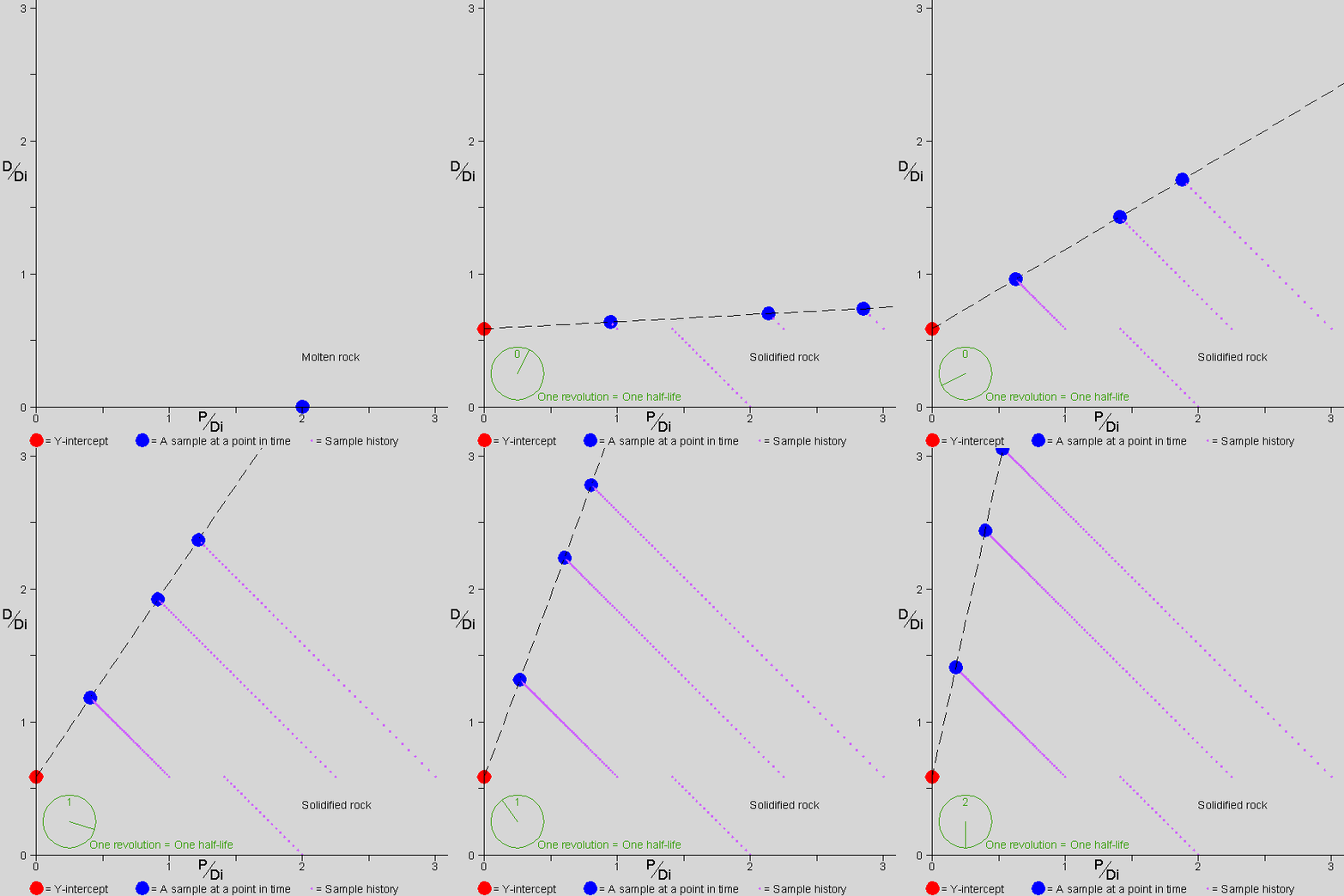
Isochron Dating techniques: a way to get around the
problems of standard radiometric dating.
- Eliminates need for closed system and need for absence of original daughter product
- Need three measurements from a rock: the amount of a radiogenically-produced isotope of an element;
the amount of a non-radiogenically produced isotope of that element; the amount of the parent
of the radiogenically-produced isotope.
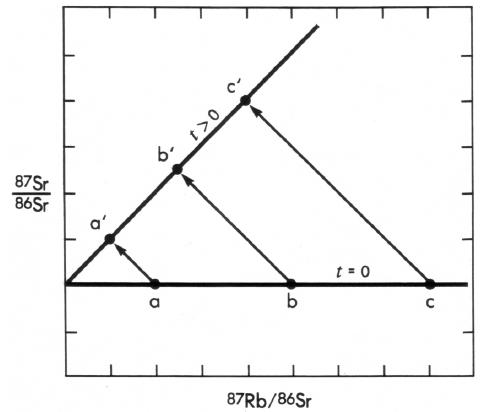
- Plot ratios of [daughter/stable] vs. [parent/stable]
- At T=0, [daughter/stable] will be a single number, but [parent/stable] will
vary from mineral to mineral in the rock, depending on how either the radioactive parent element or the
non-radioactive stable isotope of the same element and the daughter product fits into
different crystal structures in those minerals.
- Thus, at T=0 (cooling of the melt), the points will be on a straight horizontal line
- As T increases, the radiogenically-produced daughter value increases relative to both the stable and the
parent product, so the points move together away from the horizontal.
- Because of the nature of the ratios involved, as points move away from horizontal they should
do so in a straight line with the same Y-intercept as the original line. This straight
line is the isochron,
and its slope is a function of the number of half-lives that have passed. The steeper the
slope, the older the rock sample.
- If points do NOT fit on a straight line, indicates either gain or loss of one of the parts
of the system; allows for a measure of uncertainty.
The following is an animated demonstration of the isochron method, from Talkorigins.org:
(Incidentally, while the two main geological radiometric systems (40Ar/39Ar and
238U/206Pb) are now highly precise, the numbers they yeild are slightly different
based on traditional calibrations. There was already reason to suspect that Ar-dating was slightly miscalibrated on
geochemical arguments. Recalibrating the Ar-clock based on astrochronology (see below) suggests that this technique
as typically used yield numbers about 1% too young. Keep an eye of the geochronological literature of the
next few years to see how this works out...)
Other methods of numerical dating:
- Fission track: etching of crystal by decay products of uranium 238 in individual
zircon crystals.
- As 238U decays, particles thrown off smash crystal lattice.
- Number of tracks already present are counted in acid-etched crystals. This indicates the
number of decay events that have happened so far.
- Crystals are then put in a neutron field, which causes it to decay completely
- Number of new tracks are counted, which gives the number of parent that was present when the
sample was collected.
- Radiocarbon (Carbon 14) dating:
- NOT the same as radiometric dating!!
- In life, organisms take up both 12C (stable) and (radioactive).
- When dead, no new carbon added, and 14C breaks down with half-life of 5730 years.
- With short half-life, only useful for objects less than ~70,000 years old.
Some other methods of relative dating:
- Transgression-regression patterns: On scale of regional depositional basins can
be very useful, as long as no additional uplift on only one part of basin.
- Eustatic (global) sea level changes: As above, but can correlate globally.
In both cases: only accurate in environments (shorelines, mainly) where sea-level changes
are recorded. We will come back to this when we look at sequence stratigraphy later on.
- Marker beds: One-time events (volcanic eruptions, asteroid impacts, etc.) may
send particular types of material over wide region (even globally). These record
EXTREMELY short periods of time: essentially instantaneous!
- Stable Isotope Stratigraphy: Some stable isotopes of various elements (carbon, oxygen,
strontium) vary over time relative to each other due to a number of factors (productivity,
glaciers, temperature, erosion, etc.). When examined against a time scale, these form irregular
curves. Individual samples or series of samples can be compared to the known-curve of these
isotopes to see where they fall.
- Astrochronology: a relatively new field. Looks at the varying thickness of strata within sedimentary
packages to calibrate their changing thicknesses to some astronomically-controlled cycles (such as
tidal, daily, monthly, annual, or longer term cyclicity.) Not good for calibrating against a
time scale as such, nor for correlation, but very useful for determining the duration in numerical time
of packages of sedimentary rock.
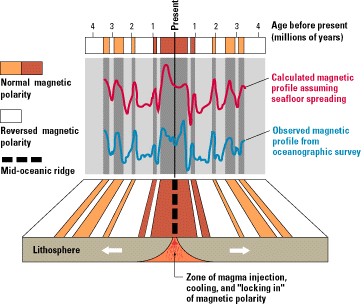
- Magnetostratigraphy
- The magnetic (but NOT the geographic) poles have
"flip-flopped" throughout geologic time, so that sometimes a magnet's north pole points
towards geographic North, and sometimes toward geographic South.
- Magnetic polarity
can be recovered by some iron-bearing rocks (sedimentary and igneous).
- Because based on the Earth's magnetic field, the changes occur everywhere on the
planet at the same time.
- Can use the particular "bar code"-like pattern of flip-flops to match any section to
known global pattern (based on
continuous record of lava on ocean floor)
- Only really good back to Jurassic: before that, lack the continuous magnetic record of the seafloor
- Here is the Phanerozoic magnetochronological
chart as of February 2010.
To Next Lecture.
To Previous Lecture.
To Syllabus.
Last modified: 27 February 2014