Key Points:
•Whatever definition you use, life requires homeostasis, metabolism, and reproduction.
•LUCA, the last universal common ancestor, was a chemosynthetic autotroph that lived in a hot anoxic environment.
•Life seems to have arisen immediately after end of the Late Heavy Bombardment ~ 3.8 Ga.
•Photosynthesis fundamentally changed Earth environments.
•the earliest microfossils are ~3.77 Ga tubular microfossils from a hydrothermal environment.
•Complex eukaryotic cells seem to have emerged between 2.7 and 2.2 Ga.
"By firm immutable immortal laws Impress'd on Nature by the GREAT FIRST CAUSE,
Say, MUSE! how rose from elemental strife
Organic forms, and kindled into life;
How Love and Sympathy with potent charm
Warm the cold heart, the lifted hand disarm;
Allure with pleasures, and alarm with pains,
And bind Society in golden chains.
(Erasmus Darwin, 1803. 'Production of Life', The Temple of Nature; or, The Origin of Society: A Poem, with Philosophical Notes)
Life is thought to have arisen (for the last time?) shortly after the end of the Late Heavy Bombardment, between 3.9 and 3.8 Ga. The environment in which this happened differed markedly from what we know today.
But how much of this, and other familiar cellular functions were present in the last common ancestor of life?
Interestingly, phylogenetic analyses suggest that among the most primitive organisms are thermophylic prokaryotes known as Archaea. Their special features:
- Live only at near-boiling temperatures
- Obtain energy from exotic reactions involving materials readily available in minerals, esp sulfur.
- Find oxygen to be toxic.
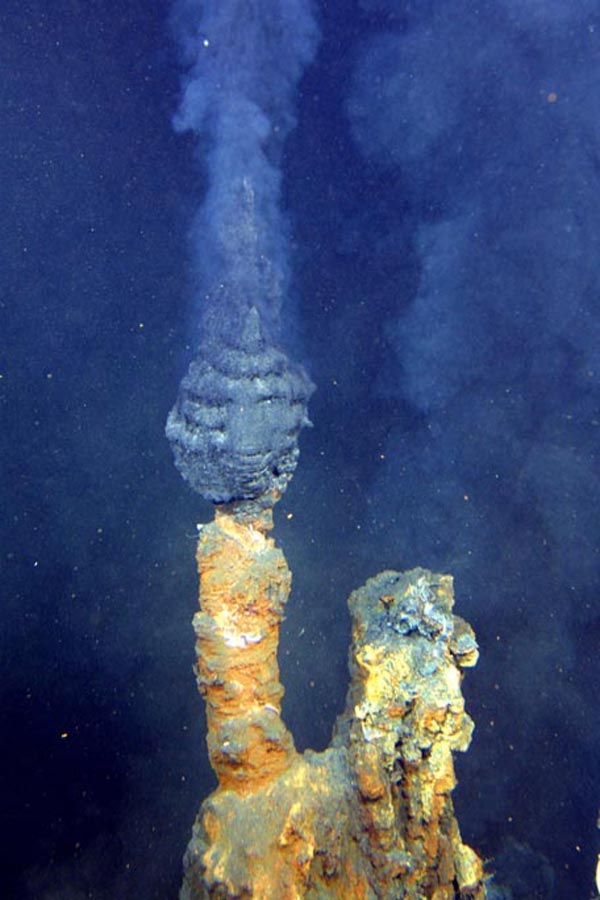
The environment in which these conditions are routinely found is near deep sea hydrothermal vents. For some time the most likely locations for the origin of life. Weiss et al., 2016 have attempted to identify genes conserved across all major domains of life (Archaea and Prokaryota) in order to characterize LUCA's environment and ecology. Their conclusions:
- LUCA has genes for energy metabolism through the combination of H2 and CO2 to form methane (CH4). It must have lived in an anoxic environment where hydrogen and carbon dioxide were common.
- It was a chemosynthetic autotroph, employing sulfur compounds as an energy source but was unable to feed heterotrophically
- It's environment was hot
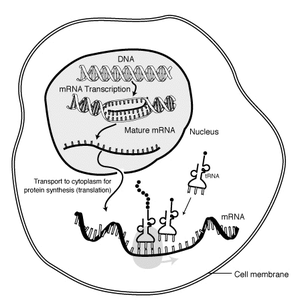
- It possessed the biochemical machinery for the translation of DNA to proteins (thus significantly advanced over hypothetical RNA-world organisms.)
- It relied heavily on molecules in its external environment for many metabolic functions that are handled internally by living cells today.
Evidence of the Rock Record:
- Geochemical markers:
- Mojzsis et al., 1996 reported a 3.85 Ga banded-iron formation with biogenically fractionated carbon from Akila island, Greenland. The rocks are considered by Fredo and Whitehouse, 2002 to be a
metavolcanic with its carbon being an abiotic metasomatic product.
- Rosing, 1999 reporting 3.7 Ga fractionated carbon in deep sea sediments from Isua, Greenland. This is a mere 100 my after the planet-sterilizing Late Heavy Bombardment. Largely unchallenged.
- Brocks et al., 1999 report hopanes in 2.7 Ga rock from West Australia that seemed to clinch the presence of cyanobacteria at that time. More recent work by Rasmussen et al., 2008 has called this into question. They maintain that the oldest unambiguous cyanobacterial body fossils are roughly 2.15 ga.
- Body fossils:
- Schopf and Barghoorn, 1967 reported the oldest body fossils in the ~ 3.4 Ga Fig Tree Cherts of South Africa.
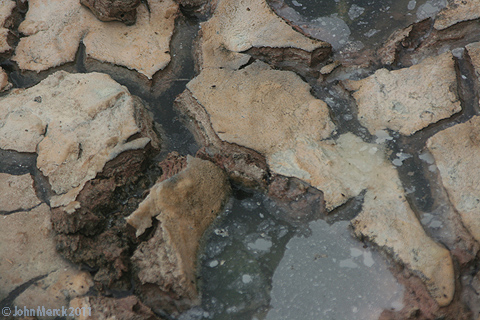
- Schopf, 1993 suggests the Apex Chert (Australia 3.485 Ga) contains "microfossils." Probably bits of organic matter in a hot-springs solution deposit. Brasier et al., 2002 skeptically note that shapes grade from reasonable bacterial shapes to wholly inorganic, suggesting supposed biological forms are just part of shape spectrum.
- More recently Wacey et al., 2011 note sulfur-metabolizing microfossils from the 3.4 Ga Strelley Pool Formation of Australia, on morphological and geochemical evidence.
- Nutman et al., 2016 have reported on 3.7 Ga stromatolitic bacterial mats, also from Isua, Greenland.
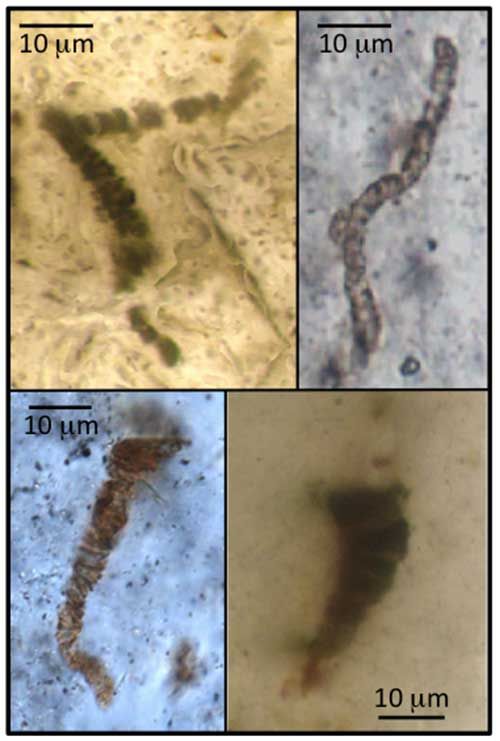
- Dodd et al., 2017 reported on microscopic tubularstructures in a marine hydrothermal environment preserved in the 3.77 Ga Nuvvuagittuq belt in Quebec.
- Baumgartner et al., 2019 report pyritized stromatolites in the 3.5 Ga Dresser Formation of West Australia. These demonstrably contain organic matter.
What we definitely know:
Photosynthesis: Organisms change Earth chemistry
For a while, organisms got away with chemosynthesis in vent environments (E.G. LUCA), and heterotrophically absorbing the organic materials that were floating around in the ocean. As these started to get scarce, one group, the cyanobacteria, came up with a new method of autotrophically capturing energy from the environment - Photosynthesis,
6 CO
2 + 6 H
2O + energy (sunlight)---> C
6H
12O
6+ 6 O
2
We can't tell from looking at microscopic fossils which were photosynthesizers, but photosynthesis had momentous consequences for life and Earth environments.
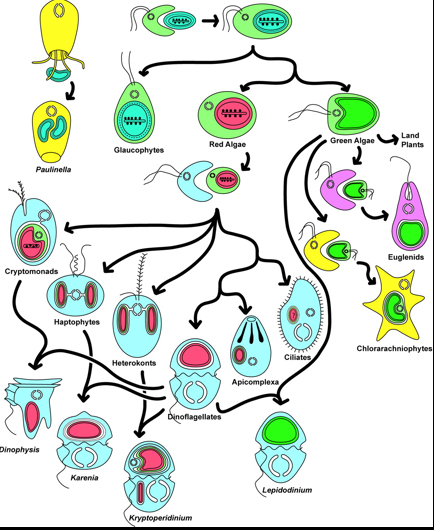
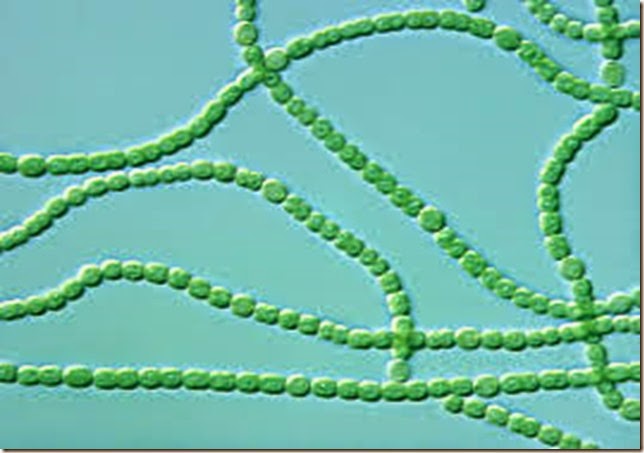
Living cyanobacteria probably provide a good picture of ancient photosynthesizers. Indeed, all other photosynthesizing organisms ultimately rely (directly or indirectly) on cyanobacterial symbionts. Phylogenetic studies of living cyanobacteria suggest a minimum divergence age of roughly 2.8 Ga.
The Gunflint Chert (1.88 Ga - Michigan) represents a well preserved Paleoproterozoic cyanobacterial flora containing forms that can be directly compared with living ecomorphs.
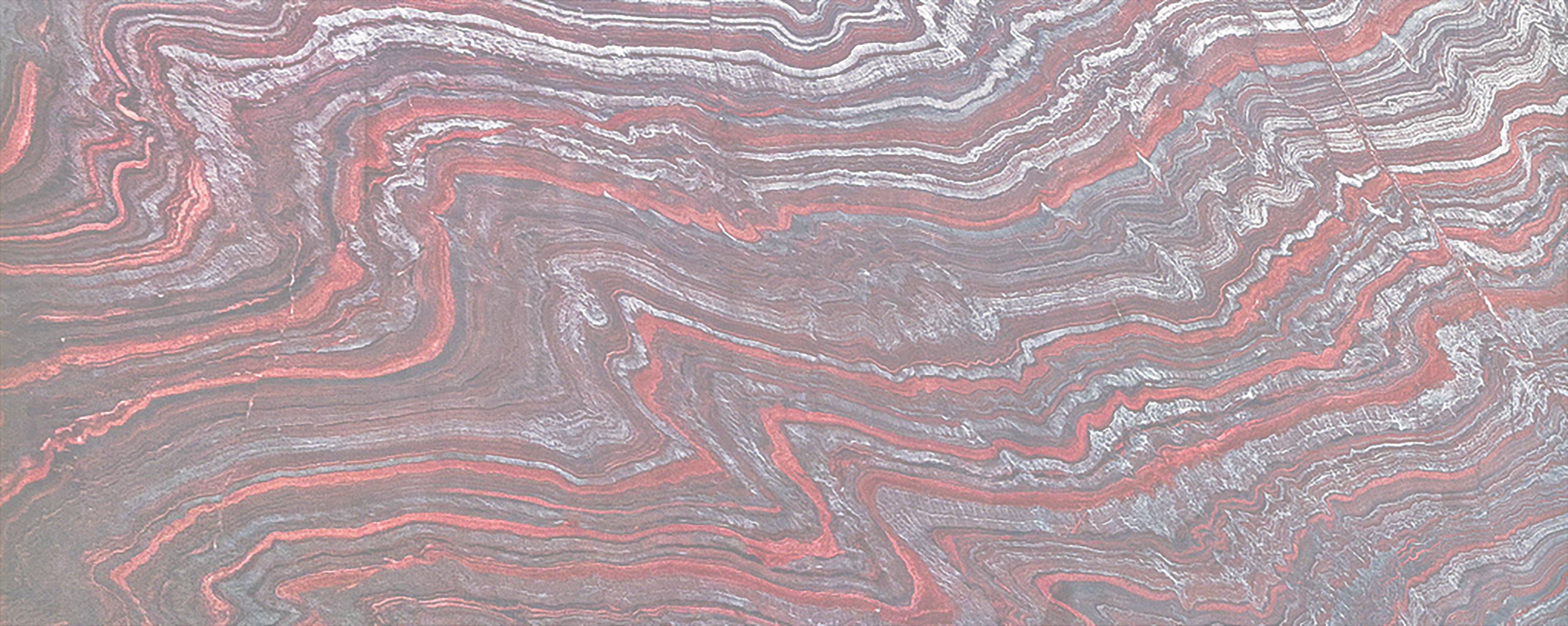
Banded iron formation
Great Oxidation Event: ~ 2.4 Ga oceanic oxygen concentrations begin to rise, indicating that cyanobacteria had become widespread by this point. This accords well with the minimum divergence age of 2.8 Ga.
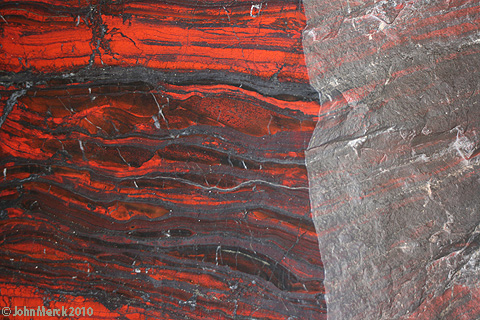
- This oxygen didn't initially escape the oceans. Rather it reacted with soluble ferrous iron (Fe2+), oxidizing it to less soluble ferric iron (Fe3+). This precipitated out, staining ocean sediments that are preserved as
Banded Iron formations (BIFs): Late Archean - Early Proterozoic (~3.0 - 1.8 Ga) Cherts with alternation of gray and rust red bands of hematite (Fe2O3).
The earliest BIFs were limited in extent, forming in localized deep marine environments, but spreading to encompass a wider environmental range.
- The disappearance of BIFs around 1.8 ga indicates the saturation of oxygen sinks and signals the beginning of accumulation of high concentrations of oxygen in atmosphere.
Bar River formation - the first red bed
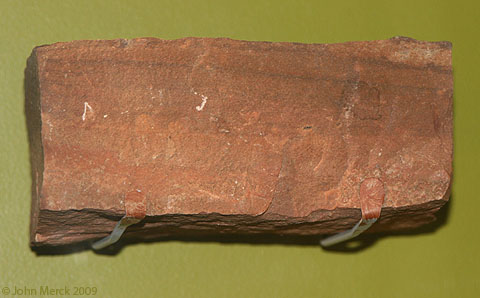
- Terrestrial red bed deposits begin to appear at around 2.2 ga. and start to become common around 1.8 ga. This tells us that the oceanic oxygen-sinks had become saturated and free oxygen was now building up in the atmosphere. This stabilized at ~1% at 1.85 Ga and didn't change significantly for a billion years, the "boring billion" of geochemistry. During this time, oxygen sinks on land were gradually filled.
- Atmospheric effects: were significant:
- Methane: CH4 was originally common in Earth's atmosphere, acting as a powerful greenhouse gas. (It's presence is a partial solution to the "young weak Sun" paradox of Earth environmental history.) Oxygen quickly oxidizes it to CO2 and H2O, weaker greenhouse gasses. As oxygen began to enter Earth systems ~2.4 Ga, global climates cooled, resulting in the Huronian glaciation (2.4 - 2.1 Ga).
- Ozone: As it accumulated, free oxygen in upper atmosphere recombined to form ozone layer (O3). Ozone is opaque to ultraviolet light. The appearance of the ozone layer thus allowed life to colonize surface waters and, eventually, land.
- Oceanic acidity: Of course, by eating up atmospheric CO2, photosynthesizers caused the acidity of the oceans to diminish, allowing the direct precipitation of carbonate rocks for the first time. Once that was possible, CO2 concentrations fell very rapidly. as carbon became locked up in rock.
- Respiration: The earliest organisms used nitrate or sulfur as electron receptors in the synthesis of ATP. As oxygen began to appear in the environment, some organisms evolved the ability to use it instead. To such aerobic critters, oxygen became a necessity rather than a poison. Today anaerobic organisms are restricted to marginal environments.
C
6H
12O
6+ 6 O
2 ---> 6 CO
2 + 6 H
2O + energy
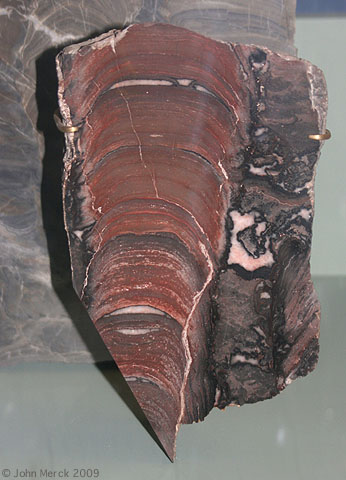
Stromatolite in cross-section
The Age of Slime
Stromatolites: Beginning about 3.0 Ga, we begin to see abundant fossil stromatolites - the body fossils of laminated bacterial mats. (Not necessarily photosynthesizing.) The earliest are from the 3.5 Ga Dresser Formation of Australia (Baumgartner et al., 2019) and possibly the 3.7 Ga Isua metasediments (Nutman et al., 2016). These were very common for most of the Proterozoic, but declined during the Neoproterozoic, when, presumably, critters appeared that could eat them.
- Stromatolites form when sediment falls onto a thin film of bacteria. The bacteria bind the sediment, and grow up through it. At any moment, only the top layer is alive.
- When there was nothing around to eat them, stromatolites were very common. Today, they only live in hypersaline environments that exclude other critters, like Shark Bay, Australia
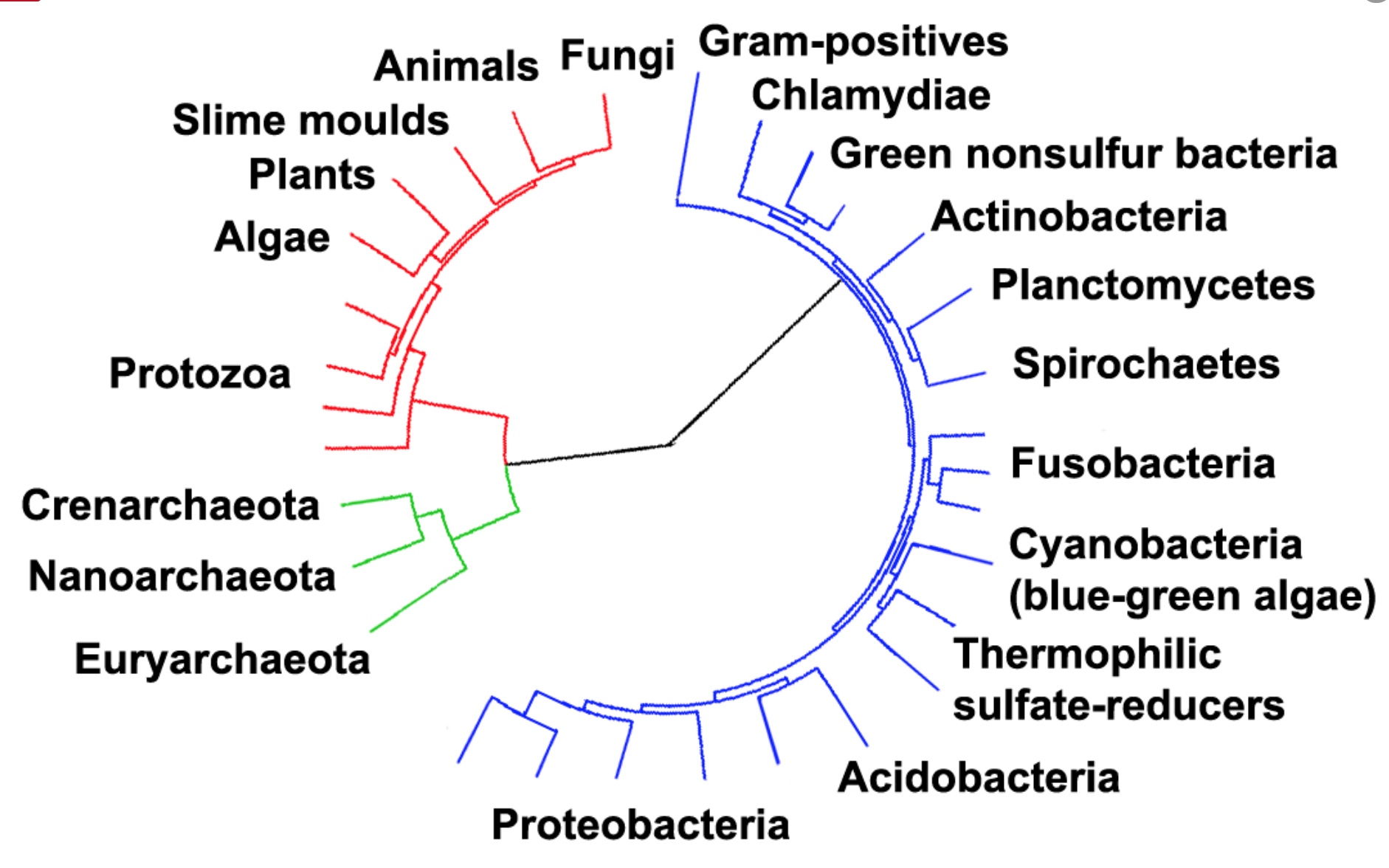
Cladogram of the domains of life showing Eubacteria (blue), Archaea (green), Eukaryota (red)
Eukaryota and the two domains of life:
Traditionally we distinguish between basic cell types:
- Prokaryotic: Small simple cells lacking nuclei and organelles. E.G.: bacteria.
- Eukaryotic: Large complex cells with nuclei and organelles, capable of forming multicellular bodies.
Woese and Fox, 1977, recognized that some prokaryotic organisms were distinct from bacteria based on their DNA transcription biochemistry and on molecular systematics. These have come to be known as Archaea. It would be simple to say that Eubacteria, Archaea, and Eukaryota are the three domains of life, but no.

Eukaryote - prokaryote comparison from
Wikipedia
Review the peculiarities of Eukaryota:
Eukaryote complexity seems to be largely a response to the challenges of the Great Oxidation Event.
- Mitochondrial symbionts enable the cell actually to use the poisonous oxygen metabolically.
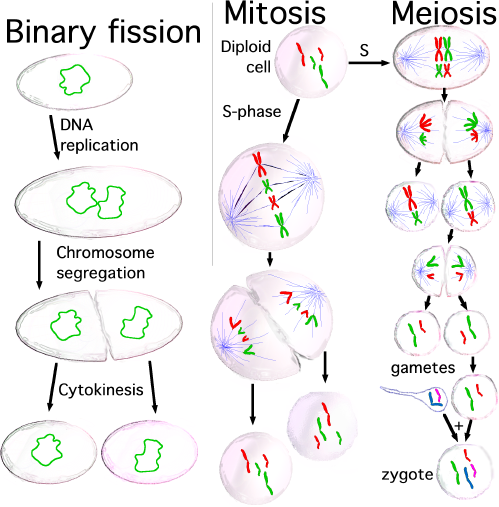
- The complex genome structure and sophisticated reproductive strategies enable the possessor to to get rid of DNA damaged by oxygen through the reshuffling of genes.
In the rock record:
- Oldest biochemical markers characteristic of eukaryotes are steranes ~2.7 Ga. (Brocks et al., 1999) Could possibly have belonged to archaean precursors.
- Oldest eukaryotic body fossils: 2.2 Ga of South Africa, reported from a terrestrial paleosol (!) by Retallack et al., 2013.
- Oldest definite fungi at 1.0 - 0.9 Ga from Grassy Bay Formation of Canada (Loron et al. 2019.)
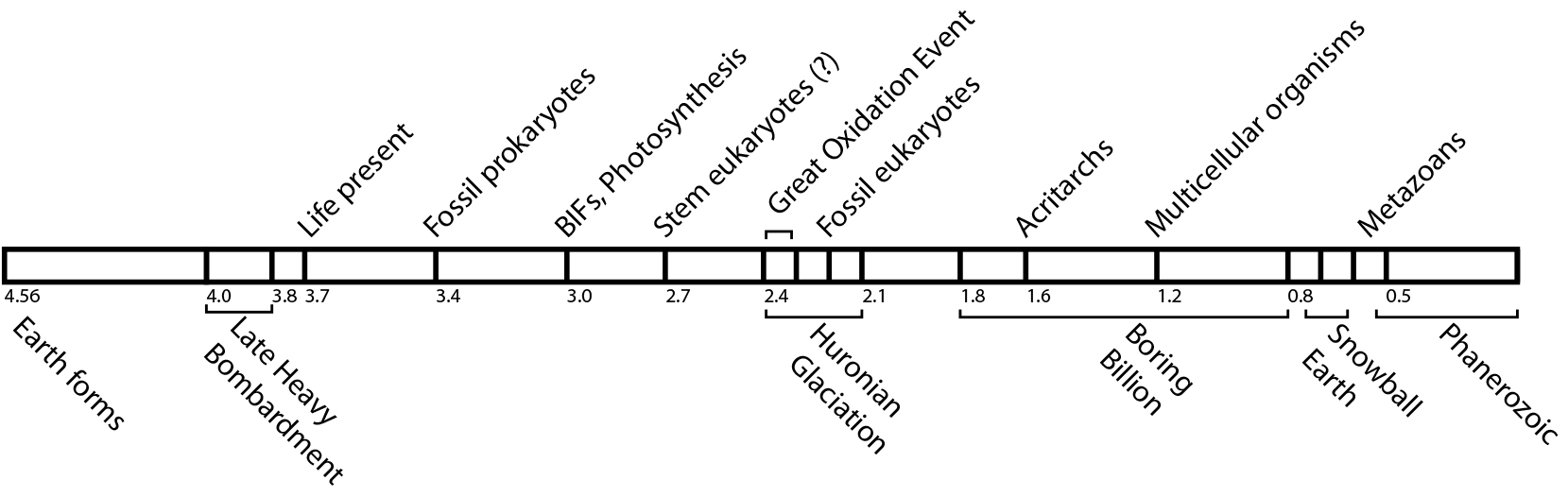
A Reasonable but Speculative Time-Line
- 3.8 Ga: End of Late Heavy Bombardment
- 3.7 Ga: Life present (geochemical evidence)
- 3.4 Ga: Recognizable prokaryote-grade cells present
- 3.0 Ga: Photosynthesis present, first BIFs.
- 2.7 Ga: Stem eukaryotes maybe present (steranes)
- 2.4-2.3 Ga: Great oxidation event. Photosynthesizers widespread.
- 2.4-2.1 Ga: Huronian glaciation
- 2.2 Ga: Eukaryotes present (fossil evidence)
- 1.8 Ga: Last BIFs. Beginning of the "boring billion."
- 1.6 Ga: Acritarchs present
- 1.2 Ga Multicellular organisms unambiguously present.
- 0.8 Ga: End of the "boring billion." Terrestrial oxygen sinks full, oxygen accumulates in atmosphere.
- 0.72 - 0.635 Ga: Sturtian and Marinoan glaciations, earliest metazoan fossils.
Additional reading:
- Abigail C. Allwood, Malcolm R. Walter, Balz S. Kamber, Craig P. Marshall and Ian W. Burch. 2006. Stromatolite reef from the Early Archaean era of Australia. Nature 441, 714-718.
- Sidney Altman, Madeline Baer, Cecilia Guerrier-Takada, Agustin Vioque. 1986. Enzymatic cleavage of RNA by RNA. Trends in Biochemical Sciences 11(12) 515-518.
- Sandra Anne Banack, James S. Metcalf, Liying Jiang, Derek Craighead, Leopold L. Ilag, Paul Alan Cox. 2012. Cyanobacteria Produce N-(2-Aminoethyl)Glycine, a Backbone for Peptide Nucleic Acids Which May Have Been the First Genetic Molecules for Life on Earth. PlosOne November 2012.
- Raphael J. Baumgartner, Martin J. Van Kranendonk, David Wacey, Marco L Fiorentini, Martin Saunders, Stefano Caruso, Anais Pages, Martin Homann, Paul Guagliardo. 2019. Nano-porous pyrite and organic matter in 3.5-billion-year-old stromatolites record primordial life. Geology (2019)
- Roy A. Black, Matthew C. Blosser, Benjamin L. Stottrup, Ravi Tavakley, David W. Deamer, and Sarah L. Keller. 2013. Nucleobases bind to and stabilize aggregates of a prebiotic amphiphile, providing a viable mechanism for the emergence of protocells. Proceedings of the National Academy of Sciences 110(33), 13272Ð13276.
- Martin D. Brasier, Owen R. Green, Andrew P. Jephcoat, Annette K. Kleppe, Martin J. Van Kranendonk, John F. Lindsay, Andrew Steele, and Nathalie V. Grassineau. 2002. Questioning the evidence for Earth's oldest fossils. Nature 416, 76-81.
- Martin Brasier, Nicola McLoughlin, Owen Green, David Wacey. 2006. A fresh look at the fossil evidence for early Archaean cellular life. Philosophical Transactions of the Royal Society B. 341(1470).
- Jochen J. Brocks, Graham A. Logan, Roger Buick, Roger E. Summons. 1999. Archean Molecular Fossils and the Early Rise of Eukaryotes. Science 285(5430) 1033-1036.
- A. G. Cairns-Smith. 1985. Genetic Takeover: and the Mineral Origins of Life. Cambridge University Press.
- Matthew S. Dodd, Dominic Papineau, Tor Grenne, John F. Slack, Martin Rittner, Franco Pirajno, Jonathan O'Neil & Crispin T. S. Little. 2017. Evidence for early life in EarthÕs oldest hydrothermal vent precipitates. Nature 543, 60Ð64 .
- Sidney W Fox, Kaoru Harada, and Jean Kendrick. 1959. Production of spherules from synthetic proteinoid and hot water. Science 129(3357) 1221-1223.
- Christopher M. Fedo, Martin J. Whitehouse. 2002. Metasomatic Origin of Quartz-Pyroxene Rock, Akilia, Greenland, and Implications for Earth's Earliest Life. Science 296(5572) 1448-1452.
- Jesse V. Gavette, Matthias Stoop, Nicholas V. Hud, and Ramanarayanan Krishnamurthy. 2016. RNAÐDNA Chimeras in the Context of an RNA World Transition to an RNA/DNA World. Angewandte Chemie September 2016 preprint.
- Corentin C. Loron, Camille Fran�ois, Robert H. Rainbird, Elizabeth C. Turner, Stephan Borensztajn, and Emmanuelle J. Javaux . 2019. Early fungi from the Proterozoic era in Arctic Canada. Nature, May 2019.
- Matson, John. 2010. Organic compound synthesis on the primitive Earth. Scientific American, February 2010.
- Stanley L Miller and Harold C Urey. 1959. Meteorite That Fell in 1969 Still Revealing Secrets of the Early Solar System. Scientific American.
- S. J. Mojzsis, G. Arrhenius, K. D. McKeegan, T. M. Harrison, A. P. Nutman, and C. R. L. Friend. 1996. Evidence for life on Earth before 3,800 million years ago. Nature 384, 55-59.
- Allen P. Nutman, Vickie C. Bennett, Clark R. L. Friend, Martin J. Van Kranendonk, and Allan R. Chivas. 2016. Rapid emergence of life shown by discovery of 3,700-million-year-old microbial structures. Nature online 31 August 2016.
- Birger Rasmussen, Ian R. Fletcher, Jochen J. Brocks, and Matt R. Kilburn. 2008. Reassessing the first appearance of eukaryotes and cyanobacteria. Nature 455, 1101-1104.
- Gregory J. Retallack, Evelyn S. Krull, Glenn D. Thackray, Dula Parkinson. 2013. Problematic urn-shaped fossils from a Paleoproterozoic (2.2 Ga) paleosol in South Africa. Precambrian Research 235, 71-87.
- Minik T. Rosing. 1999. 13C-Depleted Carbon Microparticles in >3700-Ma Sea-Floor Sedimentary Rocks from West Greenland. Science 283(5402), 674-676.
- J. William Schopf. 1993. Microfossils of the Early Archean Apex Chert: New Evidence of the Antiquity of Life. Science 260(5108), 640-646.
- J. William Schopf, Elso S. Barghoorn. 1967. Alga-Like Fossils from the Early Precambrian of South Africa. Science 156(3774), 508-512.
- Jack Szostak 2012. Attempts to define life do not help to understand the origin of life. Journal of Biomolecular Structure and Dynamics 29(4).
- David Wacey, Matt R. Kilburn, Martin Saunders, John Cliff, and Martin D. Brasier. 2011. Microfossils of sulphur-metabolizing cells in 3.4-billion-year-old rocks of Western Australia. Nature Geoscience 4, 698-702.
- Madeline C. Weiss, Filipa L. Sousa, Natalia Mrnjavac, Sinje Neukirchen, Mayo Roettger, Shijulal Nelson-Sathi, and William F. Martin. 2016. The physiology and habitat of the last universal common ancestor. Nature Microbiology 1, Article number: 16116 .
- Tom A. Williams, Peter G. Foster, Tom M. W. Nye, Cymon J. Cox, T. Martin Embley. 2012. A congruent phylogenomic signal places eukaryotes within the Archaea. Proceedings of the Royal Society B. October 2012.
- Carl R Woese CR and George Fox. 1977. Phylogenetic structure of the prokaryotic domain: the primary kingdoms". Proceedings of the National Academy of Sciences of the United States of America. 74 (11): 5088Ð90.
- Lei-ming Yin. 1997. Acanthomorphic acritarchs from Meso-Neoproterozoic shales of the Ruyang Group, Shanxi, China. Review of Palaeobotany and Palynology. 98(1-2), 15-25.
To Next Lecture.
To Previous Lecture.
To Syllabus.