Fall Semester 2022 Deuterostomia I: Basal deuterostomes and stem echinoderms
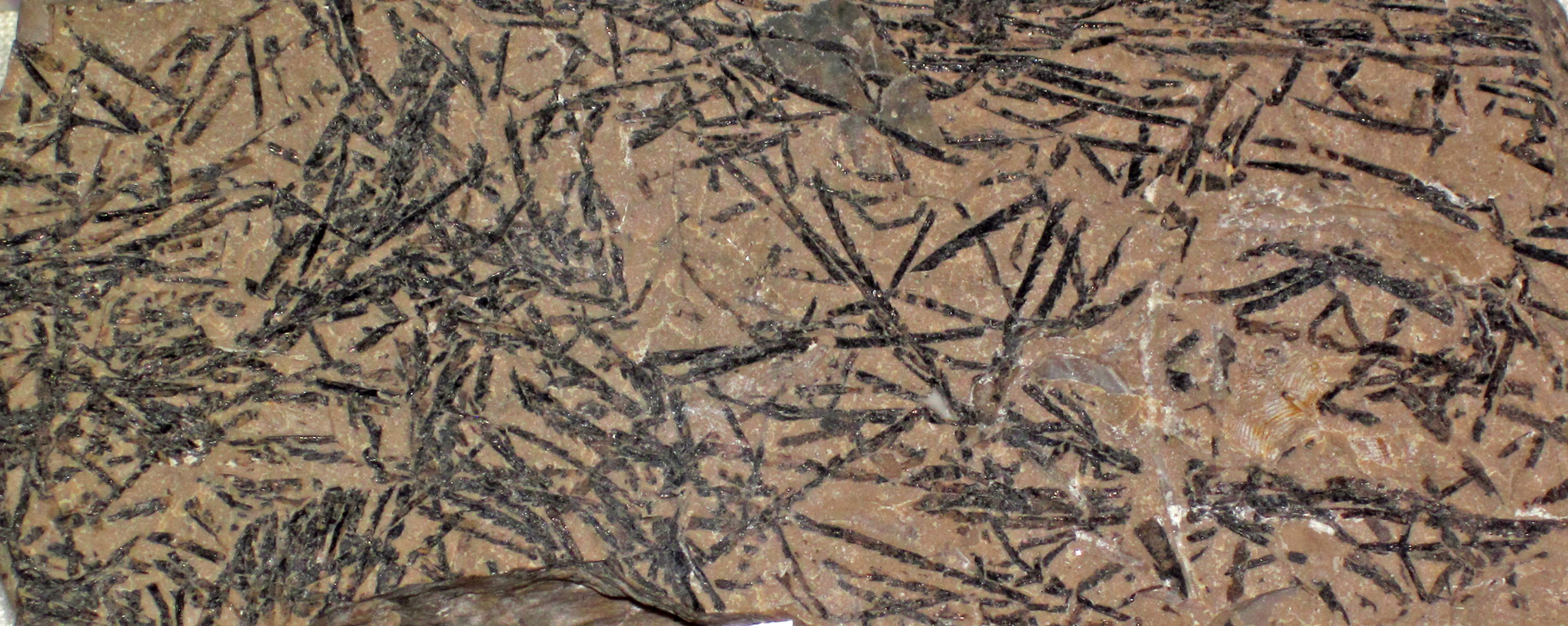
Graptolites
Key Points:
•Deuterostomia is diagnosed by the deuterostomous development in which the blastopore becomes the anus.
•Recent phylogenetic studies have cast some doubt on the monophyly of Deuterostomia. If they continue to be replicated, we will have to confront a comprehensive revision of our view of metazoan phylogeny. For 2022, we present the "classic" view of monophyletic Deuterostomia.
•Living members are an odd assortment of outwardly dissimilar creatures: Echinodermata, Hemichordata, and Chordata.
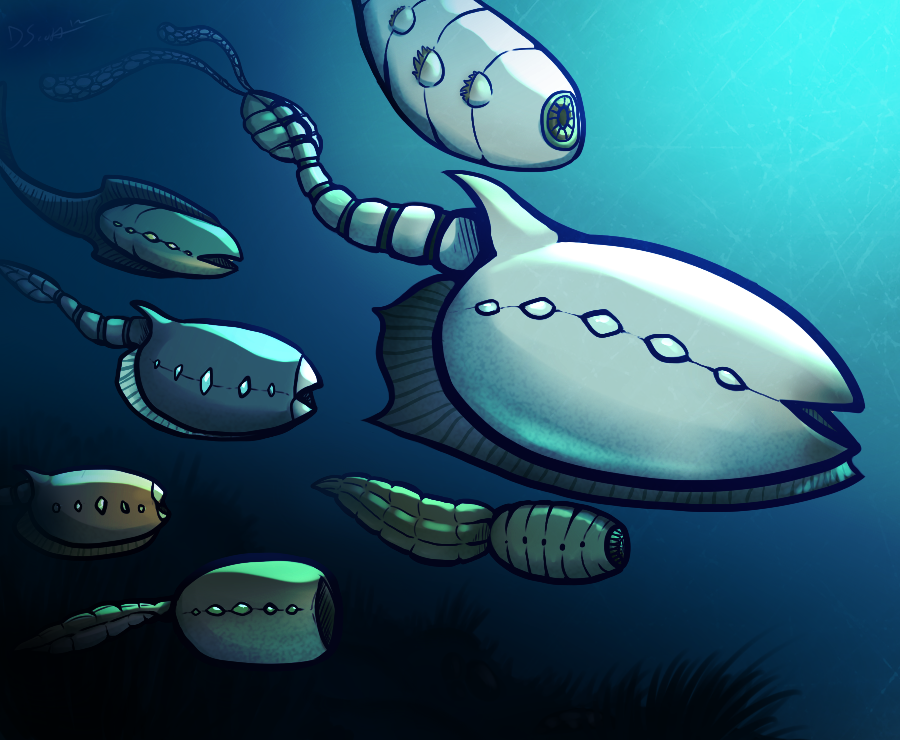
•Cambrian taxa such as Vetulicolia suggest an ancestral morphotype - a swimming pharynx.
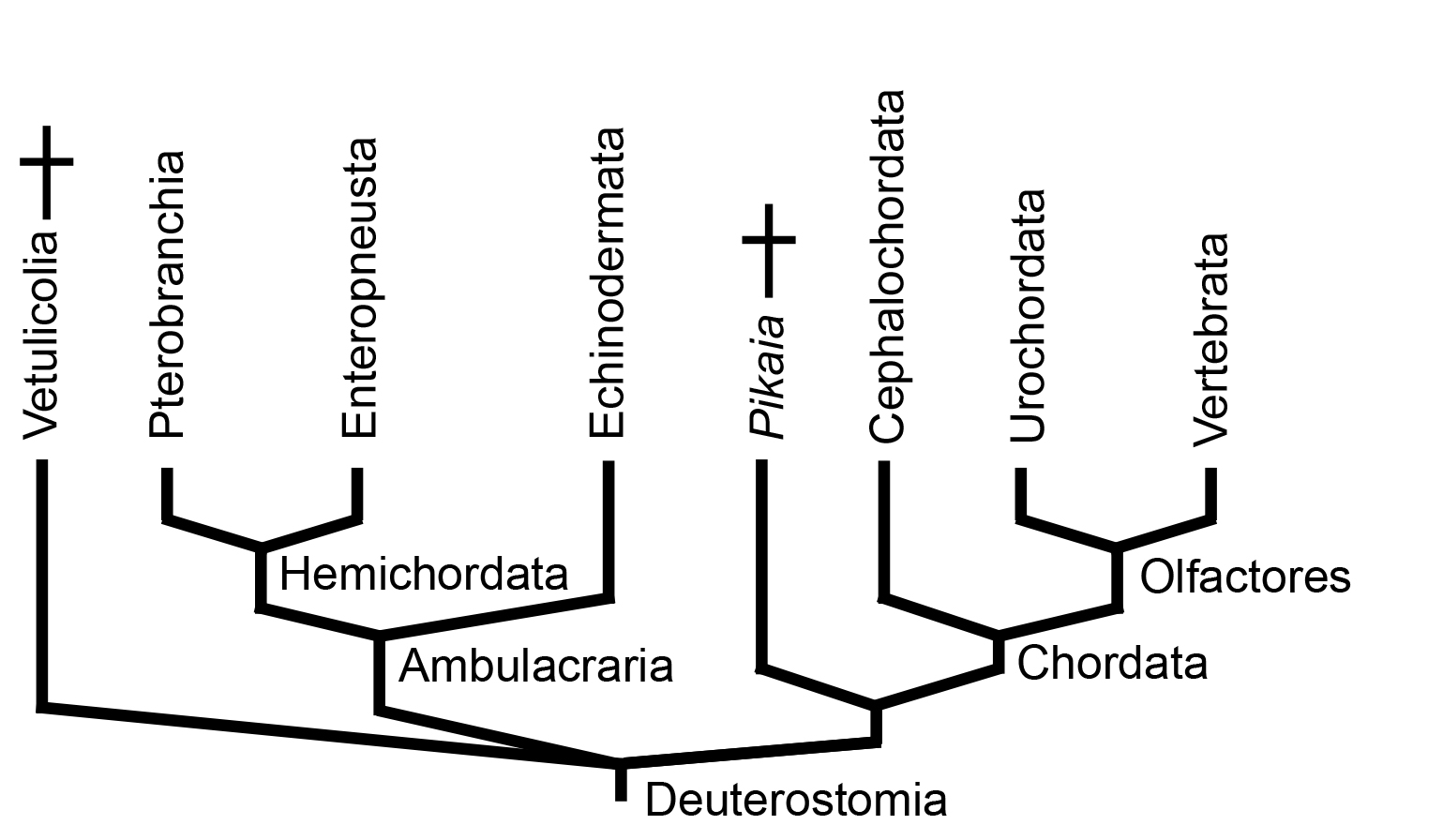
•Two major deuterostome clades: Ambulacraria and Chordata.
•Ambulacraria contains Hemichordata and Echinodermata.
•Hemichordata are marine invertebrates whose bodies are broken down into a proboscis, collar, and trunk. Among them, Enteropneusta are solitary and Pterobranchia are colonial.
•Graptolithina, the graptolites, colonial organisms from the Cambrian - Carboniferous are classic index fossils of the Ordovician and Silurian.
•Originally enigmatic, we know conclude that graptolites belong to Pterobranchia.
•The Burgess Shale taxon Herpetogaster may represent the ancestral hemichordate morphotype.
•Yunnanozoans - Cambrian swimming pharynges - are phylogenetically enigmatic, possibly fossil ambulacrarians or fossil chordates.
•Echinodermata is characterized by a set of morphological characters including five-part symmetry, the water vascular system, stereom.
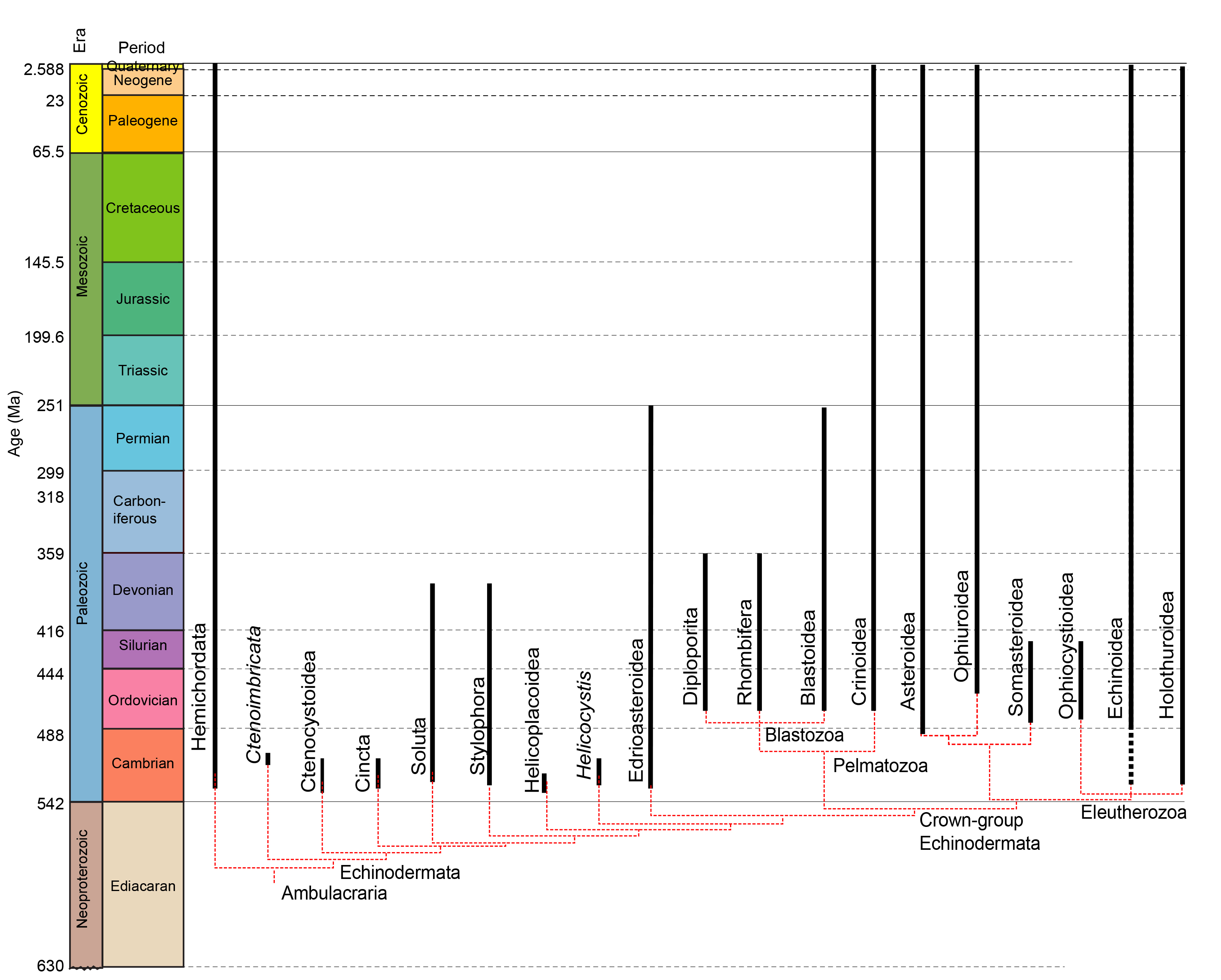
•Although crown-group echinoderms are present in the Cambrian, the Echinoderm stem (ha ha) includes a long series of oddballs, including helicoplacoids, edrioasteroids, eocrinoids, blastozoans, and homalozoans.
•Depate has long raged over the stalked echinoderms (blastozoans, crinoids, etc.) with most claiming that they are paraphyletic. Recent analyses indicate that they form a monophyletic Pelmatozoa.
•"Homalozoans" at the base of the stem lack any kind of bilateral symmetry, and have been invoked in eccentric hypotheses of chordate phylogeny.
•In 2012, the Early Cambrian Ctenoimbricata was described, the only known bilaterally symmetrical stem echinoderm!
"Heading now to Antarctica we meet what are, on paper, some of the pulpiest of Lovecraft's creations: sentient echinoderm men that lived on Earth before the evolution of man ... More routinely known as the Elder Things, this bizarre species appears in another Lovecraft classic, At the Mountains of Madness. Along with The Shadow Over Innsmouth."
(Mark Witton, 2016.)
In BSCI333/GEOL331 we adhere to the "classic" late 20th/early 21st century view of bilaterian phylogeny that distributes most members between two major clades:
Protostomia
Deuterostomia
Be aware that recent phylogenetic studies have cast some doubt on the monophyly of Deuterostomia (Philippe , 2019; Kapli et al., 2021). If additional work (especially combining genomic and morphological characters) confirms this, our understanding of bilaterian phylogeny will be significantly altered. That, however, is for the future.
Deuterostomia
Living Members: Living deuterostomes were first identified by "deuterostomous" developmental characters:
Radial cleavage
Formation of the anus from the blastopore, with the mouth arising as a secondary opening
Enterocoelous development of the coelom
This identification had little to do with their outward morphology. Indeed, the major groups are an odd assortment:
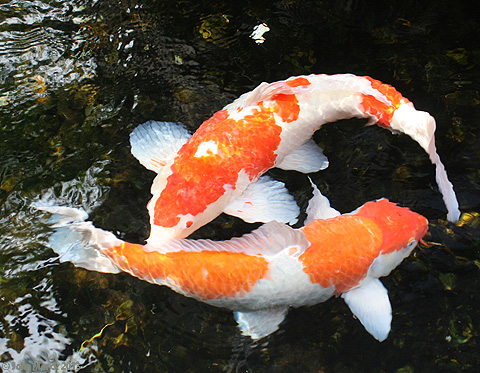
Cyprinius carpio
Chordata: (C. - Rec.) Including
Cephalochordata - Amphioxus
Urochordata - tunicates
Craniata - vertebrates and their closest relatives (right)
Yet wonderfully, the illumination of Cambrian fossils on the stems of each of these groups has provided significant, if imperfect resolution. Of particular importance:
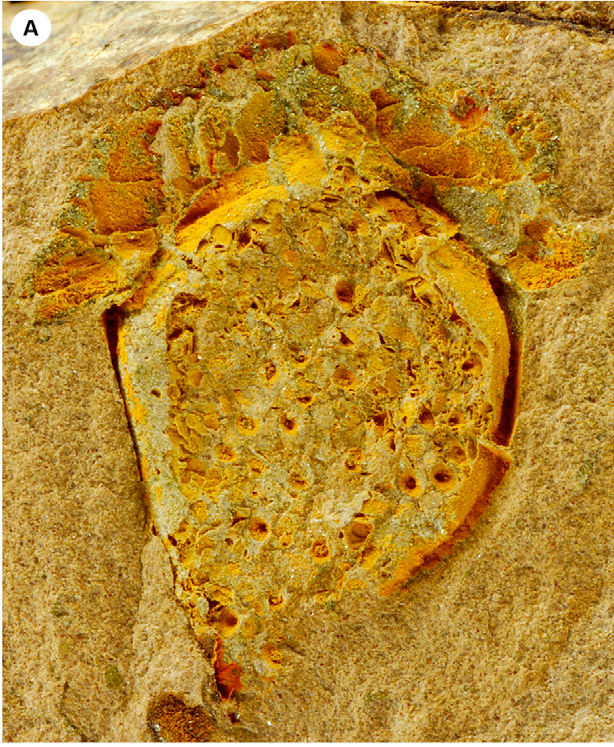
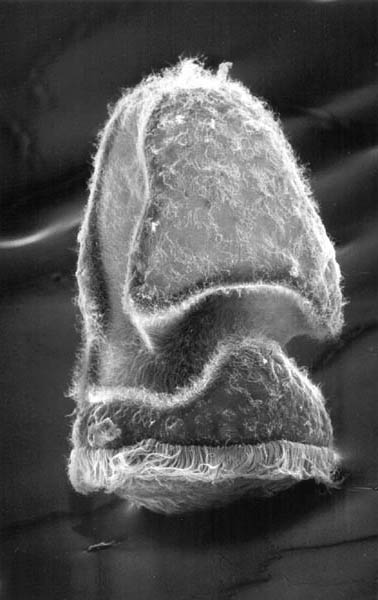
(Cambrian - Rec.) Whatever vetulicolians are, exactly, their morphology provides a model for the ancestral state of deuterostomes. Vertebrate paleontologists have long predicted that the ancestral vertebrate would be, in essence, a swimming pharynx. This seems to describe deuterostomes in general. This information enables us to propose morphological synapomorphies of Deuterostomia:
A pharynx with phayrngeal openings
A segmented tail that undulates laterally
As we will see, this interpretation meshes nicely with other emerging patterns in deuterostome evolution.
Note: 20th century literature has been rendered obsolete by molecular analyses that dispelled once and for all the notions the other creatures with three-part coeloms, including brachiopods, phoronids, and chaetognaths (arrow worms) might also be deuterostomes.
Why we care:
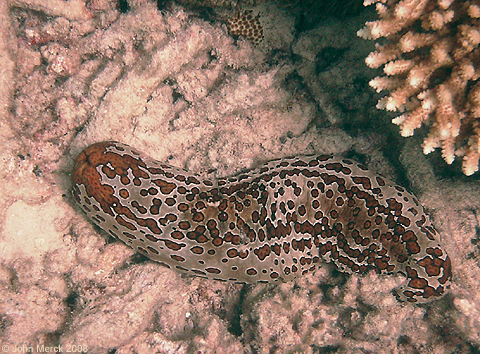
Echinodermata: After mollusks and arthropods, the most commonly fossilized bilaterian taxon. Indeed, disarticulated echinoderm plates are major constituents of Phanerozoic carbonates, especially from the Early Carboniferous. Moreover, echinoderms are appealingly bizarre.
Chordata: Contains the creatures that dominate animal biomass, occupy top of terrestrial and marine food chains, and serve as keystone species, ecologically.
We will spend considerable time on these two major deuterostome groups. First, let's put them in their context.
Deuterostome phylogeny is characterized by two major groups:
Recent molecular phylogenies indicate sister taxon relationship between Echinodermata and Hemichordata. Most members are suspension or deposit feeders, although some obtain food in more interesting ways.
Potential synapomorphies of hemichordates and echinoderms:
(Cam - Rec.) Solitary or colonial suspension and deposit feeders who use ciliated appendages to concentrate particle-rich water in pharynx, where it is filtered.
Characteristics:
Bodies divided into proboscis, collar, and trunk, each of which is invested with its own part of the three-part coelom (right):
Cilia on the proboscis move food particles to mouth.
Collar encircles mouth and proboscis.
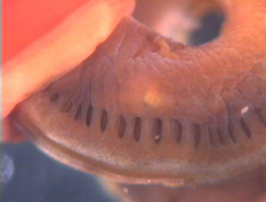
Trunk contains a large pharynx with pharyngeal openings (homologous to gill slits)
Open circulatory system present, with blood propelled by contractions of primary blood vessels. No hemoglobin.
Dorsal nerve cord, hollow in some parts of collar.
Portions of the genome that code for the expression of pharyngeal slits are homologous in Hemichordata and Chordata (Simakov, et al., 2015.)
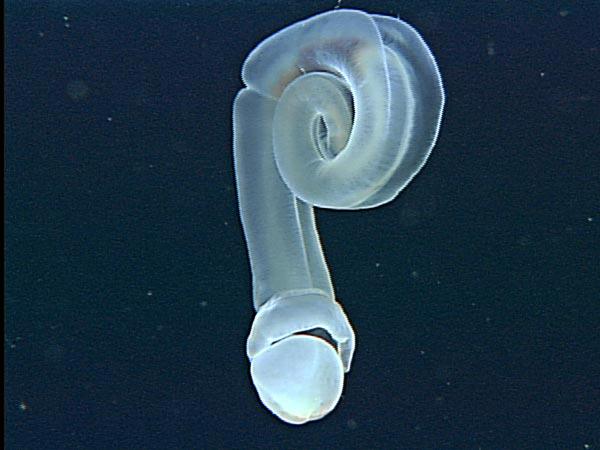
Tiny (<2 mm.) colonial critters that secrete branching colony consisting of proteinaceous tubes.
The proboscis is developed into a cephalic shield, used to secrete the proteinaceous material of the colony structure.
The collar is developed into one to five pairs of ciliated lophophore-like arms, each housing an extension of the coelom. Arms sport cilia-covered tentacles that transport food particles to mouth.
Only one pair of pharyngeal openings.
The gut is U-shaped.
Each individual zooid lives in a cylindrical zooidal tube.
Unlike bryozoans, zooids are able to move around on the outside of the colony, attached by a strand of contractile tissue, the peduncle to a common tissue thread, the stolon. When the colony is alarmed, individuals are quickly "reeled in." Cute.
Note that Hox genes expressed in the chordate tail are expressed in the pterobranch stalk.
Pterobranch growth. The stolon grows from the peduncle of the ancestral zooid. New zooids bud off from the stolon. As the stolon grows, it is encased in a creeping tube secreted by a specialized zooid, the terminal bud. Other, regular zooids bud from the stolon and secrete their own zooidal tubes.
Reflect. In the year 2000, conventional wisdom held that hemichordates shared the synapomorphy of the pharynx and pharyngeal openings with chordates, but not with echinoderms, and so were viewed as more closely related to chordates. But molecular analyses recovered a strong grouping of hemichordates with echinoderms. Now that we have vetulicolians, we can see that the pharynx is, in fact, a plesiomorphy that has been (apomorphically) lost in echinoderms.
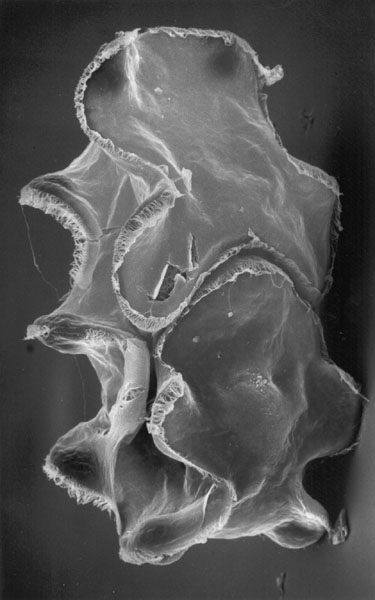
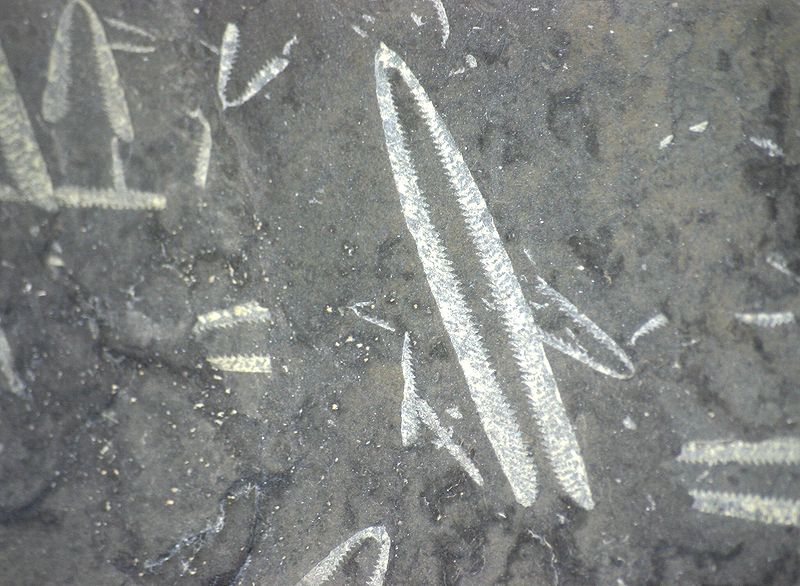
(Cam. - Carb.) first known as enigmatic fossils of the Early Paleozoic. Typically compressed into two dimensions and displaying a geometric regularity that gave them the common name "graptolite" - "writing stone."
Observations:
Very common and diverse in Ord - Sil with pelagic global distribution. The premier index fossils and bases of formal biozones of these periods.
Discovery of three-dimensionally preserved specimens, and subsequent study of pterobranchs led to realization that graptolite rhabdosomes were colonies of zooids that secreted a proteinaceous hard structure very similar to that of pterobranchs. Implies very close relationship.
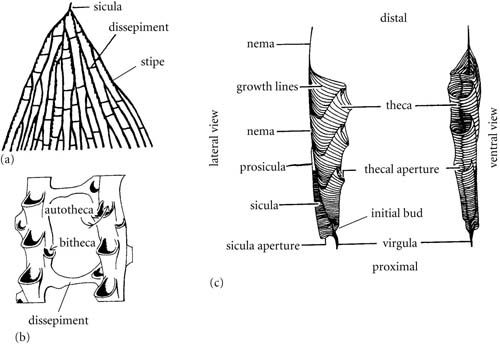
Each zooid in the rhabdosome occupies a theca. The rhabdosome grows from an ancestral zooid whose theca is called the sicula. This takes the form of a cone with its opening facing downward. It has a long nema extending upward from its apex and a virgella extending downward from its aperture (right).
Later thecae grow forming a series called a stipe.
BUT, because they had long been studied and used as index fossil prior to being biologically understood, they have their own set of terminology which is covered in lab.
Geology majors note: You may very well use these some day for stratigraphy, even if paleontology isn't your thing.
Graptolite diversity: There are two major groups. (We spare you the minor groups.)
Stipes branch at most once. See lab for rhabdosome morphology terminology based on stipe angle to nema. BUT NOTE, in some, the stipes are scandent, - i.e. they grow up the sides of the nema.
The nema attaches the rhabdosome to a floating object. (Some genera seem to have secreted siphonophore-style floats from which numerous rhabdosomes hung.)
Thecae are uniform.
Monograptid morphology an unbranched stipe growing up one side of the nema. Such rhabdosomes often assume spiral shapes. Perhaps they did not attach and depended on a slow sinking rate to remain in the photic zone.
Biostratigrapher's delight: Peak abundance and diversity in Ord. - Sil. Key index fossils for this interval.
The record of well-known hemichordates is unsatisfactory in that it doesn't seem to record transitions between:
Solitary mobile enteropneusts and colonial sessile pterobranchs.
Swimming basal deuterostomes and squirming enteropneusts.
Recent discoveries and reinterpretations are beginning to fill those gaps.
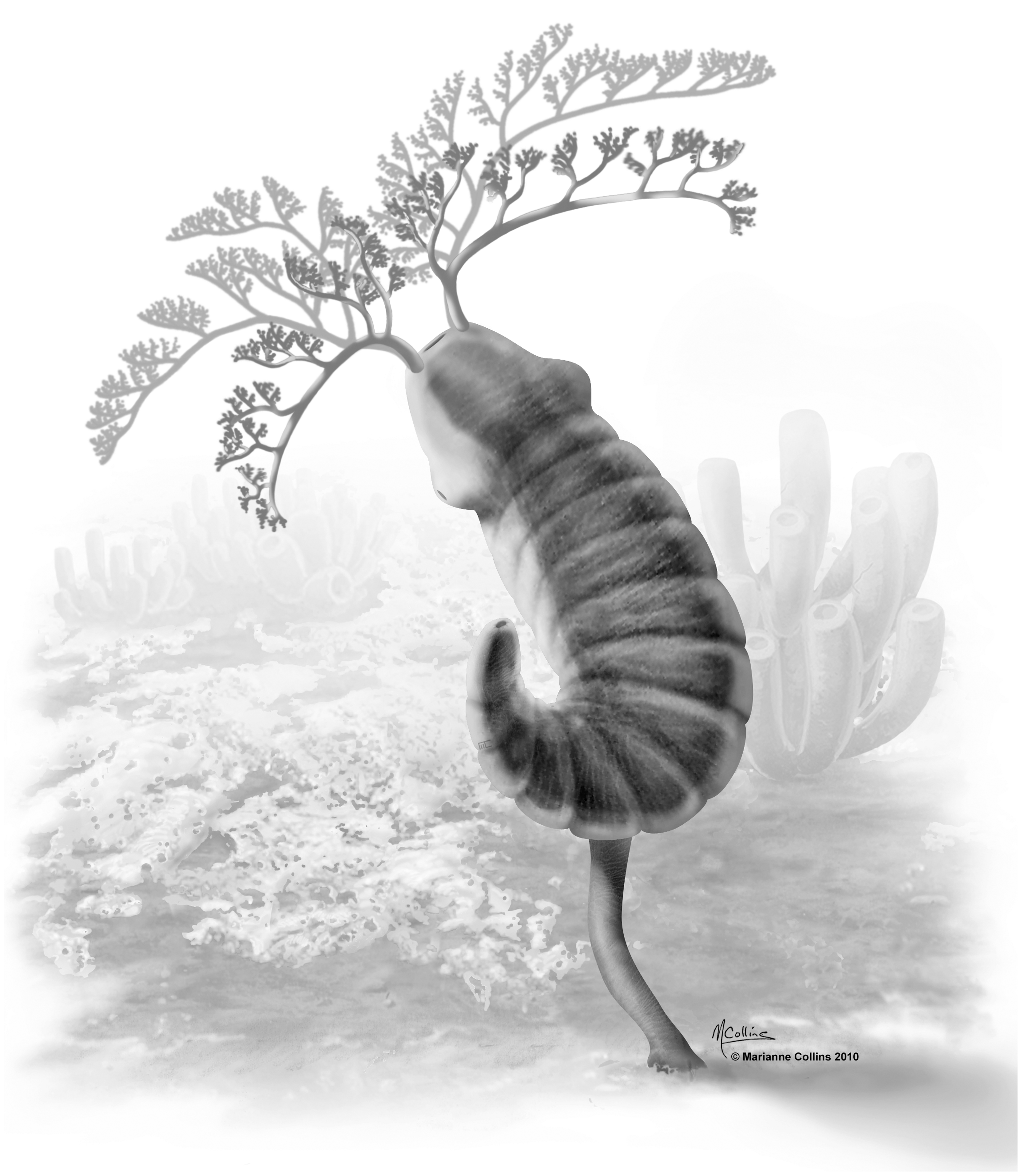
Caron et al., 2010: Described Herpetogaster collinsi (Cambrian, right) from the Burgess Shale, a macroscopic (1 - 2 cm total length) soft bodied creature that resembled a solitary pterobranch with:
Two branching feeding tentacles.
A segmented U-shaped body.
A short stalk for attachment (temporary?) to the substrate.
Caron et al. unite Herpetogaster with a few Burgess Shale problematica in Cambroernida, which they interpret as basal deuterostomes. Herpetogaster certainly looks like what one would expect of a creature on the branch leading from the common ancestor of Hemichordata toward pterobranchs. Some other cambroernids like Eldonia are harder to understand.
Another further step may be represented by Oesia disjuncta of the Burgess Shale (Nanglu et al., 2016.) In this case, the animal looks like an enteropneust, but appears to have secreted a protective proteinaceous tube, and has a posterior "grasping organ" that might represent the first representation of the pterobranch stalk.
Exclusively marine: Echinoderms lack osmoregulatory mechanisms that might allow them to live in brackish or fresh water.
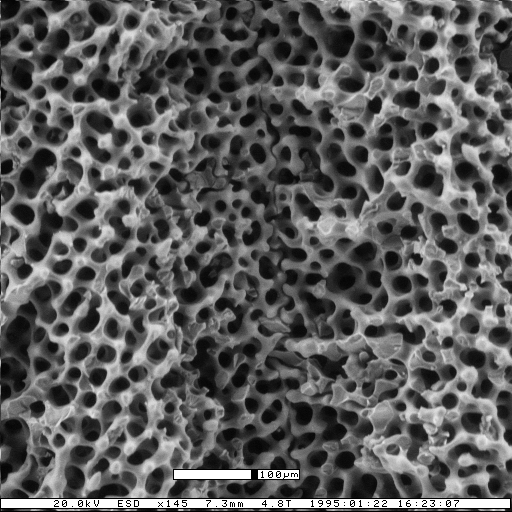
Skeleton is internal test comprised of individuals plates of porous high-Mg calcite. In life, the pores are occupied by a protein matrix and dermal cells. Such skeletal tissue is known as stereom. Carbonate petrologists typically call the pores "meat holes." These are individual birefringent elements.
Note: Echinoderm workers tend to not define Echinodermata phylogenetically. In practice, the term gets applied to any animal possessing stereom.
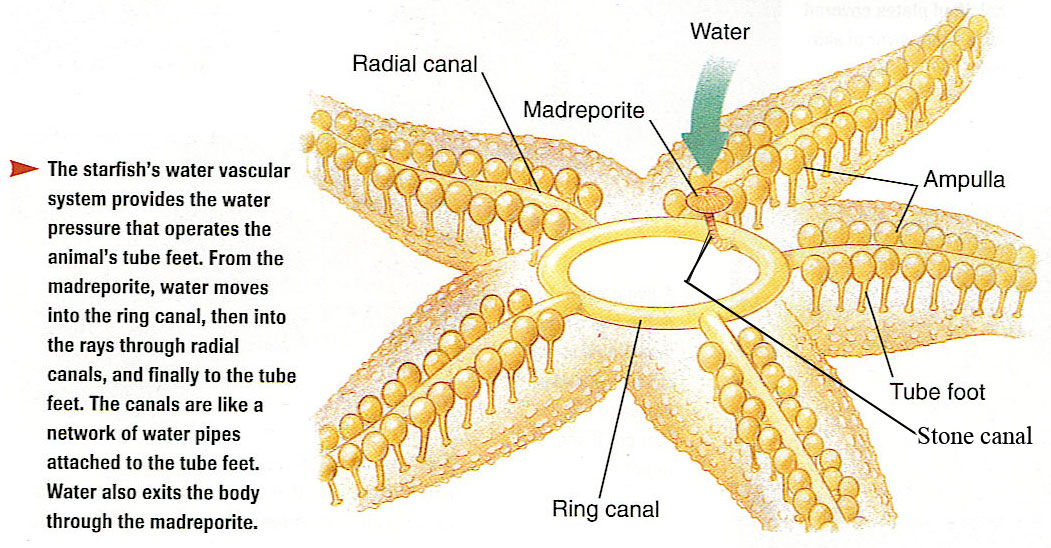
This system is passively involved in gas exchange, maintainance of posture, and locomotion.
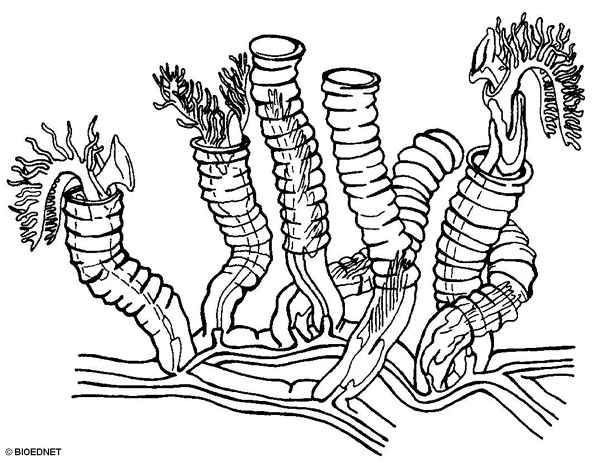
The latter is effected by outpouchings of the WVS that penetrate the body wall to form podia or tube feet that can be employed in suspension feeding or in locomotion, depending on the critter.
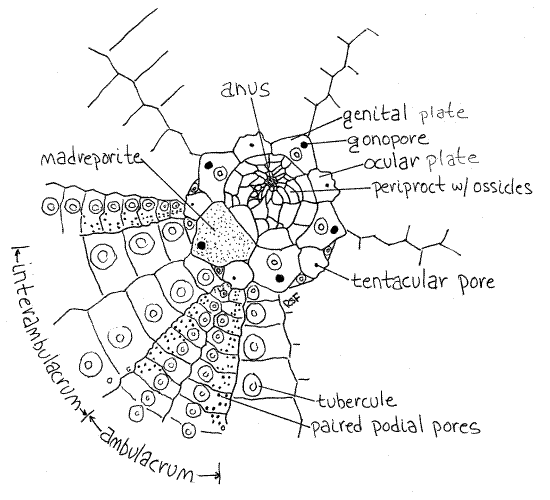
Tube feet are arranged into five double-rows termed ambulacra. Typically, these converge on the mouth and/or anus.
Muscles are used to pump water around the WVS, and each tube foot is equipped with small longitudinal muscles to help aim it, yet the hydrolic force of the WVS is what primarily effects movement in most echinoderms.
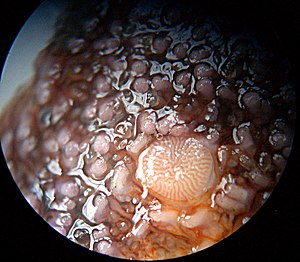
The WVS obtains water from the outside. It is connnected by a calcite-reinforced stone canal that opens to the exterior in the hydropore. The hydropore is covered by a seive-like plate, the madreporite, that strains incoming water.
The lining of the WVS is ciliated, allowing circulation of its fluid. Thus, tube-feet function as gas exchange organs.
The coelom (including the WVS) contains coelomocytes which attack foreign material and, in some cases, carry oxygen and CO2.
Despite this weirdness, they are proper bilateralians with a mouth, flow-through gut, and anus.
NOTE: In addition to the WVS, echinoderms also retain a normal enterocoelic coelom.
Mutable collagen: A form of collagen that can be partially emulsified by the application of nervous action potentials is present in crinoids.
The dominant echinoderms of the Paleozoic were suspension-feeders. Living crinoids still suspension feed, however eleutherozoans have other strategies. The feeding strategy of the first echinoderms is less clear, but recent discoveries suggest that they were deposit feeders.
Echinoderm Systematics
The cladogram at right shows a simplified version of echinoderm systematics, omitting many basal Paleozoic groups. The ones discussed here fall into three broad groups:
Basal stem echinoderms, including some like edrioasteroids (paraphyletic) that show five-part symmetry and others that don't.
Pelmatozoa: The stalked echinoderms. First conceived as a non-monophyletic Linnean taxon but recently acknowledged by echinoderm systematists to be monophyletic. (See Ausich et al. 2015, Sumrall, 2015, and Sumrall, 2017.)
Eleutherozoa: The familiar mobile echinoderms. Universally viewed as monophyletic.
Stem Echinoderms we mostly understand:
Early echinoderms represent a strange assemblage of experiments with different body forms. First, we survey the range of diversity, then try to make sense of it.
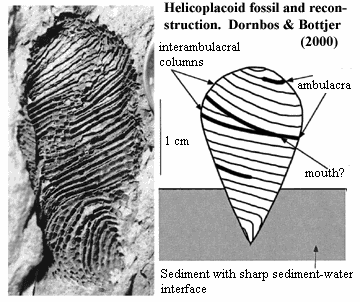
Body is helically-built (hence name) of small plates that were held together by soft tissue.
Thought to be sessile suspension feeders - Possibly among the last "hangers-on" to the Ediacaran algal mat environment.
Ambulacral groove spiralling along body. If, in your mind, you "unroll" a helicoplacoid, you find three ambulacra converging on a point about 2/3 up the body.
Position of the mouth is debated, as it is not positively identified. Possibilities:
It is at the convergence of the three ambulacra.
It is at the top (by analogy with other sessile suspension feeders.)
Sessile, benthic, attached to hard substrates like the surfaces of brachiopods, mollusks, etc.
The body took the form of a lens-like blister or a bulb sitting on a short broad stalk.
Have five ambulacra, like more derived forms. Close examination show that two pairs of these actually converge some distance from the mouth. Thus, only three ambulacra actually converge at the mouth. Edrios, therefore, provide a morphological bridge between the triradiate helicoplacoids and the proper, pentamerally symmetrical later echinoderms. NOTE: A line bisecting the edrio mouth and anus shows the primordial plane of bilateral symmetry that can be hard to recognize in other echinoderms.
Homolazoa: Stem Echinoderms we mostly don't understand
Going farther toward the base of the echinoderm tree you would expect to find creatures that connect them to other deuterostomes. Instead, things get just ugly. Homalozoa is a problematic group of Early Paleozoic echinoderms. True apples of discord with:
no symmetry of any kind.
Appendages and body openings representing the ultimate paleontological Rorschach test.
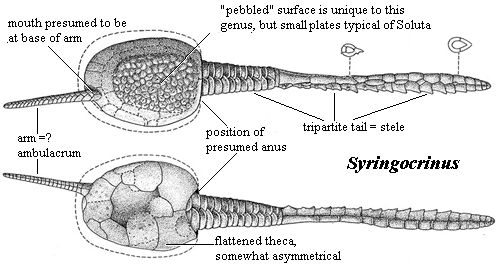
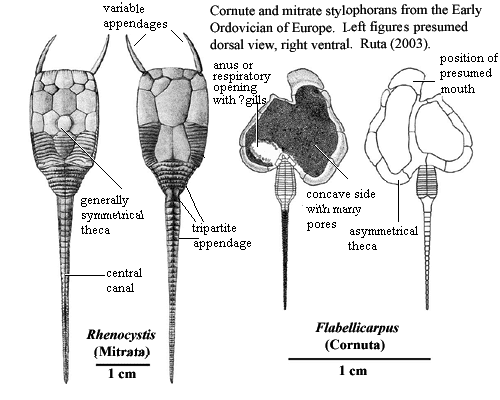
aulacophore - a feeding or locomotion appendage. (See "arm" in illustration at right.)
Stele - yet another feeding or locomotion appendage. (right)
Although some roughly approximate bilateral symmetry (right), none possess it. Others have no obvious plane or axis of symmetry. NONE are pentamerally symmetrical.
The following groups have been regarded as "members" of "Homalozoa":
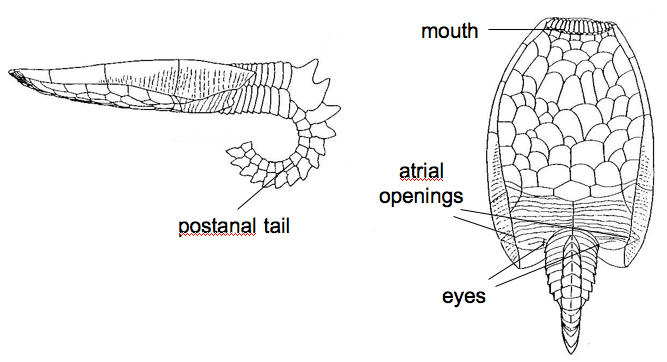
large openings to the left of the stele and at the opposite side from it.
Numerous small pores on dorsal side.
At most the creatures only approach being bilaterally symmetrical, and often there is nothing like an obvious plane of symmetry. Comprised of two groups:
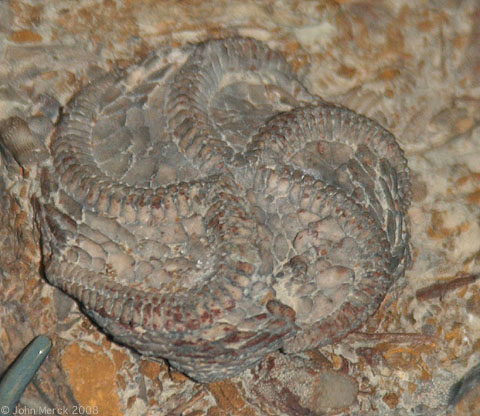
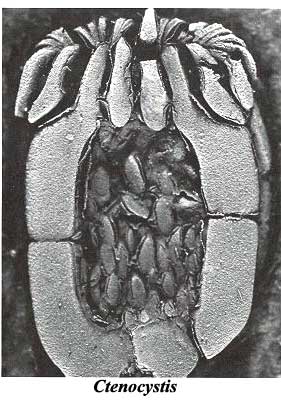
Ctenocystoidea (Cambrian - Ordovician). Strange. No stele or aulacophore. Only an approximation of bilateral symmetry, BUT...
Anterior and (more or less) posterior openings - mouth and anus.
Two anterior bilaterally symmetrical ambulacra.
Although the overall profile is more or less bilaterally symmetrical, the skeletal elements aren't.
Difficult to interpret ecology. These seem to have rested on the bottom with no way to elevate their ambulacra into the water column. Possibly deposit feeders, sifting through soft sediment for food. No indication that they were attached to the substrate, but not obvious how they would have moved around either.
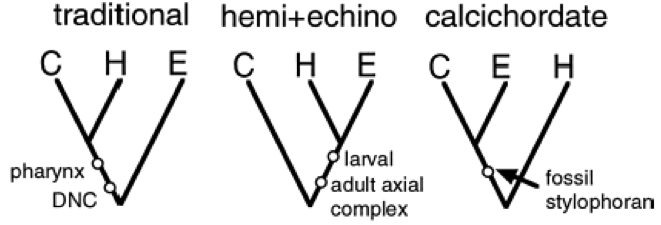
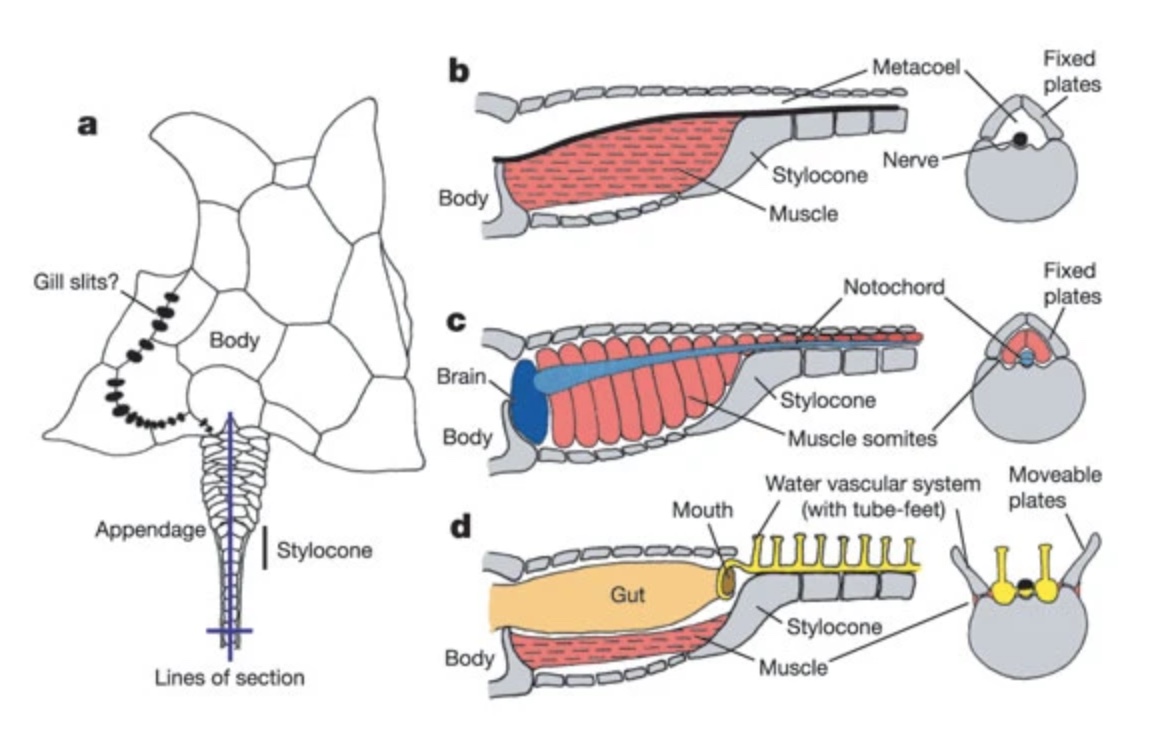
I have only described "homaozoan" features and named a few. No homologies with other organisms have been proposed. This is where the trouble starts. Consider the stylophoran stele. It could be:
an ambulacrum bearing feeding structure like the arm of a crinoid.
a tail, used for propulsion, homologous to the chordate tail.
Similar things could be said about any of the openings of the theca, which could be mouths, anuses, pharyngeal slits, hypropores, etc. Into this chasm of ignorance steps the human imagination.
During the 1980s, Richard Jeffries of the British Museum interpreted the various homalozoans as ancestral to the vertebrates (making vertebrates a polyphyletic group within Echinodermata). This hypothesis (sort of) rested on his convictions about the homologies of the structures. Consider competing interpretations of the stylophoran stele (right).
Jeffries emphatically views it as a chordate-like tail, with room inside for a notochord and myotomes. He also claims to see pharyngeal slits in the openings of the theca. In some ways, these appendages function differently. For instance, according to Jeffries, the "tail" is used to pull the theca along over the substrate.
His conclusion: Chordates are derived from these primitive echinoderms. Indeed, in his scheme, specific homalozoans gave rise to specific chordate groups. To emphasize the propinquity of the relationship, he coined the term Calcichordate. This hypothesis of "calcichordate" phylogeny was developed in the early days of cladistics, and Jeffries does not seem to have used a parsimony analysis.
Objections to his scheme included:
Morphological interpretation seems far-fetched.
The transition from them to chordates involves:
Reorganization of body for 180 deg. change of direction of movement.
Switch from calcium carbonate to calcium phosphate skeleton.
Even if we accept his morphology at face value, his preferred phylogeny of deuterostomes is far from the most parsimonious tree.
Jeffries, himself, seemed to approach the issue with the style of a true-believer.
When you add "calcichordates" to the mix, the basic pattern of deuterostome phylogeny seems completely up for grabs.
As of 2010, echinoderm systematists agreed that Jeffries' phylogeny is wrong, but were all over the map otherwise. Some maintained that his assessment of homology may, in part, be right. The Clausen and Smith, 2005 analysis of the stylophoran appendage suggests that it is, indeed, a locomotor appendage. Others, such as David et al., 2000, asserted that the stylophoran appendage is an ambulacrum on a crinoid-like arm, pure and simple, and that Ctenocystoidea have blastozoan-like brachioles. To them, Homalozoa is polyphyletic and its members belong to better known groups.
Since then, some illumination came from new fossils:
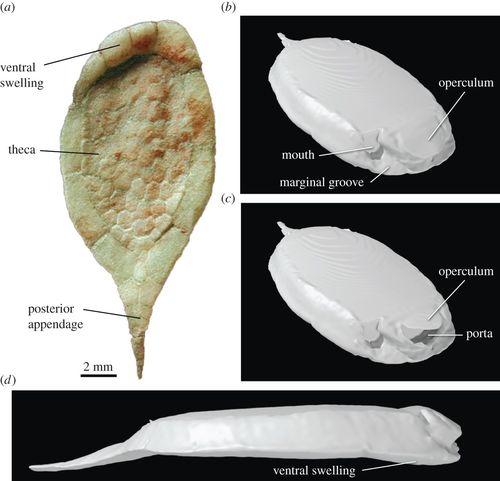
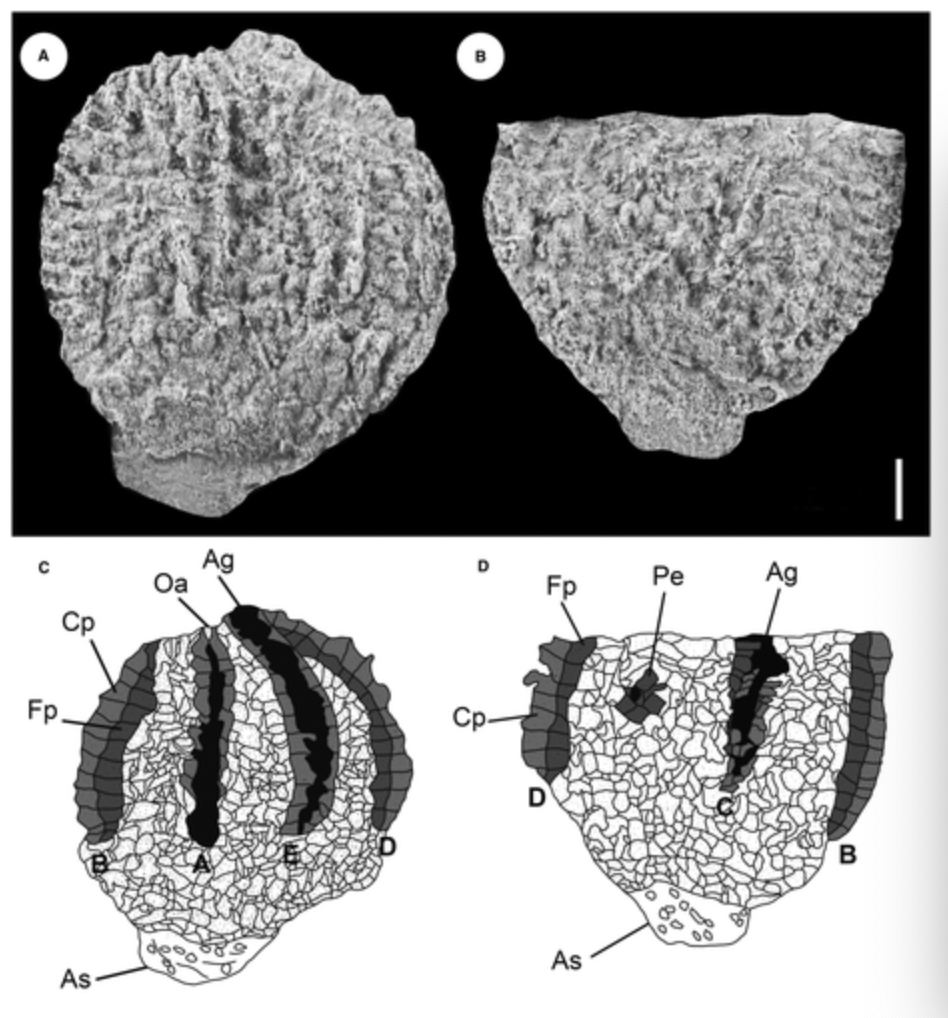
Ctenoimbricata spinosa
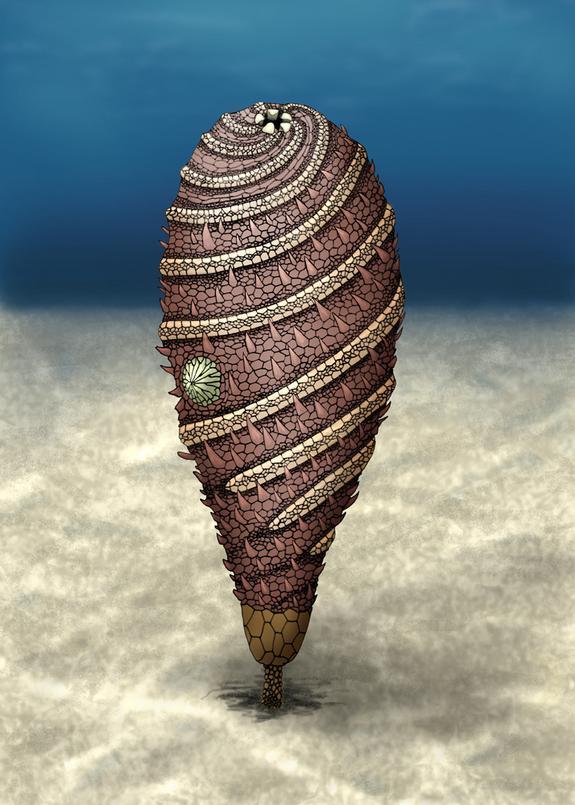
Zamora et al. 2012: Described Ctenoimbricata spinosa (Early Cambrian, right), roughly the size and proportions of a ctenocystoid but with two important differences:
Ctenoimbricata is bilaterally symmetrical.
Its mouth is definitely in front and its anus is definitely in the rear.
Ctenoimbricata is the only known creature with:
an echinoderm-style calcite internal skeleton with stereom and
bilateral symmetry.
Cool. It also seems to resolve the question of how echinoderms fed ancestrally. Its ambulacra are invested with small plates that seem to have enabled it to sift through deposits. See restoration.
But was that all? Rahman et al., 2015 modeled the feeding behavior of the cinctan Protocinctus mansillaensis to determine that its feeding apparatus was ineffective unless water was actively propelled through its oral/pharyngeal cavity by ciliary action.
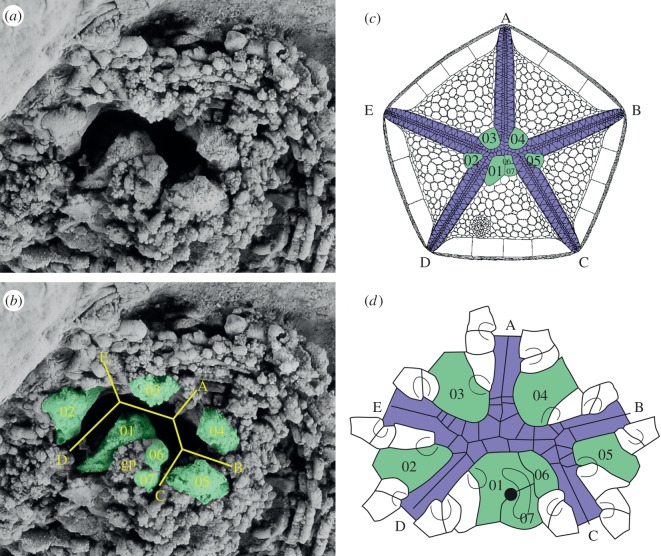
What about the rise of five-part symmetry and the gap between helicoplacoids and edrioasteroids? Smith and Zamora, 2013: Described Helicocystis moroccoensis (Early Middle Cambrian, right), the size and shape of a helicoplacoid but with two important differences:
In addition to its upper helical ambulacrum-bearing segment, Helicocystis has a body with cup resembling the theca of a pelmatozoan and a stem.
NEW FOR 2022! This just in! Zhao et al., 2022 describe Sprinkleglobus extenuatus, a basal edrioasteroid from Chengjiang resembling the ambulacrum-bearing part of Helicocystis.
Now, finally, a coherent speculative picture of early echinoderm evolution is emerging. From a vetulicolian-like "swimming pharynx" ancestor, one can picture the evolution of a deposit-feeding ancestral ambulacrarian with an anterior ciliated feeding appendage for concentrating food that that give rise to:
Soft-bodied enteropneust-like deposit feeders
Deposit-feeding creatures like Ctenoimbricata with an internal skeleton, that concentrated food by means of the ambulacrum but retained the pharynx.
Some early echinoderms became attached suspension-feeders that relied on the ambularra exclusively. (helicoplacoids)
Among those, some like Helicocystis evolved the rudiments of five-part symmetry and the body divisions characteristic of later stalked echinoderms.
Now our great wish is for a clearer picture of the evolution of Eleutherozoa - the non-stalked motile echinoderms.
We turn to crown-group Echinodermata in the next lecture.
Additional reading:
William I. Ausich, Thomas W. Kammer, Elizabeth C. Rhenberg, and David F. Wright. 2015. Early phylogeny of crinoids within the pelmatozoan clade. Palaeontology, 58(6) 937–9 52
Jean-Bernard Caron, Simon Conway Morris, and Degan Shu. 2010. Tentaculate Fossils from the Cambrian of Canada (British Columbia) and China (Yunnan) Interpreted as Primitive Deuterostomes. Plos|One 2010; 5(3): e9586
Sebastien Clausen and Andrew B. Smith. 2005. Palaeoanatomy and biological affinities of a Cambrian deuterostome (Stylophora). Nature 438, 351-354
Bruno David, Bertrand Lefebvre, Rich Mooi, and Ronald Parsley. 2000. Are homalozoans echinoderms? An answer from the extraxial-axial theory. Paleobiology 26(4):529-555
Diego C Garcia-Bellido, Michael S Y Lee, Gregory D Edgecombe, James B Jago, James G Gehling, and John R Paterson. 2014. A new vetulicolian from Australia and its bearing on the chordate affinities of an enigmatic Cambrian group. BMC Evolutionary Biology 14:214
Paschalia Kapli, Paschalis Natsidis, Daniel J. Leite, Maximilian Fursman, Nadia Jeffrie, Imran A. Rahman, Herve Philippe, Richard R. Copley, and Maximilian J. Telford. 2021. Lack of support for Deuterostomia prompts reinterpretation of the first Bilateria. Science Advances 2021 Mar; 7(12).
Karma Nanglu, Jean-Bernard Caron, Simon Conway Morris, and Christopher B. Cameron. 2016. Cambrian suspension-feeding tubicolous hemichordates. BMC Biology 14:56
Herve Philippe, Albert J. Poustka, Marta Chiodin, Richard R. Copley, Pedro Martinez, and Maximilian J. Telford. 2019. Mitigating Anticipated Effects of Systematic Errors Supports Sister-Group Relationship between Xenacoelomorpha and Ambulacraria. Current Biology 29(11), 1818-1826.
Imran A. Rahman, Samuel Zamora, Peter L. Falkingham, Jeremy C. Phillips. 2015. Cambrian cinctan echinoderms shed light on feeding in the ancestral deuterostome. Proceedings of the Royal Society B 282(1818).
D Shu, X Zhang, and L. Chen. 1996. Reinterpretation of Yunnanozoon as the earliest known hemichordate. Nature 280, 428-430.
Oleg Simakov, Takeshi Kawashima, Ferdinand Marletaz, Jerry Jenkins, Ryo Koyanagi, Therese Mitros, Kanako Hisata, Jessen Bredeson, Eiichi Shoguchi, Fuki Gyoja, Jia-Xing Yue, Yi-Chih Chen, Robert M. Freeman, Akane Sasaki, Tomoe Hikosaka-Katayama, Atsuko Sato, Manabu Fujie, Kenneth W. Baughman, Judith Levine, Paul Gonzalez, Christopher Cameron, Jens H. Fritzenwanker, Ariel M. Pani, Hiroki Goto, Miyuki Kanda, et al.. 2015. Hemichordate genomes and deuterostome origins. Nature 527, 459-465
Andrew Smith and Samuel Zamora. 2009 Rooting phylogenies of problematic fossil taxa; a case study using cinctans (stem-group echinoderms). Palaeontology 52(4): 803-821.
Sumrall, C. 2015. Understanding the oral area of derived stemmed echinoderms. 169–173. In Zamora, S. and Rábino, I. (eds). Progress in echinoderm palaeobiology. Cuadernos del Museo Geominero, 14, 291 pp.
Jakob Vinter, M. Paul Smith, and David A. T. Harper. 2011. Vetulicolians from the Lower Cambrian Sirius Passet Lagerstätte, North Greenland, and the polarity of morphological characters in basal deuterostomes. Palaeology 54(3): 711-719
Samuel Zamora, Imran A. Rahman, Andrew B. Smith. 2012. Plated Cambrian Bilaterians Reveal the Earliest Stages of Echinoderm Evolution. PLOS|one June 6, 2012
Jun Zhao, Imran A. Rahman, Samuel Zamora, Ailin Chen, Peiyun Cong. 2022. The first edrioasteroid echinoderm from the lower Cambrian Chengjiang biota of Yunnan Province, China. Papers in Palaeontology 8(4) July/August 2022.