Climate change as a reality of nature: By the 18th century, literate people recognized that climate conditions described by Classical and Medieval authors were often different from those that they witnessed. Today we note that the canals of the low countries are no longer the reliable winter highways for skaters depicted by Peter Brueghel or described in Hans Brinker, or the Silver Skates. It is apparent that climate changes over time. As the science of geology arose, the attention of geologists was drawn to ancient climates for which no eye-witness accounts existed.
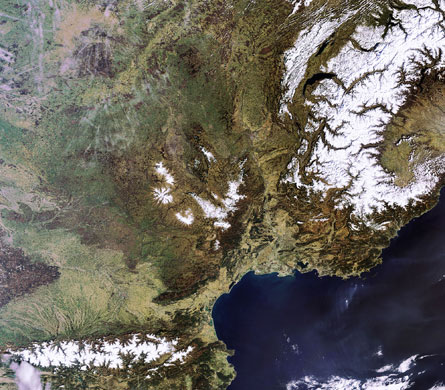 Louis Agassiz: (1807 - 1873) Swiss geologist, paleontologist, paleoclimatologist. Investigated reports of glacial erratics (glacier-transported boulders) in places where contemporary glaciers couldn't possibly transport them, such as the Jura Mts. of France. In 1840, published Etudes sur les glaciers (Study of Glaciers), proposing that the prehistoric Earth had experienced an ice age in which a continental glacier similar to that of Greenland had covered the Alps and had lapped against the Juras. As more information rolled in, it became clear that the the ice age glaciations had occurred at high elevations throughout the world and throughout high latitudes.
To know what kind of landforms led to this conclusion, one needs to understand the deposition of continental glaciers today:
Land forms resulting from continental glaciers: Continental scale glaciation creates interesting opportunities for ice to interact with large volumes of sediment. Results include:
- Erratics: Large boulders deposited in setting to which gravity, wind, or water could not have taken them.

- Drumlin: Hills made of reshaped glacial till (not bedrock like a roche moutonee.
- The steep end is on the side of the ice's approach
- The shallow end points in the direction of ice movement


- Kame [Scots"comb." Pronounced like English "came"]: Hills of stratified drift that form when a stream deposits sediment in a hole in the glacial ice.
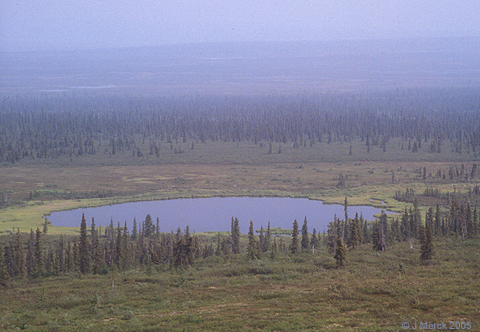

- Kettle lake: This is essentially the opposite of a kame. When a block of glacial ice is stranded by a retreating glacier, it prevents sediments from being deposited. When if finally melts, a depression is left that fills with water. Think of Minnesota - the land of 1000 lakes. these lakes are mostly kettles formed during the retreat of a continental ice sheet.


- Esker [Irish Eiscir - "ridge"]: Long sinuous ridge of stratified drift. Results from sediment deposited in the point bars of under-glacier stream.
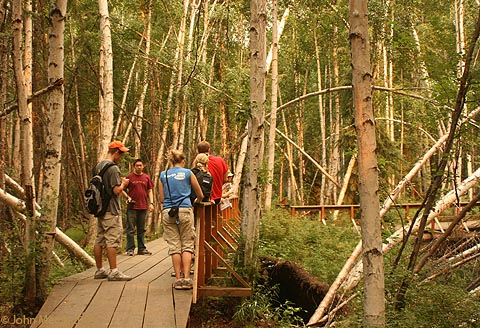
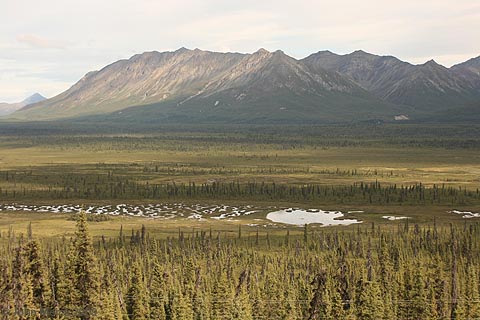
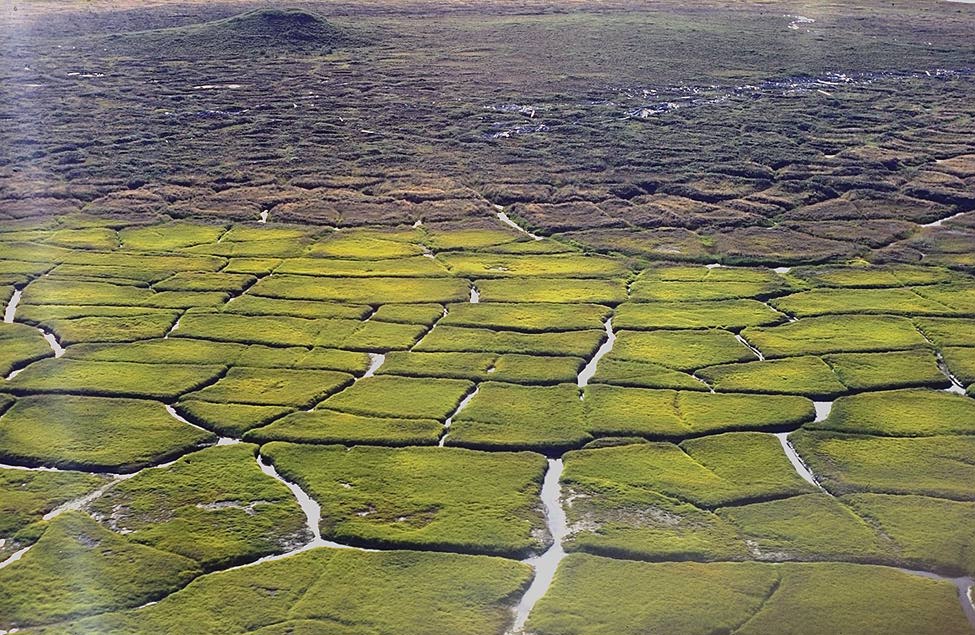
- Permafrost in subsurface.
- Intense freeze-thaw cycles at surface
Resulting land-forms reflect interaction of regolith and ice:

Ice ages:
 So what has the global distribution and age of the glacial and periglacial features taught us?
The Cretaceous and early Paleogene was a greenhouse world. From the Late Plaeogene onward, we have been in an ice house conditions occurred during that interval. During last 2 million years (the Quaternary Period), the situation has become extreme, an ice age with major continental glaciations alternating with interglacials. The interval from 2 mya to 10,000 years ago is called the Pleistocene Epoch. The last interglacial of the Quaternary Period (the one we are in) is the Holocene Epoch.
Pleistocene temperature and "proxy data": The first reliable thermometers went into use in Italy in the late 17th century. The first continuous records of daily temperature didn't begin until the early 19th century in England, so how do we know about ancient temperatures? We infer them indirectly through proxy data:
- Glacial landforms: document the presence of glaciers, but are a very blunt instrument. The problem with glaciers is that they don't record temperature precisely and that new ones bulldoze away the traces of older ones. As a result, ancient moraines and such only tell us so much about the history of glacial intervals.
- Geochemical data gives a clearer picture.
The Oxygen isotope record: Holtz has discussed how we can reconstruct the ocean's isotopic history by looking at the ratio of oxygen isotopes present in foraminiferan shells deposited at different times. That ratio, in turn, tells us how much water was locked up as continental ice.
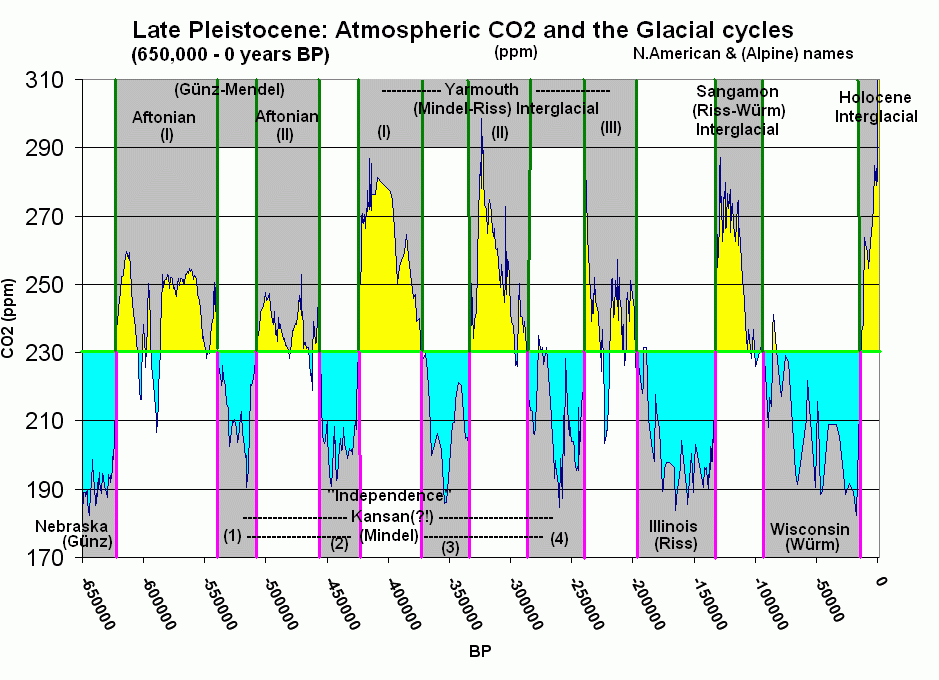
Apparently there were closer to thirty distinct glacials and interglacials. On a longer time scale, we see that these cycles have gradually increased in severity.
"Global" this and that: Paleoclimatologists use the word "global" in a very literal-minded way, to refer to trends in average climate conditions throughout the world. This contrasts with regional trends. For example, the Little Ice-Age, the cool climate conditions that prevailed in Western Europe from the 16th to the 19th centuries, was balanced by warmer conditions elsewhere on Earth. The Little Ice-Age was a regional event, not a global one. Note: at its coolest, Europe was only 1 deg. C cooler on average than it is now.
Global cooling and ice-ages:
Definitions:
- Glacial: Interval of intense and extensive continental glaciations, characterized by dramatic climate fluctuations.
- Interglacial: Interval of relatively constant warm climate with lesser continental glaciation.
- Ice-age: Interval characterized by the prolonged alternation of glacials and interglacials.
- Milankovitch cycles: In the 1920s, the Yugoslavian meteorologist Milutin Milankovitch realized The Earth's movement through space is subject to three kinds of cycles:
- Orbital eccentricity: The orbit around the Sun is an ellipse that changes shape (becoming more and less circular) in a cycle of 100,000 years.

- Axial inclination: The axis of rotation is tilted. The angle of tilt varies from 21.5 deg. to 24.5 deg. in a cycle of 41,000.

- Axial precession: The axis of rotation wobbles around an axis like that of a toy top. So, today the axis points toward Polaris, the north star, but in earlier times, it didn't. One full precessional wobble takes 23,000 years.

- Orbital eccentricity: The orbit around the Sun is an ellipse that changes shape (becoming more and less circular) in a cycle of 100,000 years.
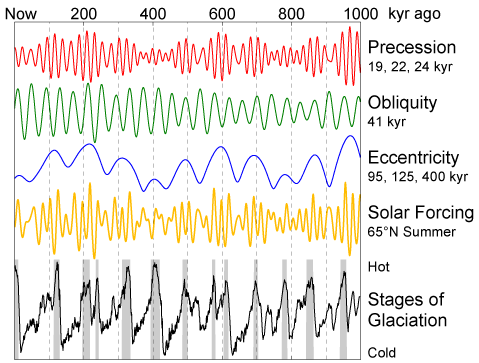 Solar forcing: The sum of the effects of these cycles gives the general tendency for glaciers to form. Note: Solar forcings are different at different latitudes and in different hemispheres.
Factors Influencing the growth of continental glaciers:
- Mild summers: Each cycle influences the severity of winters to some degree, but what really matters is the mildness of summers. It snows hard in many places. Glaciers only form in regions where at least some of the previous winter's snow survives the summer. Thus, when Milankovitch cycles favor mild summers, as when:
- orbital eccentricity is great,
- axial inclination is slight,
- axial precession is such that summer comes when Earth is farthest from the sun,
- Ice-house world conditions prevail: The slight differences in summer weather caused by Milankovitch cycles doesn't make a lick of difference in greenhouse world conditions in which no winter snow has a prayer of surviving the summer. Thus, ocean circulation must bring water to the poles before we can think about having glaciations.
- Large land masses (snow-catchers) exist in high latitudes Consider past ice ages:
- Quaternary Period:, The northern continents are close to the North Pole and Antarctica is at the South Pole.
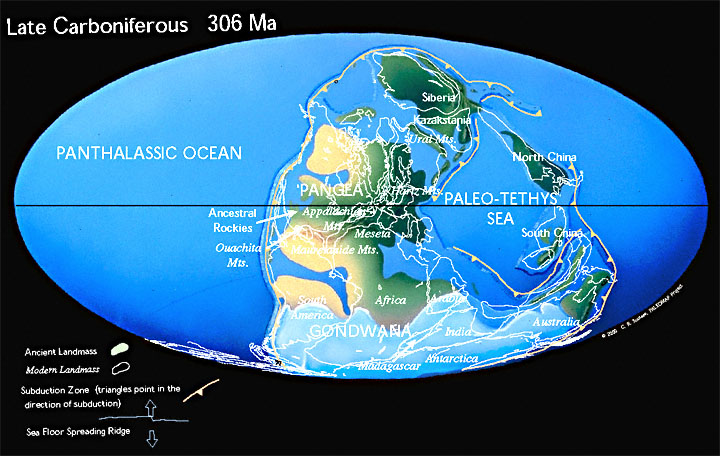
- Carboniferous Period: The southern half of Pangea lay over the South Pole.
- Late Proterozoic Snowball-Earth episode: Not well understood but all indications are that the supercontinent of Rodinia blocked circumtropical circulation and extended into high latitudes in both hemispheres. Remember, this was when continental glaciers extended into the tropics, and the majority of the ocean was covered in sea ice.
The process: If the above conditions are met, then the interaction of the Milankovitch cycles can initiate a glaciation. That is only the beginning. The factors that cause ice ages form a positive feedback loop. In the following schematics, keep track of these variables:
- Incoming solar radiation: Controlled by Milankovitch cycles or (possibly) changes in the sun's actual output.
- Albedo: The Earth's reflectivity. Ice's albedo is very high. That of ocean water is low. The more sunlight gets reflected into space, the cooler the climate.
- Greenhouse gas concentration: Especially CO2. These are consistently erupted from volcanoes, regardless of the climate.
- CO2 weathering reactions: Atmospheric CO2 (in a series of steps) interacts with rocks in weathering reactions, yielding CaCO3. The CaCO3 typically ends up in the oceans, where it can be precipitated as chemical sediments. By this means, these take atmospheric carbon and move it into the solid Earth.
Snowball Earth in a Nutshell: We start with the example of the most extreme, but also the simplest example, the Snowball Earth episode of the later Proterozoic in which the supercontinent Rodinia was gripped by the greatest known glaciations. Note: The Proterozic world was simpler, because there was no significant biosphere to move carbon around.


The end? Only until solar forcing upsets the equilibrium again.
How long does it take? From the time that the ice starts to melt and CO2 weathering reactions can resume, it takes up to 150,000 years for the atmosphere to return to equilibrium. Why doesn't the CO2 just dissolve in the oceans? Much of it does, but to get it into the deep oceans requires passing it through the small oceanic "windows" where surface waters sink into the depths. (Today = North Atlantic and around Antarctica.) That also takes millenia.
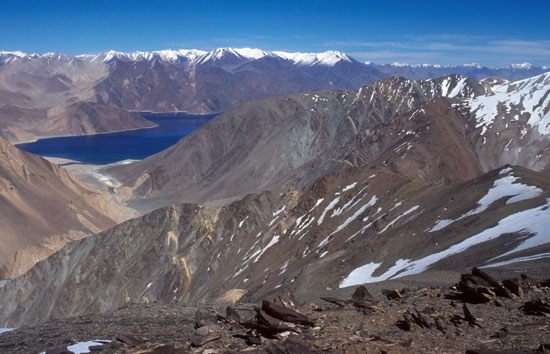 Cooling without solar forcing? Possibly. There may be another way to force a cooling event. Simply expose a huge amount of unweathered bedrock to the atmosphere, and CO2 will be drawn out by weathering reactions. The resulting anomalous reduction in greenhouse gasses can cause global cooling. In fact, the Neogene collision of India and Eurasia, with the elevation of the bare bedrock of the Himalayas and Tibetan Plateau has been suggested as a contributor to the Neogene ice-house world. This correlates well with previous great ice-ages that were characterized by supercontinents with enormous interior orogenies. Recovery would occur when erosion rates eventually diminished and atmospheric CO2 returned to equilibrium levels.
Global warming:
We have already seen examples of global warming - the recoveries at the end of glacial intervals. These tend to happen rapidly. More recent ice-ages (Carboniferous and Quaternary) have been less extreme than the Snowball Earth episode, so that the restoration of strong incoming solar energy in summer has been enough to trigger deglaciations. Just as cooling triggers a positive feedback loop over a short time scale, so does warming:
- Incoming sunlight warms summer hemisphere causing ice to begin to melt.
- Warming oceans can hold less CO2, so this comes out of solution, increasing atmospheric greenhouse effect.
- On warming continents, decomposition of (previously frozen) plant material releases more CO2.
BIG CONCEPT: We see that just as the albedo of growing ice sheets amplified cooling through solar forcing, the release of CO2 amplifies warming through solar forcing.
Caveat: Yes, we just said that warming exposes bedrock that drives CO2 weathering reactions that remove CO2 from the atmosphere. Now we're saying that warming adds CO2. WTF? The difference is the time scales involved. The positive feedback processes described above work on an order to decades. The weathering reactions work on the order of tens of millenia. Weathering reactions win in the end, but not before the positive feedback elements have had their day.
Indeed, CO2 concentrations and isotope data from the Greenland Ice Core suggests that during the last deglaciation, global temperatures rose rapidly, on a time scale of decades. Note: at the glacial maximum, average global temperature was 5-6 degrees C lower than today.
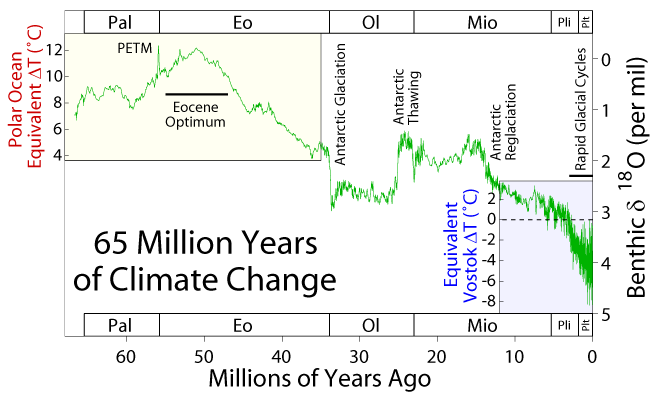 Can we have a warming event without first cooling the Earth off? In fact, it's happened.
 The Paleocene-Eocene Thermal Maximum (PETM): 55 m.a., the boundary of the Paleocene and Eocene Epochs of the Paleogene was marked by proxy data suggesting a rapid warming of 5-6 deg. C within 20,000 years. This was caused by the sudden appearance in the atmosphere of a high concentration of CO2. Over the following 150,000 years, temperatures returned to their previous (greenhouse) equilibrium. This event is of great interest because it strongly resembles the anticipated effects of contemporary anthropogenic global warming. The big question: Where did the "extra" CO2 that drove the PETM come from? Two possibilities:
- Methyl hydrates: Solid solutions of ice and methane that form in sediments of the deep oceans under great pressure. Methane (CH4) is much more powerful than CO2 as a greenhouse gas. It is quickly broken down into CO2.
- CO2 released by unusual volcanic activity.
Extinction event: The PETM coincided with a minor extinction event, and with the origin of several modern mammal groups (even and odd-toed ungulates, carnivorans.) For foraminiferans, it was a true disaster. The PETM is quite visible in the core sample at right. The change in color coincides with a global extinction of foraminiferans.
Why were they extinguished? Arguably, the acidification of the oceans, as large amounts of CO2 reacted with water to form carbonic acid.
Condition 18,000 years ago during the last glacial maximum:
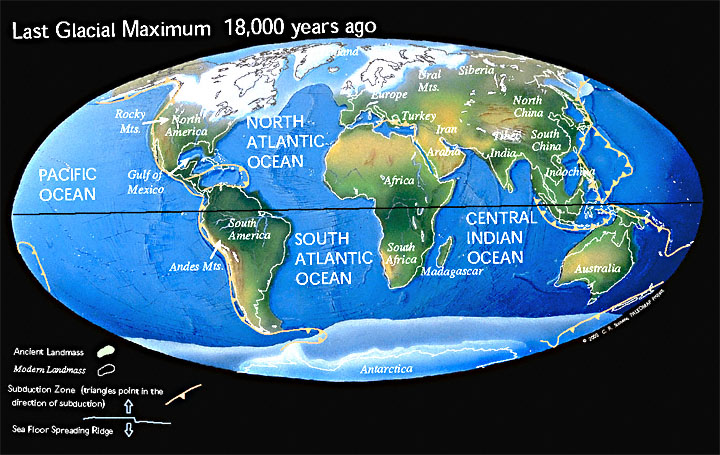
- Beringia - the land bridge across the Bering straites
- Australia, Tasmania, and New Guinea were one large land mass
- Many of the islands of Southeast Asia were part of the mainland.
Quaternary biota of North America
 During the last glacial, plant communities were both shifted southward from their current ranges, and altered by different combinations of rainfall and temperature. Compare recent biomes (right) with those of the glacial max. The big losers in the glacial were temperate forests, which were replaced by boreal (northern) forests and evergreen taiga, and the deserts of the southwest, which were occupied by grasslands and scrub. Naturally, animal communities were also different, with significant grasslands and boreal/taiga forest communities.
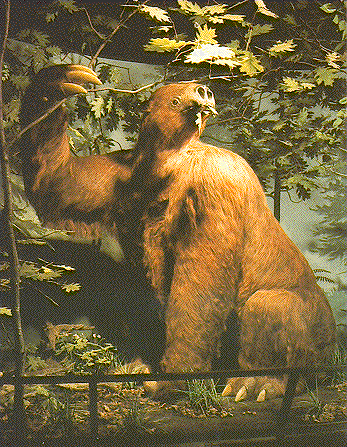
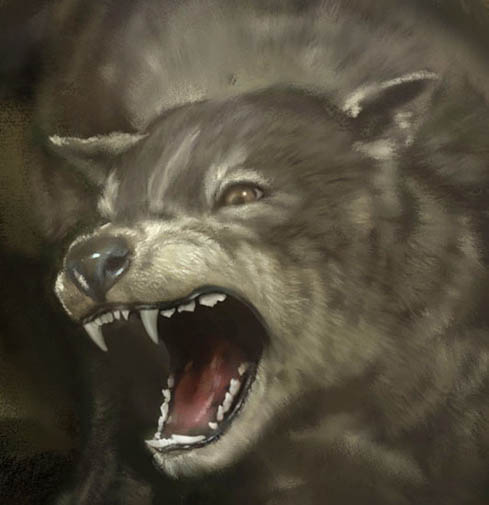
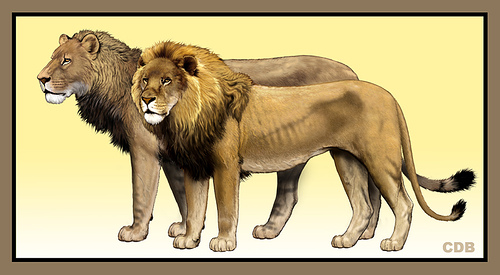
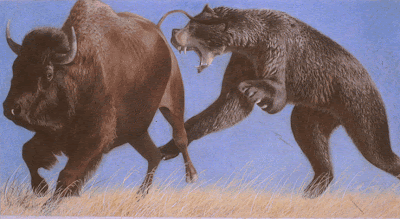
At the end of the last ice age lots of North American animals went extinct - especially large plant-eating mammals and the predators that fed on them, including:

- Four species of elephants (e.g. North American Columbian mammoth)
- Native horses (right)
- Giant ground sloths
- Native camels (right)

- Two species of sabre-toothed cat (E.g. Smilodon (right) and Homotherium)
- A native wolf, the dire wolf (right)
- A native pantherine cat, Panthera atrox (lion or possibly jaguar - right)
- A native cheetah, Miracinonyx inexpectatus (right)
- A native bear, the short-faced bear (right)
these large mammals were scavenged by large vultures including:
- Teratornis merriami - extinct
- The California condor
- barely hanging on
 Was this extinction due to:
- Changes in climate
- Loss of habitat
- Overhunting by humans? (So called "Pleistocene overkill")
An irrationally emotional debate rages. (Psst! Merck bets on the third option in most cases.)
 No one has a freaking clue what the equilibrium ecology of North American forests was like back when they were crawling with elephants. In Africa and Asia these creatures radically transform forests into open savannahs. This probably happened in North America as well. Some people speak of "old-growth" forests as if they were the pristine primeval state of this land, but they, too, are an invention of the Holocene.
Note: Absent from North America were familiar animals such as elk, brown bears, and timber wolves, which invaded the continent at the same time as humans.
Ice-Age details
 The Younger Dryas: By fifteen thousand years ago, climate was warming rapidly and glacial ice melting quickly. Then, thirteen thousand years ago, glacial conditions returned to the lands around the North Atlantic, as evidenced by the presence of pollen of Dryas, an arctic weed. WTF? Apparently, huge North American meltwater lakes had penetrated an ice barrier separating them from the ocean, reducing ocean salinity to where the formation of Atlantic deep water was curtailed.
The Holocene optimum: In contrast, despite local climate fluctuations, the last ten thousand years have been a time of unprecedented climatic stability. Coincidentally, this is the interval in which humans developed a sophisticated material civilization.
 Dansgaard-Oeschger events: In contrast, cliamte during glacial intervals was far from stable. Glacials are punctuated by Dansgaard-Oeschger events, abrupt warming to almost interglacial levels followed by slow cooling. These occur roughly every 1500 years. Some climatologists regard them as indications of a recurring cyclicity - the Bond cycle, although their cause is not absolutely clear. Some D-O events are correlated with Heinrich events in which warming is correlated with the advance of icebergs across the northern oceans. Why would warming lead to the proliferation of icebergs? Possibly regional warming in the southern ocean prompted melting of antarctic ice that raised sea level, floating northern glacial ice off of its bedrock foundation. Icebergs raft large pieces of sediment into the deep oceans.
The future: Had the industrial revolution not occurred, this would still be a complex topic. What is known is that:
- The warmest period of the Holocene Epoch (the last 10,000 years) occurred roughly 6,000 years ago. At this point Earth had its highest recent sea levels. Since then, Earth has cooled and sea levels dropped slightly.
- Projections of solar forcing suggest a close approach to the point at which continental ice might start growing in 3000 years. If glaciers don't grow then, the stronger solar forcing is expected in 50,000 years.

- But the industrial revolution has returned to the atmosphere CO2 that was locked up over millions of years during the late Paleozoic. The predictable result is an increased greenhouse effect. The extent of future global warming will depend on exactly how much CO2 is ultimately released. The consumption of all accessible fossil fuels could yield a warming event on the scale of the PETM.
As of now, only climate models that incorporate both natural and anthropogenic (human caused) forcings yield results consistent with observations.
The future. Extrapolating from current trends in CO2 emissions, climatologists predict a 3-5 deg. C increase in global temperature by 2100. That's at least half the increase that the world experienced at the end of the last glacial! Such a warming will overwhelm any solar forcing and "postpone" the next ice age for at least 150,000 years, long enough for weathering reactions to get rid of excess CO2.