Trilophosaurus buettneri
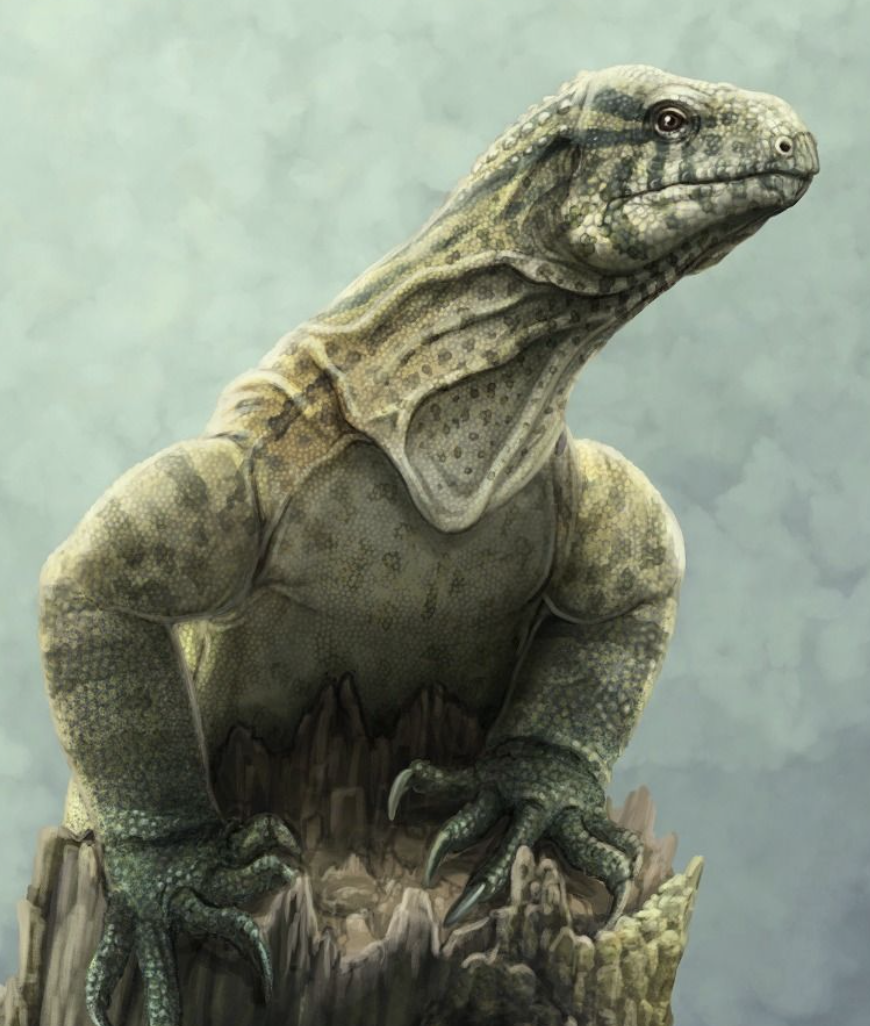
Name: Trilophosaurus buettneri [Oblong scaled pharynx]
When: Late Triassic Period, 225 - 205 million years ago
Where: Texas
Claim to fame: Trilophosaurus is more interesting than it looks. On the outside, this herbivore looks like a large lizard with a turtle's head - complete with a beak in front. Pry its mouth open, however, and you see its unique feeding arrangement. Its unusual teeth are arrayed in plates of chisel-like blades that occlude precisely with their opposite numbers. Among reptiles, teeth are shed and replaced regularly, with the result that any tooth-position may be vacant at any time. In Trilophosaurus, only one tooth is shed at a time in each tooth row. Upper teeth and their lower partners are shed at the same time, ensuring that most teeth continue to mesh with their counterparts.
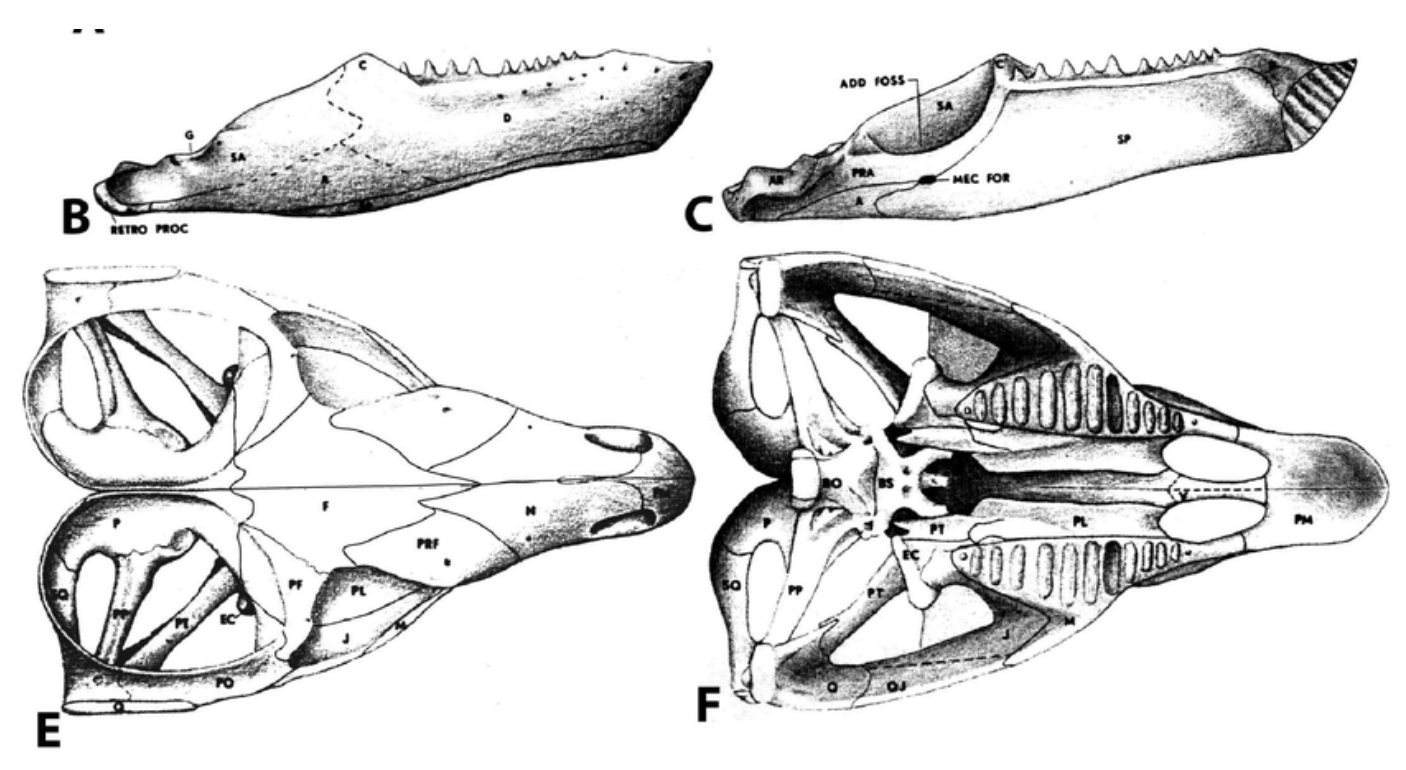
What kind of animal was Trilophosaurus? Although it has been known for 80 years (Gregory 1945), its relationships with other animals were a notorious enigma for forty years, when Benton (1985) found it to be a distant relative of crocodylians and birds, but closer to them than to lizards or turtles. During the 21st century, we discovered that it had close relatives like the long-snouted Teraterpeton and hell-boy mimic Shringasaurus. All are specialized herbivores and form the group Allokotosauria.
- Michael Benton. 1985. Classification and phylogeny of the diapsid reptiles. Zoological Journal of the Linnean Society, Volume 84, Issue 2, June 1985, Pages 97–164.
- Gregory, J. T. 1945. Osteology and relationships of Trilophosaurus. – University of Texas Publications, 4401: 273–359.
- Nesbitt, S.J.; Flynn, J.J.; Pritchard, A.C.; Parrish, M.J.; Ranivoharimanana, L.; Wyss, A.R. (2015). "Postcranial osteology of Azendohsaurus madagaskarensis (Middle to Upper Triassic, Isalo Group, Madagascar) and its systematic position among stem archosaur reptiles" (PDF). Bulletin of the American Museum of Natural History. 398: 1–126.
- Gregory, J. T. 1945. Osteology and relationships of Trilophosaurus. – University of Texas Publications, 4401: 273–359.