
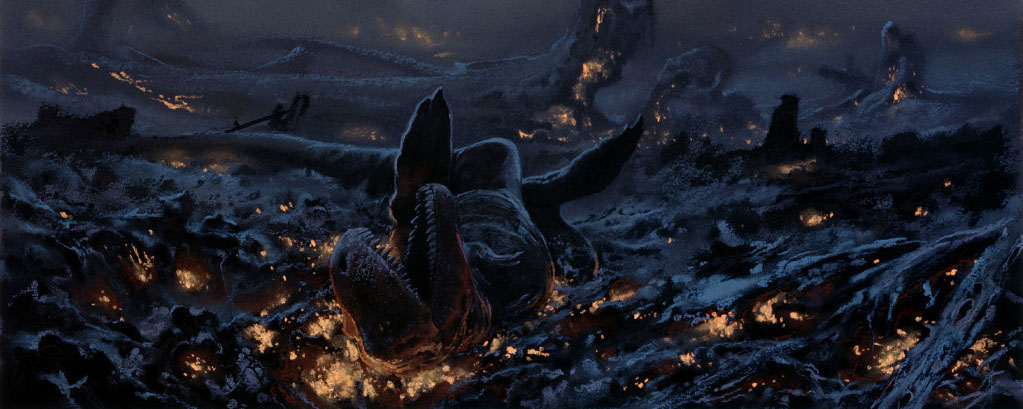
Key Points
- The disappearance of non-avian dinosaurs was just one part of a larger event: the Cretaceous-Paleogene (K/Pg) mass extinction (formerly called the Cretaceous-Tertiary or K/T extinction).
- Diverse groups of land and sea organisms died out at this time, 66.05 million years ago.
- Three major environmental changes (the Maastrichtian Regression; the Deccan Traps volcanism; and the Chicxulub asteroid impact) occurred in this same general time. While the first two seem to have generated some level of extinction, it is the impact that seems to be the primary driver of this extinction.
- Survivorship on land seems to be controlled mostly by favoring small body size and ability to feed from stored food resources; in the sea it is the latter which is the most important factor.
- The devastation from the impact has served as a model for understanding the effects of a global thermonuclear war.
We'll start our look at particulars of mass extinctions by looking at the most famous of all: the end of the Age of Dinosaurs. This is the
boundary between the Mesozoic Era and the Cenozoic Era (and thus between the Cretaceous and Paleogene Periods, the Late Cretaceous and Paleocene Epochs, and the Maastrichtian and Danian Ages). Currently dated (as of 2013) as being 66.0 Ma, this is the extinction event that eliminated the dominance of dinosaurs and allowed the adaptive radiation of mammals.
(By the way, this event is by no means the largest of mass extinctions: we saw that back at the P/Tr! It was also not the final extinction of the dinosaurs, as of course Dinosauria (in the form of crown-birds) is still alive and flying!)
This event goes by many names:
In the marine realm, among the main victims were:
Introduction
The Cretaceous-Paleogene Extinction (66.0 Ma)

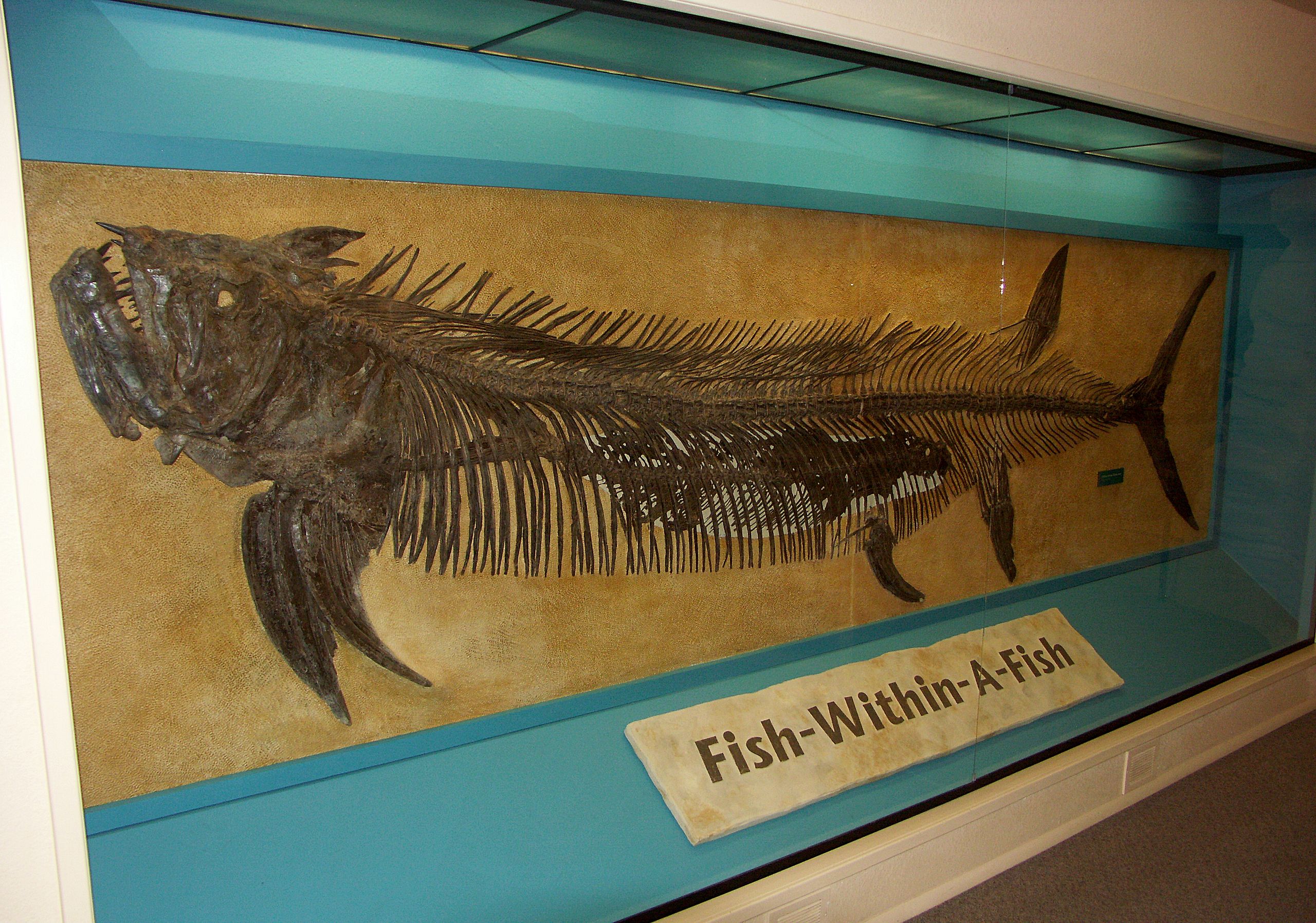

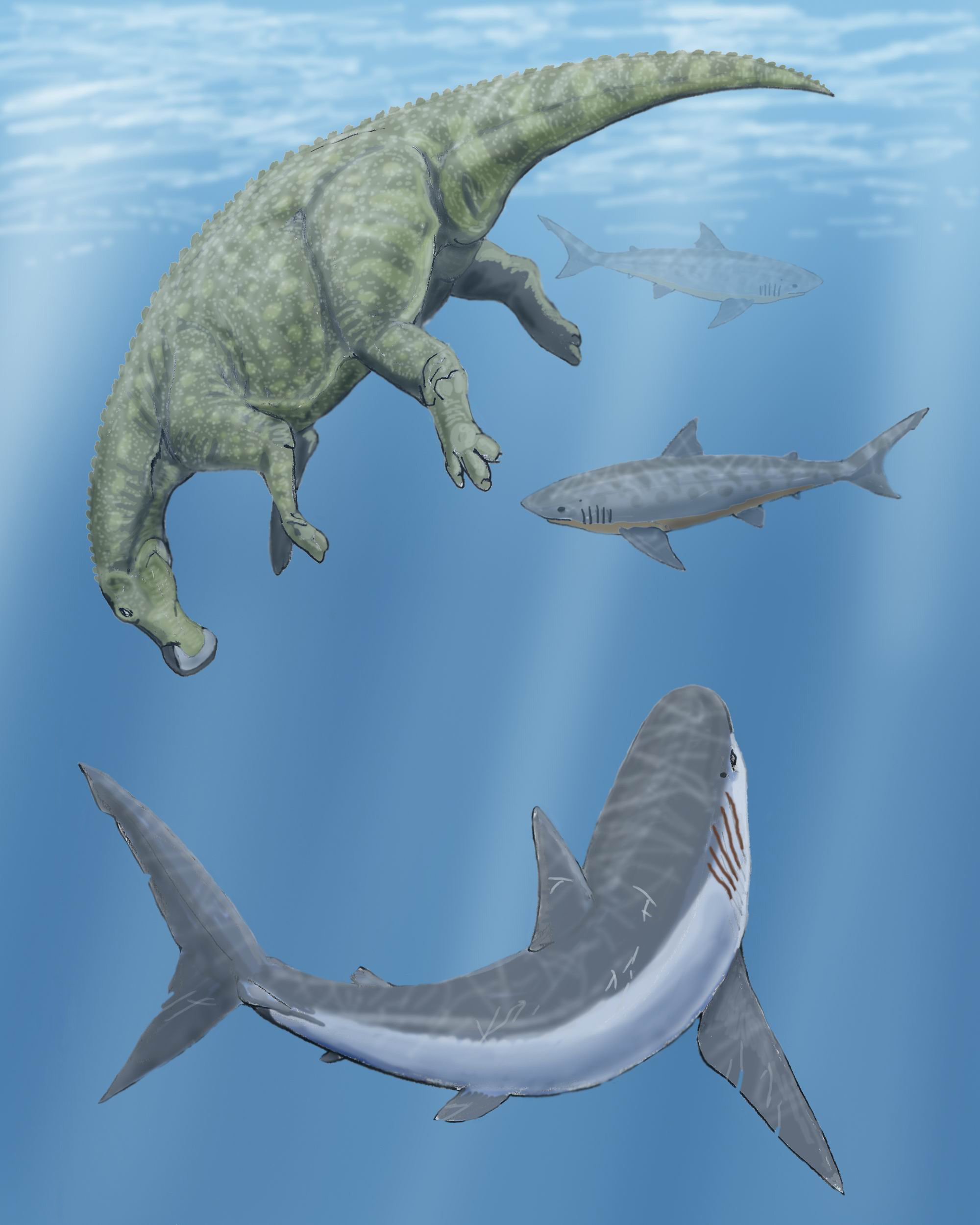

In contrast, there does not seem to be too much in terms of extinction among smaller bottom-dwelling organisms.
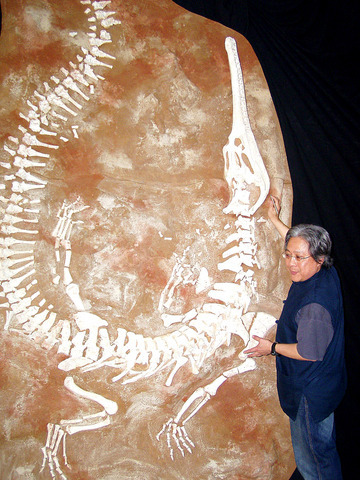
In the terrestrial/continental realm, major victims include:
- One major group of plants (bennettitaleans) (which actually might have died out earlier)
- Temporary decrease in the amount of insect feeding damage on leaves, but no major insect extinction
- Many groups of Mesozoic mammals. (However, the ancestors of marsupials and of placentals survived, as did the monotremes (already present), and some Mesozoic groups that ultimately died out later in the Cenozoic, such as the multituberculates.)
- Many types of crocodyliform, including terrestrial armored herbivores
- The pterosaurs (flying reptiles), although at this point limited to one major clade
- All the larger types of dinosaurs, and many clades of birds
- Indeed, pretty much all fully-terrestrial animals greater than 5 kg mass goes extinct

In the terrestrial realm there is a transition from a gymnosperm-dominated flora to an angiosperm (flowering plant)-dominated one. The toothless crown-group birds survived, as did the living groups of amphibians, turtles, lepidosaurs, and crocodylians. The long-snouted champsosaurs (distant kin to the archosaurs) survived and thrived in the early Cenozoic, but have subsequently died out.
Some Outdated Ideas
Many hypotheses proposed for the K/Pg Extinction. In evaluating the hypotheses, must consider:
- Does the proposed agent only affect dinosaurs, or does it affect the other known victims?
- Is it overkill? (i.e., is it so strong it should have killed EVERYTHING?)
- Is the cause telluric (from Earth) or cosmic (from space)?
- Is the cause biological or abiotic?
- Is the cause unique to the K/Pg or the same as other mass extinctions?
- Did the extinction occur instantaneously (over hours to weeks to months), gradually (over tens or hundreds of thousands or millions of years), or in between?
- Was it a single agent or multiple agents?
- Were the marine and terrestrial extinctions caused by the same or different causes?
Most significantly:
- Is the hypothesis testable (i.e., falsifiable)?
- Would the agent leave a record independent of the extinction itself?
Here are but some older proposed causes for the K/Pg event:
Global Diastrophism
- Discussed in a previous lecture, the idea that most mass extinctions were caused by intense climate change brought about by geologic upheavals.
- This was one particular extinction to inspire that idea. The latest Cretaceous and earliest Cenozoic of western North America--for a long time the best studied region for the end of the Mesozoic--does indeed have a major pulse of mountain building. However, this is by no means a global phenomenon.
Racial Senescence
- Idea that clades, like individuals have a "lifespan" with a fast growing "youth", long stable "adulthood", and period of decline and decay at end: racial senescence or senility.
- "Evidence" for this was "nonfunctional" structures in dinosaurs (thick pachycephalosaur skulls, short tyrannosaurid arms, spikes on horned dinosaur frills, etc.), heteromorph ammonoids, etc.
- However, these structures likely have functional significance
- Also, no evidence of predetermined "lifespans" of clades
Poison Gas from Comets
- Shortly after WWI (when poison gas was used on battlefield), astronomers identify cyanogen gasses in comet tails
- Thought that if Earth passed through tail of comet, the globe might be "gassed"
- Looked at dinosaur skeletons, showed necks bent backwards as in deaths on battlefield
- However, such positions are common in rock record: due to drying and shrinking of neck ligaments
Caterpillars ate all the food
- Perhaps caterpillars diversified and ate all the plants before the dinosaurs could?
- No evidence for this!
- How would it affect coccolithophorids, ammonoids, etc.?
Mammals ate the dinosaurs to death
- Mammals indeed may have eaten eggs of dinosaurs, but...
- Why didn't they eat eggs of toothless birds, crocs, turtles, lepidosaurs, etc.?
- How could it affect marine community?
- Also, mammals and dinosaurs coexisted since Late Triassic!
Allergies to Angiosperms?
- How would this affect all dinosaurs except for toothless birds?
- Why only at latest K, tens of millions of years after rise of angiosperms?
- How could it affect marine community?
Diseases
- Why would it affect so many diverse taxa?
- Why at same time on land and in sea?
More Modern Thoughts
The global nature of the K/Pg extinction would seem to favor some causal agent which could affect the whole planet. Cosmic (extraterrestrial) phenomena might be a good possibility.
Supernova?
1971: Suggestion by Dale Russell (dinosaur paleontologist) and Wallace Tucker (astrophysicist): a supernova killed the dinosaurs. Supernovae are exploding stars: put out TREMENDOUS amount of energy. If a star in a nearby solar system exploded, it would bombard surface of planet with radiation, bringing radiation sickness, cancer, etc.
Modern analogue: during 1950s through 1970s, greatest fear about nuclear war was radioactive fallout.
Predictions for a supernova-caused extinction:
- Large animals would suffer worst; small animals and burrowers might survive
- Organisms on the surface of the water (or creatures that fed off of these) would be hit worse then bottom-dwellers
- Would affect whole planet simultaneously (essentially every part but the poles would get clobbered once per day until the supernova faded)
Some of the data does match the prediction. However, it is problematic because it is an untestable (and thus non-falsifiable) hypothesis:
- Cannot observe remnants of the star, because supernova would have dispersed (and besides, the Solar System and all other star systems have moved greatly since the Cretaceous)
- Would leave NO geologic signature other than the extinction itself.
So, remains as a potential but no reason should be supported. This was the leading candidate during the 1970s.
Confirmed Potential K/Pg Causal Agents
While the above phenomena are largely insufficient to explain the event, there are three confirmed large-scale environmental changes during the end of the Maastrichtian that potentially are involved with the extinction. In order of appearance (and of increasing severity) they are:
- The Maastrichtian Regression: a global drop in sea level
- The Deccan Traps: a flood basalt invent in India
- The Chicxulub Impact: an asteroid slamming into Mexico
Maastrichtian Regression
The Maastrichtian is the last Age of the Late Cretaceous Epoch; regression refers in this context to any period of sea-level drop. In this particular case, it was triggered by reduction in mid-ocean ridge activity. As the mid ocean ridges shrank, the water that they had displaced onto the continents throughout the Late Cretaceous drained away.
For the marine realm, this caused a very large drop in the area for the shallow marine communities. Additionally, it removed a major source for marine productivity and modified global circulation patterns. For the terrestrial realm it made climates more continental (hotter summers, colder winters) because now not every place was essentially close to the sea shore. This would also mean that habitats would shift.
The Maastrichtian regression unquestionably occurred (although as with all such changes, there were local and global smaller scale sea level rises mixed in with the pattern of the drop.) One would predict that the environmental effect of the Maastrichtian regression would play out over the period of a few million years.
Deccan Traps Volcanism
The Maastrichtian has long been known as a period of intense volcanism in parts of the world (see "Global Diastrophism" above). For instance, in North America, associated with change in mountain building in Rockies (the beginnings of the Laramide Orogeny). But the biggest aspect of this volcanism is the Deccan Traps.

The Deccan Traps were a GIGANTIC series of lava flows in western India. It was among the largest flood basalt events since the Siberian Traps at the Permo-Triassic boundary and the Central Atlantic Magmatic Province volcanism that formed by the break up of Pangaea at the Triassic-Jurassic boundary. In some places the Deccan Traps are 2.4 km (1.44 MILES) thick. An area of 2 million km3 was covered. As with all flood basalts, it was not a single continuous event; instead, there would be eruptions; periods of cooling from sulfates; global warming from excess greenhouse gases; stabilization of the environment after the eruption had ended; then a new eruption.
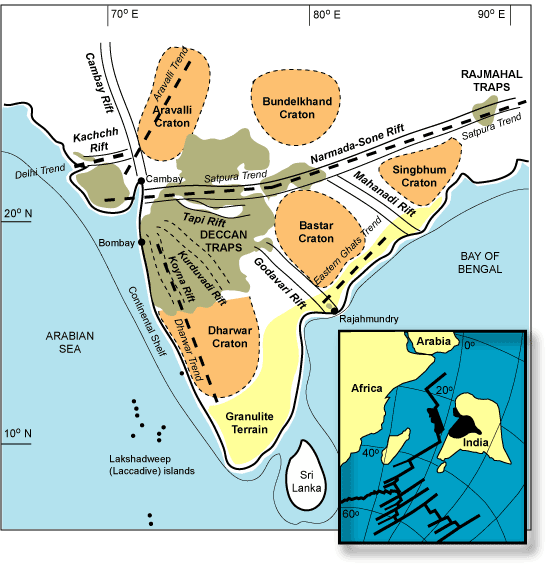
The Deccan Traps began around half a million years before the K/Pg boundary. The lowermost beds erupted during a global magnetic normal time (subchron C30n), while the impact of the asteroid and the boundary itself would be later in a magnetic reversed interval (subchron C29r). Since the switch from C30n to C29r happened 350 kyr prior to the boundary, the asteroid impact could NOT have been the cause of the Deccan Traps. That said, there is some evidence that a few thousand years after the impact the intensity of the eruptions increased: this timing would be consistent with magma chambers being disrupted by impact-generated mega-earthquakes, and then percolating slowly up to the surface.
As with the Siberian Traps and CAMP, the Deccan Traps would provide both a cooling and a warming component. There is a 5-6°C increase in annual temperature in western North America during the pre-impact eruptive phase, that might reflect the volcanic greenhouse contributions. Furthermore, we would expect ocean acidification as a side effect.
So, Deccan Traps themselves were a MAJOR event, and might have contributed to the extinction event. Had just this eruption plus the Maastrichtian regression occurred, there probably would have been a mass extinction. But perhaps it would have been much less severe, and not an "era-ending" one. But Nature had one more, far more spectacular event to unleash.
The Chicxulub Impact
The discovery of an asteroid impact at the end of the Cretaceous began in the latest 1970s and was published in 1980. Geologist Walter Alvarez was investigating a layer of clay in Gubbio, Italy at the K/Pg boundary. He wanted to determine length of time represented by the clay layer. He knew that the limestone below was latest Maatrichtian and those above were earliest Danian (early Paleogene). But how much time was there for the clay layer? A few years? Decades? Millennia? More? (The biostratigraphy above and below showed it couldn't be more than a million years.) Being clay he couldn't radiometrically date it, and there is no magnetic flip-flop right near the boundary. So he consulted his dad (Nobel winning physicist Luis Alvarez) for possible solution. After teaming up with a few chemists, the decided to look for meteoritic material as a possible clock. This was based on the following observations:

- Meteors impact the Earth's atmosphere all the time
- Some chemical elements more common in meteors and such than on Earth's surface: these should be traceable in minute quantities in sediment
- Find the average infalling rate of these elements today; use this rate and observed amount at the Gubbio clay layer to find out how much time
The element used: iridium (a platinum-like metal, common in metallic asteroids but very rare in Earth's crust).
When examined Gubbio clay, found a huge increase in iridium (the iridium spike) at base of clay. Using their method it would mean that there was a few million years missing, which was clearly not the case. So which assumption was not correct? They eventually realized that this wasn't a case of an average rate of infall. Instead, they hypothesized that an asteroid impacted Earth at the K/Pg boundary. Luis Alvarez had been part of the US nuclear weapons program, and later had worked with NASA on calculating the energy of impacts from asteroids and comets. Both of these sets of skills proved useful in determining the effect of the end-Cretaceous impactor.
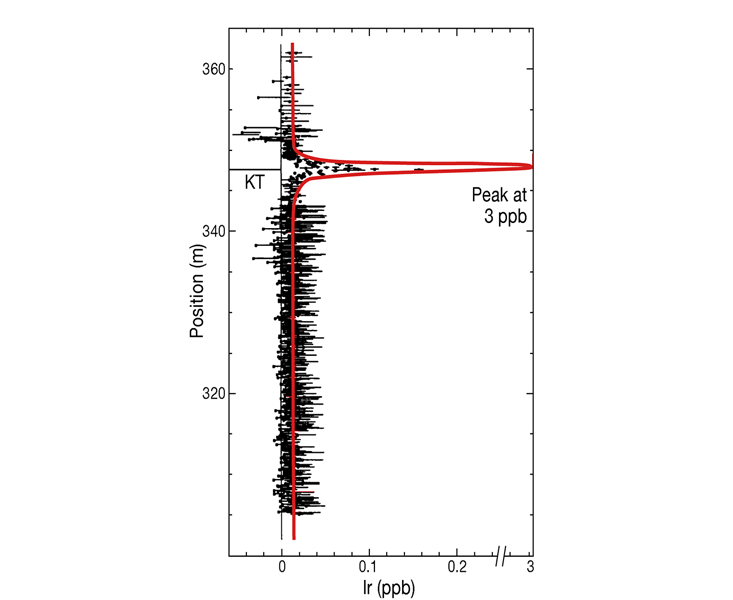
- Calculated probable size need to increase the rate of iridium infall suggested a 10-15 km diameter object (Manhattan-sized or Mount Everest-sized)
- Calculated that a blast of this size would have released about 1.8 x 10⁸ megatons!! (A "megaton" is the destructive force of 1,000,000 tons of TNT. The most powerful nuclear blast ever produced by humans was 50 Mt, and the largest standard H-bombs were in the 5-10 Mt range. The energy involved here as 1000-10,0000 times the total nuclear weapon yield available at the height of the Cold War.)
The iridium spike was subsequently confirmed at many sites across the planet. The Alvarez team recognized that the primary killing agent wouldn't be the blast as such, but rather the debris kicked up into the atmosphere. Some of this would rain down right away, yielding a thermal pulse. The finer particles would remain suspended in the stratosphere, blocking out insolation and plunging the world into an impact winter of frozen temperatures and mass starvation.
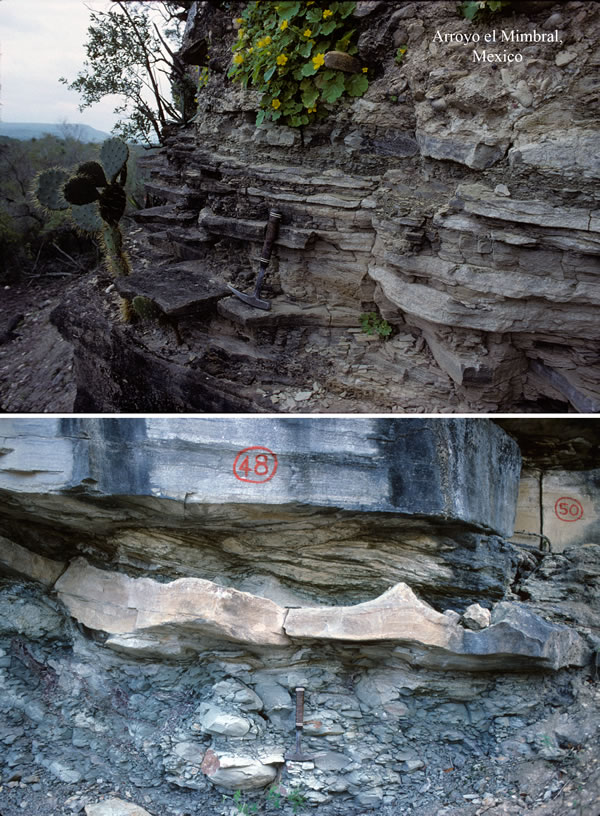
Although there had been a very good chance that the impact had hit oceanic crust that had since been subducted back into the mantle, the crater was actually recognized in 1990s. It is in the Yucatán Peninsula of Mexico. It is not visible from the surface except by radar scanning, because it is covered by 300-1000 m of Cenozoic sediments. But cores drilled during petroleum exploration had found a disrupted and melted layer right around the K/Pg boundary; with the publishing of Alvarez paper and subsequent search for evidence to test their hypothesis, these cores were re-examined and re-interpreted as being from a crater. Seismic and gravity scanning revealed the presence of a 180-km diameter crater, exactly the right size for hypothesized impactor. There are even sinkholes (cenotes) in the rock above that trace out the disrupted layer, because groundwater in the limestone preferentially drains down into the crustal fractures. The crater is named Chicxulub after a town near the first core where the disruption was recognized.

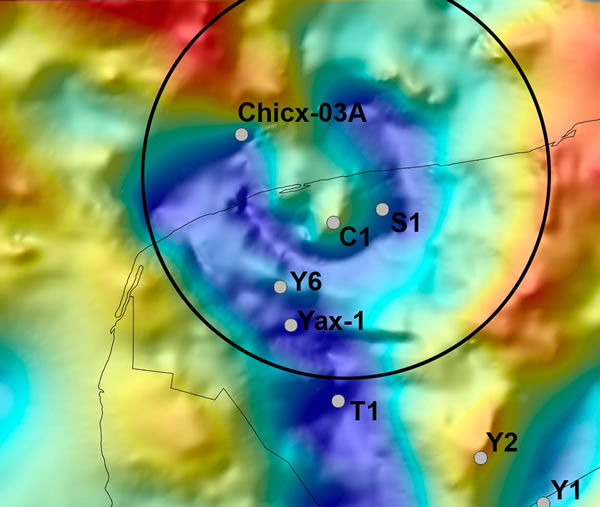

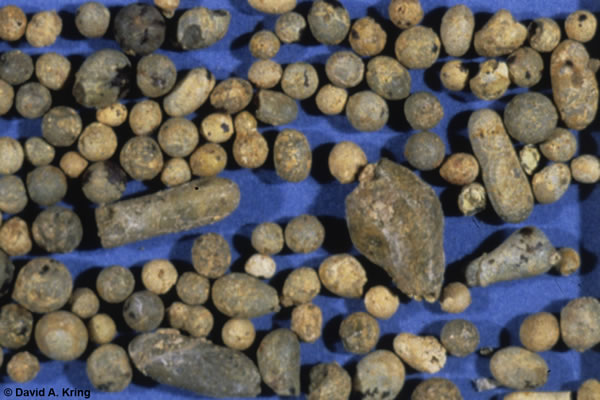
Between the initial Alvarez paper and the discovery of the crater, several proxies of the impact beyond the iridium spike were recognized. These include:
- Shocked quartz: grains of the common mineral quartz found with fracture planes within its crystalline structure. A volcanic blast might make a single direction of shock planes, but impacts and nuclear blasts produce multiple shock planes in the same crystal, and that is what is found in the K/Pg shocked quartz. More than 100 sites worldwide have shown these deposits.
- Melt Glass (Tektites): Debris that is blasted out of the atmosphere can melt as it re-enters, chilling into a glass when it reaches cooler temperature. These melt glass spherules and droplets are found in many locations around the world.
- Tsunami and Ejecta Deposits: The blast wave from the impact sent out tsunamis in the ocean. Similarly, ejecta (material thrown sideways rather than up and out of the atmosphere) splashed from the blast. Both of these have distinctive sedimentary structures, and are found at boundary sites particularly in the Western Hemisphere.

The map of the K/Pg sites and the thickness of the disrupted layers form a bullseye around Chicxulub, showing that this rather than some other spot was the source of the blast.

Effects of the Chicxulub Impact
An asteroid impact is a very different kind of causal agent, and its effects are more instantaneous than the other types of mass extinction causes we've explored. (Some of the effects, however, are extended over long periods.) Here is what we have reconstructed so far.
Phase I (the same day): Shockwave and Tsunami
A magnitude 10.1 to 11.3(!) earthquake would be expected from this blast. In the modern world this would likely topple buildings all over the planet; in a Cretaceous world it might be very disruptive to forests and cause landslides (and make dinosaurs fall over...), but wouldn't be a primary killing agent. A shockwave of hurricane-force winds would spread over southern North America and northern South America would also be locally dangerous, and the energy flash from the impact would incinerate everything in line-of-sight, but again these are not mass extinction-causers. A tsunami of 100-250 m would surge out, but again while regionally disruptive would not bring an era to an end.
Phase II (later the same day) "Easy Bake Oven" and the Canopy Collapse
However, other events of that first day would be globally catastrophic. Infalling material would mostly burn up in the atmosphere. Your average meteor doesn't put out much heat, but so much infalling material generates substantial infrared radiation. This heat raises air temperature by only about 10C° (18F°), but would be fully absorbed by rock, leaf, flesh, and any other opaque material. It is predicted that the increase in infrared radiation would be 8-10x that of high noon at the hottest spot of the Earth, and persist for many minutes to hours. Living tissue would bake, unless underground 10 or more cm (heat wouldn't have time to make it that deeper) or underwater (upper few microns of water might boil off, but that would be it). I have nicknamed this the "Easy Bake Oven" effect, and may be the reason that no land animal larger than 5 kg seems to have survived.
Related to this, some of the material WOULD make it down to surface, and seems to have sparked off global forest fires. This is called the canopy collapse, and is shown by an increase of soot and charcoal and by an increase of fern spores (the fern spike in sediments post-impact. (Ferns are excellent at recovering from periods of forest fires.)
Phase III (the first decade or so): Impact Winter
Material vaporized by the impact is kicked up into the stratosphere, blocking insolation. This was the primary killing agent suggested by the Alvarez team. Probes on Mars show big temperature drops when fine particles are spread to the high atmosphere. And in human history, the eruption of Tambora in Indonesia in 1815 produced chilling effects worldwide for more than a year later; later eruptions, such as the 1991 eruption of Mount Pinatubo, while not as severe, were better studied and analyzed.
Estimates of duration of the Impact Winter have varied from a year or so to a few months to just a few weeks, but a model published in January 2017 puts a duration for a 26°C (46.8°F) temperature drop in global surface temperature for 3-16 years and a greater than 30 year duration until recovery! Recovery on land goes much more quickly (basically once the skies are clear), but some deep-water sites show the cooling required 10 kyr to recover.
Phase IV (100 kyr or so): Greenhouse Warming
The impact site was covered by carbonate rocks; when you oxidize carbonate rocks, you release CO2 (this is the same as when limestone is converted into cement). The Deccan Traps already released enough CO2 to raise the atmosphere from ~500 to 1400 ppm; the new addition brought it up to 2300 ppm or so. Once the dust was cleared the full effect of the greenhouse gases could be in play. Recent studies show a warming of 5C° in the shallow ocean for 100 kyr; air temperature warming might be between 4.3 and 13.5C°C (average of 7.5°C). See the discussions of the P/Tr and the PETM a few lectures ago about the effects of this on the living world.
General Patterns of the K/Pg Extinction
In the marine realm, plankton (including the larval ammonoids) and nekton suffer worse than benthos. Photosynthesizers, and the creatures that feed on them directly (and those that fed on THEM directly) suffer worse than bottom feeders (which eat food "stored" in sediment). Groups with symbiotic algae also suffer strongly. Among marine vertebrates, larger ones in the open seas suffer worse than those on the coast, and those with higher metabolic rates worse than those with lower ones.
(Note: the basic pattern is the exact opposite of the P/Tr, where the benthos got clobbered relative to nektonic and planktonic forms.)
In the terrestrial realm, freshwater animals and those that feed on the water ecosystem tended to do better than those which fed on land. Larger animals and medium-sized animals with high metabolic rates suffer worse than small animals and medium-sized animals with low metabolic rates.
For the terrestrial realm, it seems that "Easy Bake Oven" is the primary selective filter, with the Impact Winter taking out some survivors and the Greenhouse Summer even more. For the marine realm the "Easy Bake Oven" is likely not a factor, but the Impact Winter is the dominant selective force.
The pattern of extinction looks like it was global and essentially instantaneous: hours to days to months to a few years. This suggests that the Chicxulub impact is by far the major causal agent. But all three events (Chicxulub impact, Deccan Traps volcanism, Maastrichtian Regression) are known to occur, so the earlier scenarios may have destabilized the ecosystems to some degree.
Lessons Learned from the K/Pg Mass Extinction
Throughout the course we've asked (and will continue to ask) the question "What Good is the Fossil Record?" We previously saw that the fossil record gives us insight as to how climates form, and how the rapid introduction of greenhouse gases can disrupt global ecosystems (as in the PETM). We've seen that the fossil record is our only evidence of mass extinctions: the reality that when environments change too quickly and intensely that global ecosystems can collapse, taking millions of years to recover.
But the K/Pg mass extinction taught scientists two major lessons, often learned and studied by the same teams who initially examined the K/Pg event itself:
- Realizing the potential catastrophes produced by asteroid impacts (after all, even a 1-km impactor would cause a natural disaster far surpassing anything in human history), NASA and other space agencies have been mapping the asteroids whose orbits could potentially bring them into collision with Earth, and have debated different strategies to deal with such a threat should it be identified.
- Realizing the disruption produced by impact winter, some of the same research groups began to model the effect of nuclear war. While most policy makers in the 1970s and early 1980s assumed that the main damage of nuclear war would be the destruction of cities and other targets and the radioactive fallout from these blasts, climate modelers showed that ten times or more as many people would die from nuclear winter. Nuclear winter is essentially human-generated impact winter: the uncontrolled burning of cities and other targets releases soot into the stratosphere, where it blocks out insolation and plunges the Earth into prolonged darkness. It need not be a full exchange of weapons between America and Russia to produce this; even limited nuclear war between India and Pakistan involving only 50-100 bombs was shown to be sufficient to produce a nuclear winter so cold that the crop-producing regions of the Northern Hemisphere would be below freezing for multiple years (and thus bringing mass starvation and the deaths of billions).
- It's worth noting that after the first round of nuclear winter studies both the US and the USSR decreased their nuclear arsenals down from the record levels of the mid-1980s. In later interviews leaders from these nations both admitted that the scientific studies of the scale of devastation from nuclear winter was a key item in their decisions.
So understanding the world-ending catastrophes of the ancient world can help us plan to prevent them in the future.
Some Relevant Videos