HONR 259C "Fearfully Great Lizards": Topics in Dinosaur Research
Spring Semester 2007
Introduction to the Course; "Fearfully Great Lizards" and the Discovery of the Dinosaurs
Review course policies,
syllabus.
Paleontology, the study of ancient life and their remains (fossils).
Fossils (from Latin fossilium "that which is dug up") are the physical
remains of past life and its activities preserved in the rock record.
Vertebrate Paleontology, the study of ancient backboned animals, including dinosaurs
Dinosaur fossils have been found in Mesozoic Era rocks from every continent, including Antarctica.
Types of dinosaur fossils:
- Isolated bones and teeth
- Skeletons, in varying degrees of completeness
- Footprints and trackways
- Skin impressions and Feathers
- Mineralized soft tissue (muscles, intestines, possible heart)
- Eggs (some with embryos) and nests
- Coprolites (fossilized feces)
Webnotes on history of dinosaur discoveries.
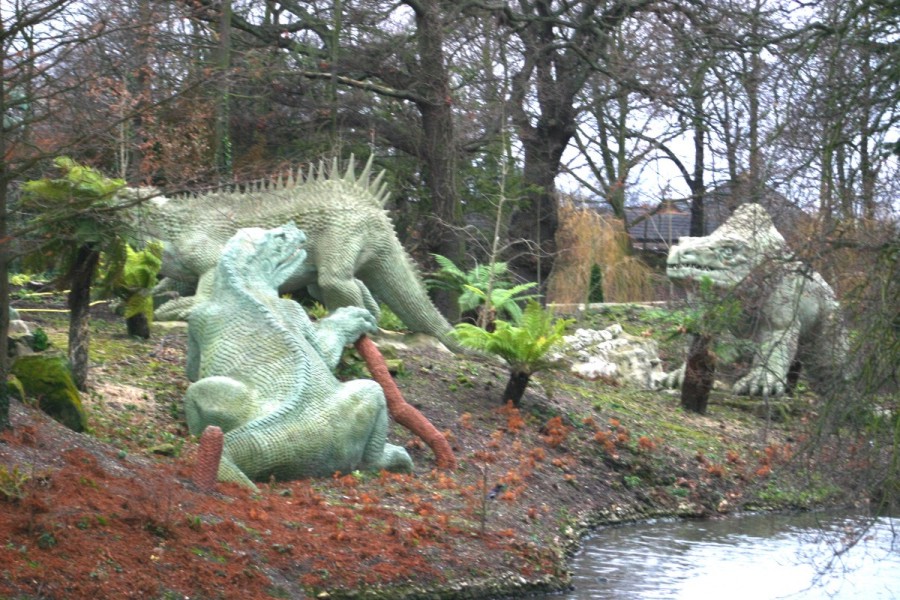
A current photos of the Crystal Palace dinosaurs.
The word "Dinosauria" (and hence "dinosaur") was coined in 1842 by Sir Richard
Owen:
- Greek deinos "fearfully great" (i.e., not just big, but SCARY BIG!), and sauros "lizard"
- Note: hundreds of books to the contrary, Owen did not say Dinosauria meant
"terrible lizard"
Owen recognized 3 different dinosaurs:
- carnivorous Megalosaurus
- herbivorous Iguanodon
- armored Hylaeosaurus
Saw that they were different from other fossil (and modern) reptiles because of:
- upright limbs
- extra hip vertebrae
- and a few other skeletal features
Dinosauria is now recognized as a single major group of organisms, all descendants of a
common ancestor (a concestor).
Modern Definition of Dinosauria:
The concestor (most recent common ancestor) of Megalosaurus and
Iguanodon and all of its descendants
Last modified: 12 January 2007
To Next Lecture.
To Syllabus.