
Key Points
- In order for fossils to be part of our scientific database, they need to be collected from the field and stored and studied in a collection.
- Discovery of fossils in the field requires actively searching likely deposits and careful excavation of bones.
- Steps must be taken to recover the fossils and get them safely to a collection.
- In a museum specimens are prepared: sediment is removed and the bones protected.
- The majority of fossil specimens accessioned into a collection are intended for research purposes, and are not shown on display to the public.
- If the specimens are intended for display, preparation often involves restoring missing fragments of a bone. If they are intended to be mounted as a skeleton, missing bones must be created (by mirror-imaging bones from the other side, or by duplicating from other individuals) and an armature framework constructed to support the whole structure.
Step 1: Finding the Fossils (Prospecting)
In order for a fossil to be useful in paleontology, we have to know it exists! That means someone has to find it in the field, recover it, and bring it back to a lab or museum for description and study.
Many fossils are discovered purely by accident, by individuals not looking for fossils at all. They are found by people digging foundations for buildings, or quarrying rocks, and then brought to the attention of scientists. However, for the most part paleontologists actively seek out new specimens. These might be elaborate expeditions, short day trips, or any scale in between. The team might be a few individuals, to a dozen, to many hundreds (although the latter cases tend to have been rare in history.) (One important aspect, though, is that one should never go out in the field alone (or at least out of communication!)
In order to find dinosaur fossils, you have to go to rocks of the right geologic age and depositional environment. (Some dinosaur specimens do wind up in marine units, but these are relatively scarce. It is more cost effective to have people come across these by accident (or possibly searching for marine fossils) than to organize dinosaur fossil hunting expeditions aimed at marine formations.
While in the field, prospecting works by walking the hills of the badlands and looking for fragments of bones and teeth weathering out of the sediment. Normally you don't immediately find a bone sticking out of the ground: instead, one looks for a trail of fragments weathering out of the hillside, then trace them up to the layer in which they are coming.
If you determine a layer in which fossils are preserved, you move from prospecting to excavating.
Step 2: Getting the Fossils Out of the Sediment (Excavating)
When you come across a layer with fossils, it is unlikely that it is the current surface of the ground. (In fact, if that were the case, the fossils would have weathered into fragments!) So some degree of removal of the sediment above the fossil layer (the overburden) has to be done. Depending on the geometry of the situation, this might involve geologic hammers, picks, shovels, pneumatic drills, jackhammers, backhoes, or (in the old days) dynamite. Ideally one wants to expose a broad surface parallel to the bedding plane with the specimens.
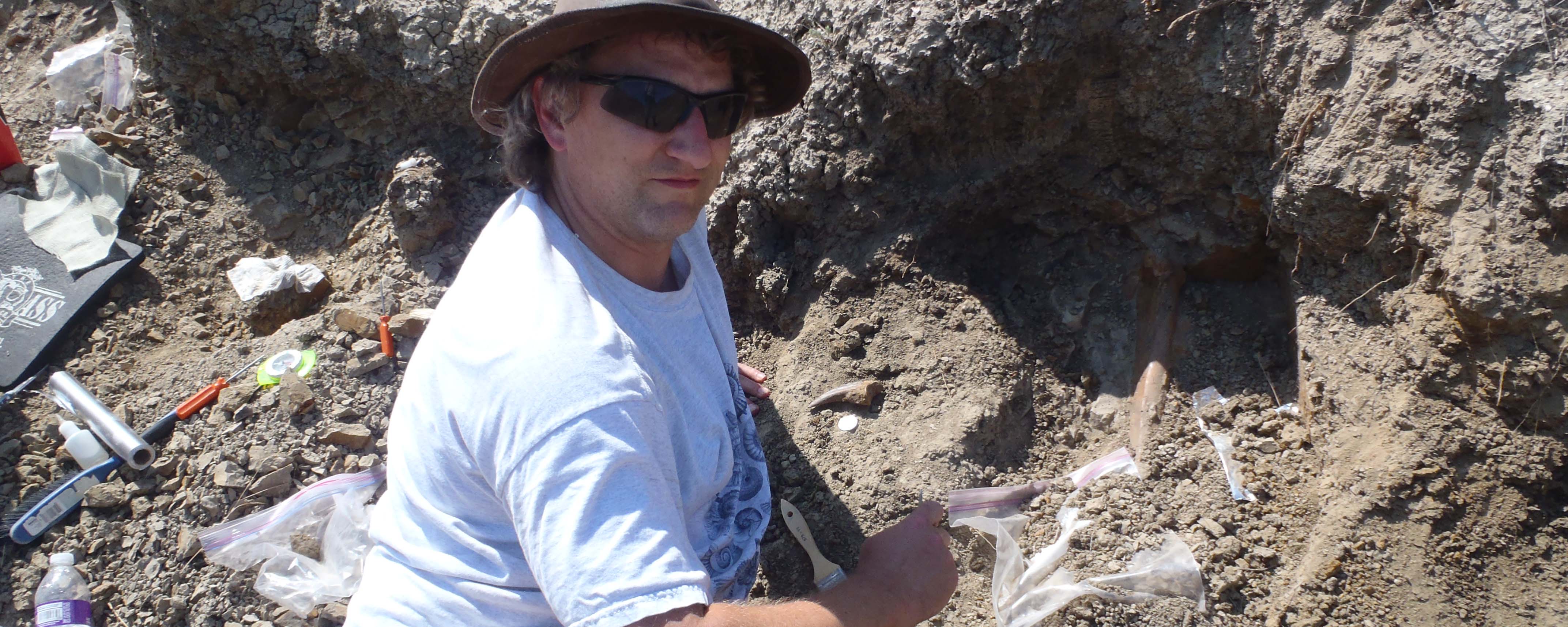
Once the area immediately above the fossil is exposed, the team will dig downward onto the fossil layer. ("Digging" here really should be "scraping": when you are close to the bones you use awls and dental picks, not shovels and rock hammers, for fear of obliterating the very specimens you want to collect.) Each person on the team works in their own part of the quarry, working downward to expose the upper part of the bones (if any) they come across.
As bones are exposed, they need to be protected. Permineralized bone may be dense, but it is fragile and subject to shattering. Often a consolident (generally some plastic mixed with acetone) is "painted" or dripped onto the specimen: the mixture penetrates the fossil and enters the pore space, then the plastic is left behind as the acetone quickly evaporates. This helps to hold the specimen together and makes it more resilient.
The quarry site is mapped as the bone layer is exposed. This information is important to help reconstruct the taphonomic setting of the layer, which will help in reconstruction what happened to the bones between the death of the individual(s) and their burial. If nothing else, it is important to figure out which bones go with which individuals!
Step 3: Jacketing & Return to the Museum
Smaller bones and teeth might be wrapped up with paper towels and/or foil, requiring no additional protection. These can be carried back to the field vehicle as is. But larger bones--or sets of bones still in articulation--require special care. A very standard technique in field paleontology is jacketing. The upper surface of the bone is exposed, then a short margin of sediment around the bone is traced. The field workers move downwards until the bone is on top of a short pillar of sediment. When they are underneath the bone layer, the whole area is cleaned off. Some sort of separator (in the 19th Century it was wet rice paper, but for the last century or more the go-to material has been wet toilet paper) is put on to cover the surface, then a layer or two of plaster and burlap is laid over this and left to dry. The team then undercuts the pillar and as carefully as possible (often praying to Lethaia, the goddess of field paleontology, or any other imaginary supernatural help they can think of) tip the pillar over and hope that the whole block doesn't fall apart. On the newly-exposed undersurface the work starts again, carefully working the way down to close to the bone layer. A new cover of separator and plaster is put on the lower side, so that the whole bone and some surrounding sediment is jacketed. These jacketed blocks (whose positions should have been carefully mapped up at the beginning of the process) then can be carried back to the vehicles.
As a field season (running from a week or two to most of the summer, but normally around a month) progresses, it is almost certainly the case that many individual sites and quarries will be worked by a team. All the appropriate data has to be collected for each site: its sedimentology, sedimentary structures, statigraphic level, specimen maps, etc. All specimens have to be carefully labels so which site they are from and where in the site they come from can be reconstructed.
At the end of a field season the specimens need to be shipped back to the museum in which they will be studied. By muscle power (or sledge or helicopter) the bags or bones and jackets are moved to the off-road vehicles, then driven back (or shipped via some other transport) to a lab.
Step 4: Preparation
Back at a laboratory the field specimens need to be prepared before they can be stored and studied. Some require very little work: often teeth need very little cleaning or repairs, for instance. But in many cases there is a substantial amount of work required, done by a special group of technical paleontologists called preparators.
Specimens in jackets can be stored in these until they are ready for preparation. (In fact, there are jackets from the 19th Century Yale field expeditions still unopened in the collections of the Peabody Museum!) But since most paleontologists actually want to study the bones that they found, jacketed specimens need to be removed from their jackets. This is done in a preparation lab. These have appropriate tables, lighting, HVAC and other air handling equipment, and especially cutting, drilling, and scribing devices. Preparators carefully open the jacket and excavate the bones from the sediment. They will often be applying special consolidents and other protectors on it the bone.
There may be more serious repairs required: gluing together broken pieces, for instance. Larger specimens need a new sort of jacket: a storage jacket, to protect them while they are in cabinets and shelves.
Step 5: Cataloging & Accessioning
Every specimen in a museum has to have a record; otherwise they are useless as data. So museums have catalogues listing each specimen, its identity, the site and formation it was from, who found it and when, etc. This process is called accessioning, and is the way a bone or tooth makes its way into the scientific record.
Museums behind the scenes have collection rooms where fossils are stacked on shelves or in cabinets. A staff of collection managers is responsible for maintaining these, and making them accessible to visiting researchers. (Despite common thoughts to the contrary, this is a different job than curator, which is normally a research-oriented position.)
[Optional] Step 6: Restoration & Mounting
The vast majority of fossils in any museum will mostly be in storage, and be worked on by researchers but not seen by the general public. But a number of skeletons and other specimens might be selected for public display. These are chosen for a number of reason: most importantly how impressive they might be and how they might be incorporated thematically into a larger exhibit.
Complete fossil skeletons are vanishing rare, however, especially for larger species. Broken bones need to be repaired, for instance, and missing bones need to be replaced. In the case of missing bones, they might be sculpted (or today, 3D printed) by mirror-imaging the same bone from the opposite side of the body. In other cases it might be replaced by the same bone from another individual (but care must be taken to make sure the proportions are appropriate for the main skeleton). Some museums make it clear (by color, for instance) which parts of a restored fossil are real, and which are filled in; in others, though, it is hard to tell.
The bones are arranged on an armature to hold them together (since skeletons do not stand up by themselves!) Museum technicians these days construct such armatures to allow individual bones to be removed and studied, but in the older times they would actually drill right through the bones and run metal piping through them! As a consequence, older museums often have programs trying to repair and restore fossil displays from the 19th and 20th Centuries. This is a long and costly process, though, so in some cases the old-style mounted skeletons remain as-is.
Not every fossil skeleton on display at a museum is actually the "real" thing, though. Many museums have at least some skeletons which are entirely casts, based on specimens at other museums. However, claims that museums are trying to dupe people are totally unfounded: simply reading the museum display sign for that specimen should make it clear if it is the original or a cast!!
A relevant video