Key Points
- Fossils as the remains of extinct species were only fully recognized as such in the late 1700s.
- In the last years of the 18th Century fossil marine reptiles (mosasaurs, ichthyosaurs, plesiosaurs) and flying reptiles (pterodactyls) had been recognized, but no fully terrestrial forms.
- In the early 19th Century fossils of giant land reptiles--carnivorous Megalosaurus, herbivorous Iguanodon, and armored Hylaeosaurus--were discovered in southern England. In 1842 Sir Richard Owen recognized these as form distinct group of reptile, which he termed "Dinosauria" (Latinized Greek for "fearfully great lizards").
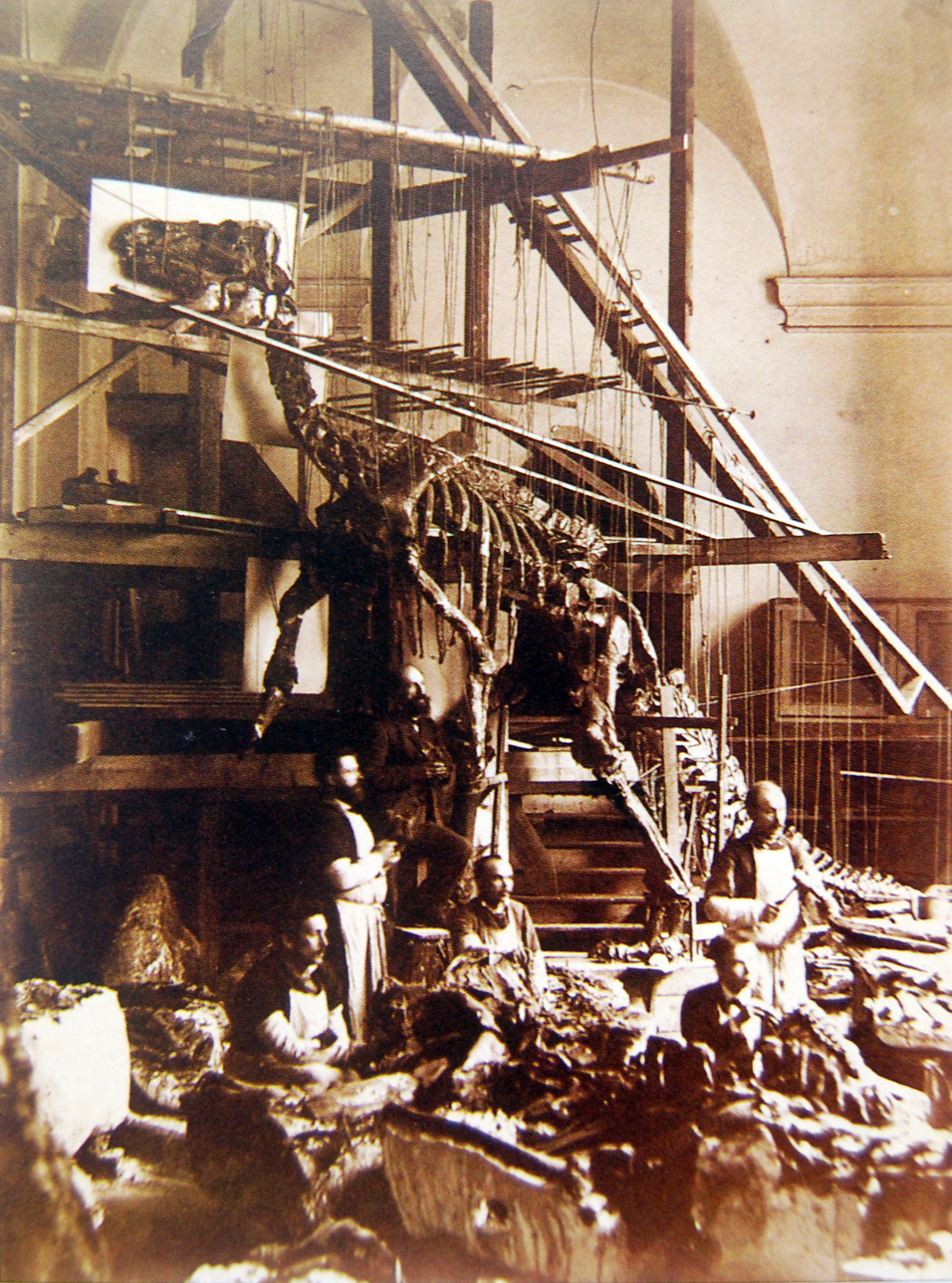
- The initial dinosaur fossils were very fragmentary. Subsequent discoveries (in England, on the European mainland, and most especially in the United States) revealed better, more complete skeletons, documenting that dinosaurs were a diverse group with very distinctive anatomy.
- In the later 19th and early 20th Centuries expeditions around the world greatly increased our knowledge of dinosaurs.
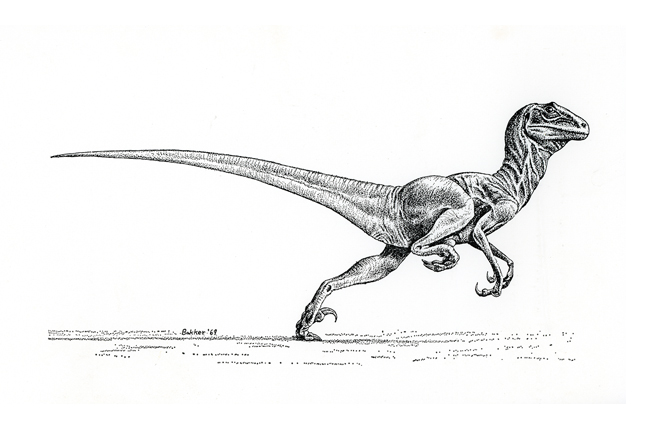
- After a great slowdown of research in the middle of the 20th Century, the work of John Ostrom sparked a "Dinosaur Renaissance", in which dinosaur evolution, biology, physiology, growth, behavior, and extinction became major fields of study.
The Meaning of Fossils
Fossils (remains of once-living things and traces of their behavior preserved in the rock record) have been known since before humans had evolved into modern humans, but their origins were obscure. Some considered them what they really are--fossil shells were once shells, fossil leaves were once leaves, fossil bones were once bones--but others considered various other alternatives. Perhaps they were unusual crystals, or traces of an incomplete creation, or made by the Devil to confuse us.
A key hindrance to understanding fossils is that you first have to understand rocks and how they form. Although some earlier thinkers' speculations came close to the truth, it wasn't until the 17th and 18th Centuries that a combination of field observations and laboratory work found the answer: rocks were recycled bits of previously existing rocks, and that different pathways (melting and cooling; recrystallization; or fragmentation and reassembly) produced different types of rocks. It was in this last pathway (what would be called sedimentary rocks) that fossils would be found.
17th Century naturalists such as Nicolas Steno, Robert Hooke, and John Ray discovered that fossils had once been parts of living things that had died. Their remains were buried in sand, silt, or mud, and that this sediment later was transformed into rock.
18th-early 19th Century naturalists such as Jean-Baptiste Pierre Antoine de Monet, Chevalier de Lamarck, Georges-Louis Leclerc, Comte de Buffon and (most especially) Jean Léopold Nicolas Frédéric Cuvier established the science of comparative anatomy. With access to the large and growing collections of modern and fossil specimens of animals and plants, they were able to describe the particular features of each species. Given this database, Cuvier was able to establish that at least some of the fossils being discovered were not any known living species, but instead must be extinct.
Cuvier and colleagues also established that there was not a single "prehistoric age", but that instead different assemblages of fossils were earlier or later than others. For instance, mammoths and mastodons were among the youngest (closest to us in time) of fossils, and that different mammals (more different than any living ones) were found in earlier times.
Among the major sets of discoveries in the late 1700s and early 1800s were a series of giant reptile fossils older than the mammal fossils. These were among the specimens that first helped demonstrate that fossils were in fact remains of extinct creatures, and not simply to bodies of still-extant species. These included the "Great Animal of Maastricht", a giant marine reptile eventually recognized by Cuvier and others as a huge sea lizard, and now named Mosasaurus: the first giant fossil reptile known to Science! Others include the discoveries of fossil collector Mary Anning: fish-like Ichthyosaurus and long-necked Plesiosaurus. In addition to these sea reptiles, there were discoveries of remarkable flying reptiles such as Pterodactylus and Dimorphodon. So it became apparent that before the age in which mammals were the dominant animals, there was an "Age of Reptiles". But so far these discoveries were swimmers and fliers: what lived on land during this age?


"Fearfully Great Lizards"
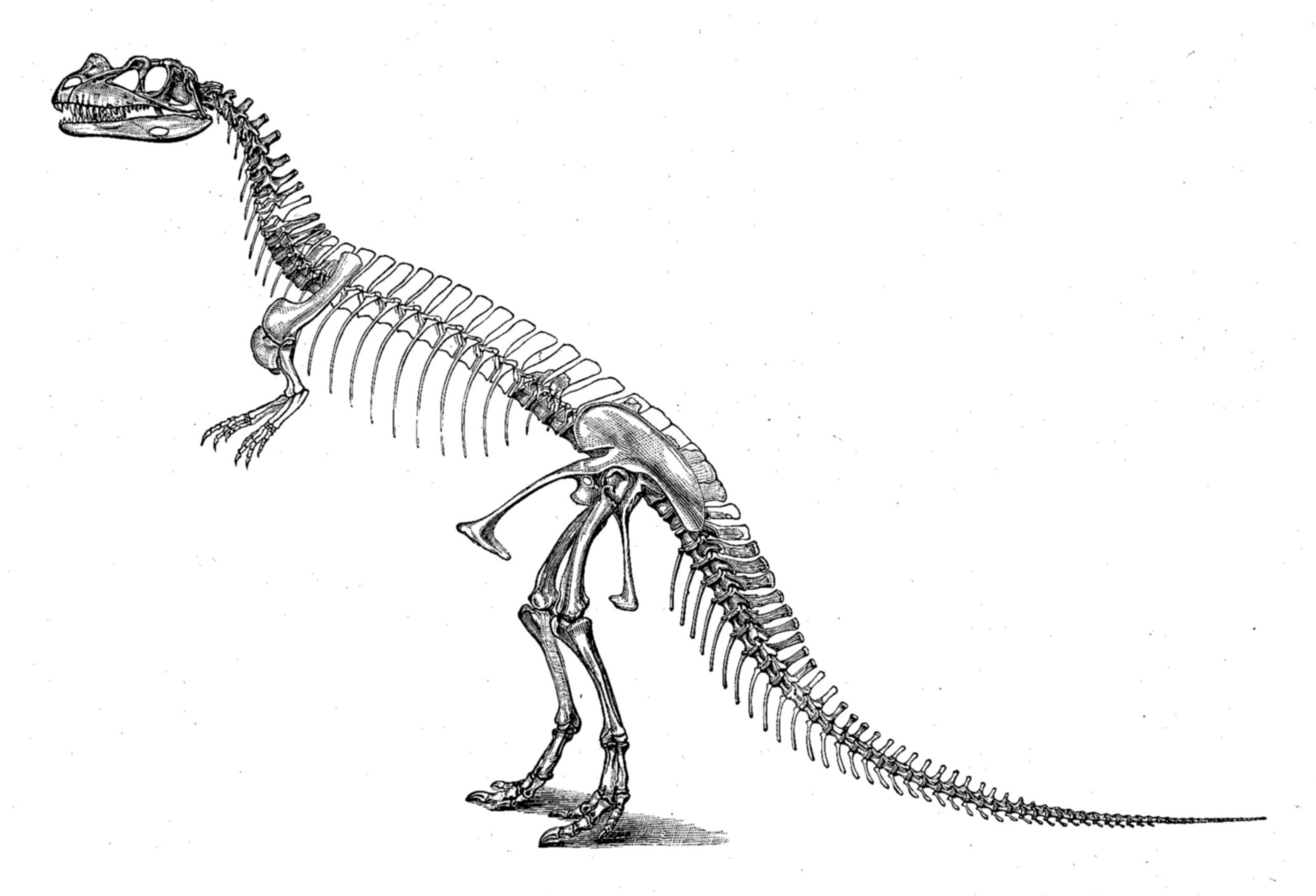
The first major dinosaur discoveries--documenting the large-bodied creatures of the "Age of Reptiles"--were made in Great Britain. The first of these was made by Oxford geologist Reverend William Buckland. Only a few parts were discovered: jaw bones with blade-like teeth as well as some backbones, hip bones, and limb bones. This animal was formally named Megalosaurus ("big lizard") in 1824, and thought to be a giant version of modern monitor lizards.


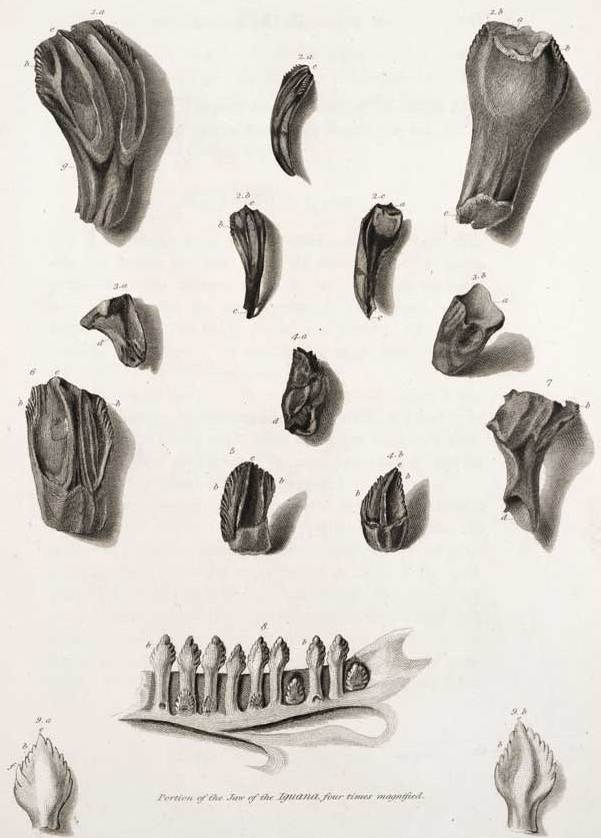
The next major discovery were made in the in the Weald region of southern England, by husband and wife team Dr. Gideon and Mary Ann Mantell. These included teeth were leaf-shaped, reminiscent of the modern Iguana, a primarily herbivorous reptile, as well as limb bones, vertebrae, and so forth. When Gideon Mantell formally described the animal he called it Iguanodon ("iguana tooth"), and imagined it to be an immense version of the iguana.

.jpg)

The third major discovery, also in the Weald region and also by the Mantells, was a partial skeleton with very large spikes were found arranged along the skeleton: the first evidence of giant armored reptiles. Mantell called it Hylaeosaurus ("lizard of the Weald") in 1833.

Other discoveries were made on the European continents in the 1830s and 1840s.
In 1841, Sir Richard Owen gave public talks about the fossil reptiles of Britain. He concluded that Megalosaurus, Iguanodon, and Hylaeosaurus formed their own distinct group, for which proposed the name Dinosauria ("fearfully great lizards") when he wrote up talk (in 1842):
"The combination of such characters, some, as the sacral ones, altogether peculiar among Reptiles, others borrowed, as it were, from groups now distinct from each other, and all manifested by creatures far surpassing in size the largest existing reptiles, will, it be presumed, be deemed sufficient ground for establishing a distinct tribe or sub-order of Saurian Reptiles, for which I would propose the name of Dinosauria."
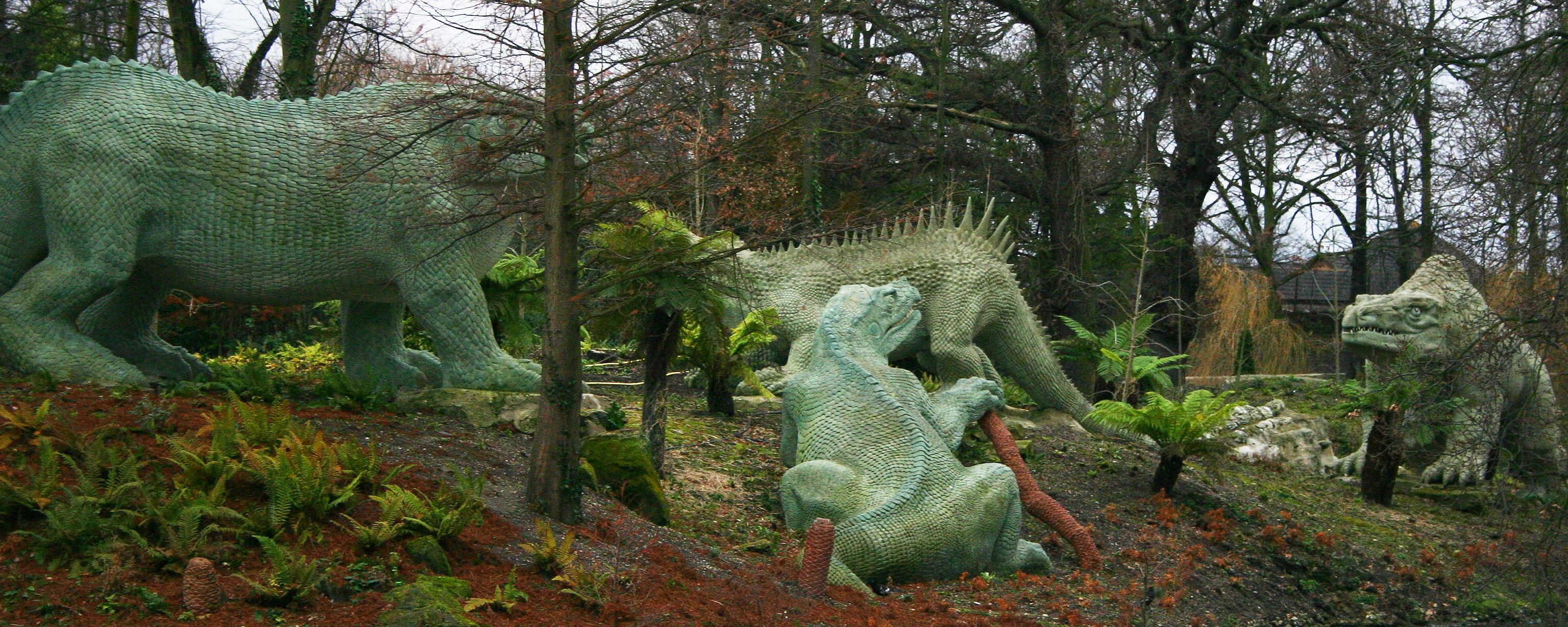
In the 1850s as part of the Great Exhibition (one of the first World's Fairs), natural history artist Benjamin Waterhouse Hawkins sculpted life-sized reconstructions of Megalosaurus, Iguanodon, and Hylaeosaurus (and other non-dinosaurs) under Owen's guidance. (Here is a recent photo of those models.) Because of this (and popular writings) dinosaurs became parts of the general public discourse: in popular science books, in political cartoons, in science fiction writing, etc.
But up until this point, there were still no complete dinosaur skeletons.