
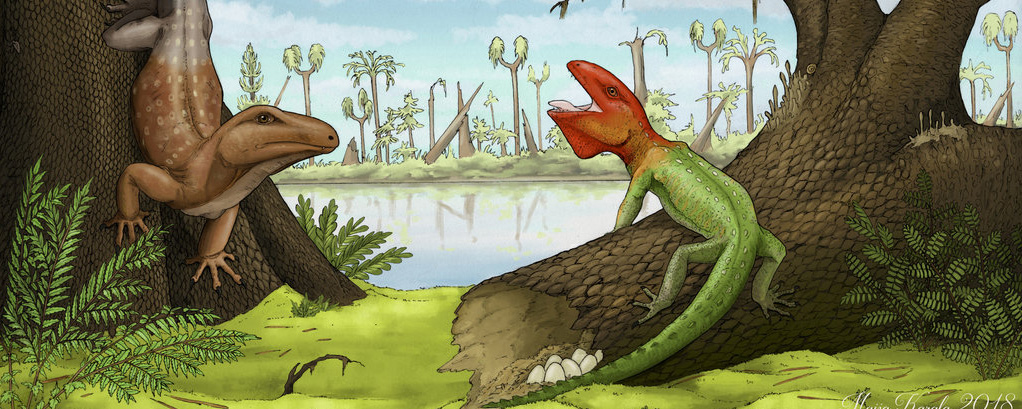
Key Points
- Life emerged in the water, and it took a series of adaptations (defense against gravity and desiccation; new forms of respiration, reproduction, locomotion, and senses; etc.) for taxa to colonize the land.
- Among vertebrates, it was "amphibian"-grade tetrapods which partially made the transition to life on land, but only the amniotes that lived their entire life cycle on land.
- The amniotes had evolved a shelled egg, keratinized skin, and claws (among other traits) which allowed them to be successful at living on land.
- Different groups of amniotes radiated at different times: the first group were the basal members of the Synapsida (the lineage that contains mammals) in the Carboniferous and Early Permian; followed by their descendants (the Therapsida) in the Middle and Late Permian.
The Colonization of Land
Life on Earth first evolved in the seas over 3.5 billion years ago, and even today the majority of living things are aquatic. The terrestrial realm of land and air offers many challenges to organisms adapted to aquatic life:
- Gravity: aquatic life is buoyed by water. Air is not so buoyant! So terrestrial animals have to have some sort of supporting tissue.
- Desiccation: air is drier than water (duh!!), so terrestrial organisms need some form of skin or coat to keep all their precious bodily fluids from leaking out.
- Respiration: aquatic organisms exchange oxygen and carbon dioxide dissolved in water. In air, these substances are gases, so new structures are needed to breathe.
- Reproduction: aquatic organisms often release their eggs, sperm, etc., directly into the water. This approach is much less effective in air, so other solutions evolve.
- Locomotion: aquatic animals can swim, scuttle, squidge, or otherwise move through the water. These motions have to be modified in the terrestrial realm.
- Senses: light, sound, and smell transmit differently in water than in air, and some senses (such as the pressure sense and electric sense) don't work in air at all. Terrestrial animals have to evolve new adaptations to deal with these differences.
The first organisms that spent at least sometime out of water were algae mats along the edges of seas and lakes (which are among the oldest fossils known!) But for over 3 billion years life was essentially limited to the water. By the early Paleozoic Era, the marine realm was as crowded with living things as the modern oceans, but the land was still mostly barren: perhaps some lichens and bacteria, but not much more.
Among the first fully terrestrial organisms were true primitive plants that had colonized land by the Silurian Period (443.1-419.62 Ma). (Some fossils show that they actually had colonized at least by the earlier Ordovician Period, but were apparently not widespread.) The terrestrial world offered the primitive plants mineral resources and plenty of more space (to collect sunlight!) than could be found in the crowded seas.
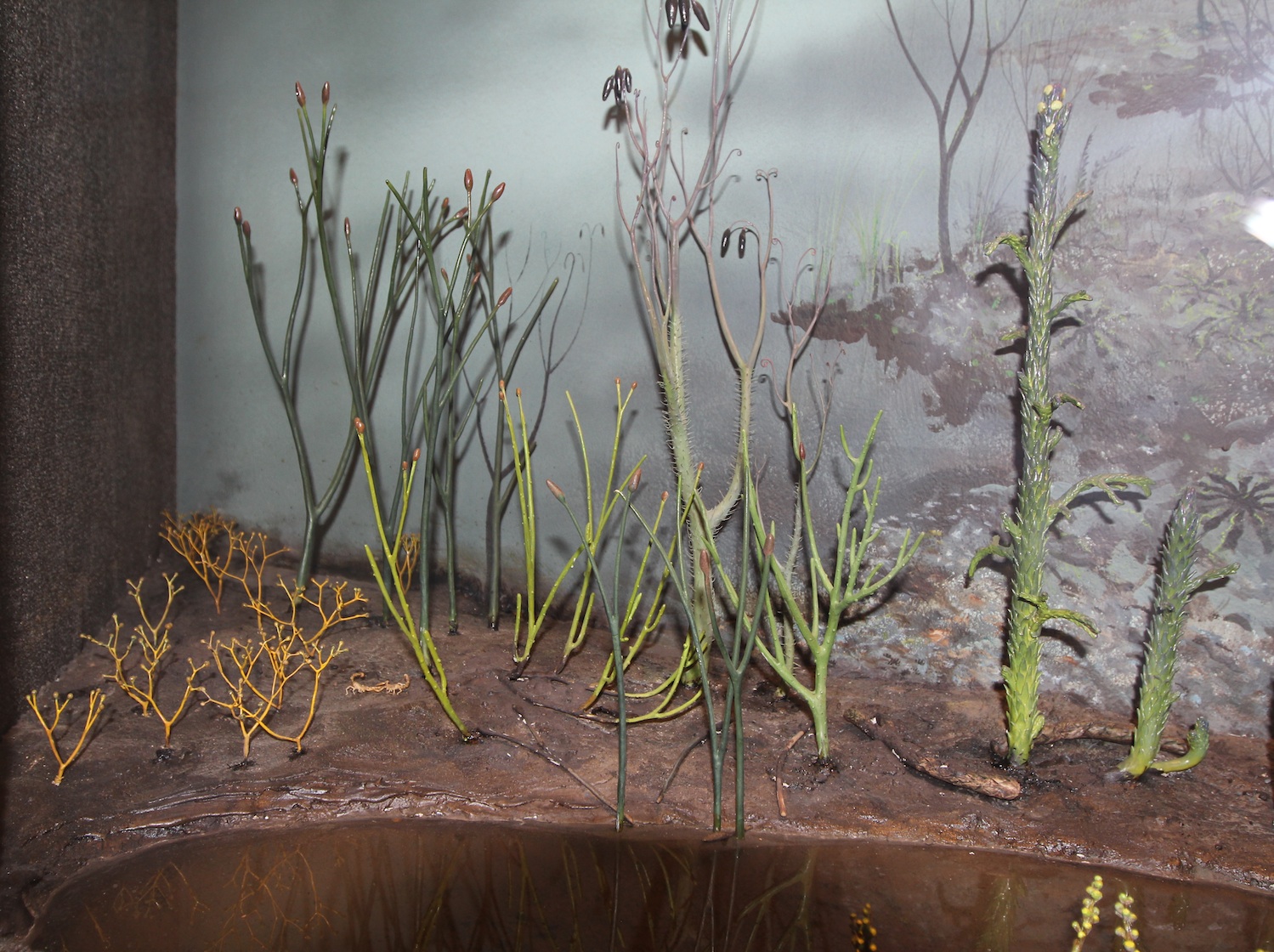
The first terrestrial animals were various types of arthropods (bugs, broadly defined): the ancestors of millipedes and centipedes, the earliest arachnids, and the ancestors of insects were established on land in the Silurian Period. These ate the early plants, and each other.
(Other groups, such as earthworms, other worms, snails, and so on colonized during this time.)
The ancestors of the dinosaurs (and us!) during this time were still entirely aquatic. Primitive vertebrates were all aquatic: in other words, they were fish. ("Fish" is simply the name for all vertebrates that aren't tetrapods; there are many diverse lineages of vertebrates other than the land ones!).
In the early part of the Devonian Period (419.62-358.86 Ma), the fish continued to diversify. This diversity included many sorts that lived in freshwater.
Freshwater has its own problems compared to sea water, but various types of fish evolved traits to deal with them:
- In lakes, ponds, and swamps the oxygen often gets used up, so fish evolved a lung to gulp air. Various types of modern fish (including a group called "lungfish") still use these lungs to gulp air to breath; in others it has evolved into a swim bladder.
- Freshwater systems can often get choked with logs, weeds, and so forth, so one group of fish (the Sarcopterygii, or lobefins) evolved a series of bones down their fins to give them strength to push along, dig, etc.
- Freshwater bodies are far more likely to dry up than the oceans (duh!), so fish evolved ways to deal with those situations. Some burrowed into the mud and waited for the wet season, but others moved from one dried up pond to another (hopefully less dried up) one. Today there are several sorts of fish that still do this: mudskippers, some eels, some catfish, the snakeheads, etc.
- In the Devonian one branch of lobefins, the stegocephalians, evolved wrists to give them extra "push" and digits (that is, fingers and toes) to give them better purchase.
- Ponds, lakes, and streams can get starved of food resources more easily than the sea, so many freshwater fish capture food from the shores. Devonian stegocephalians may have crawled onto shore to capture food, just as mudskippers and snakeheads do today.
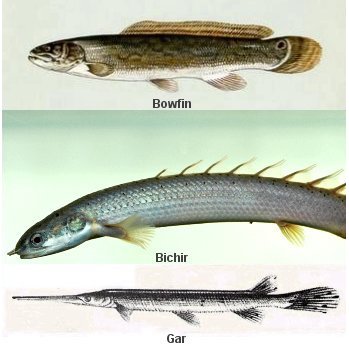
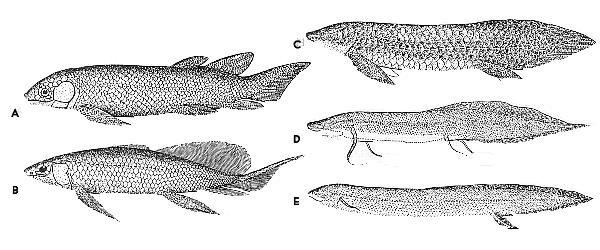

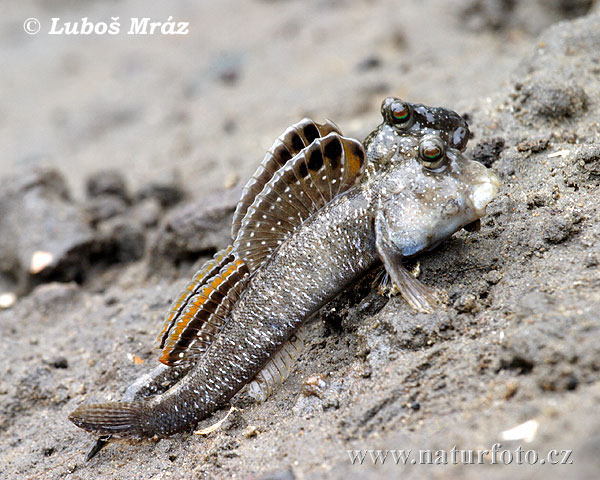

So by the later part of the Devonian Period there were vertebrates which had a bony skeleton to support their bodies; bony limbs with wrists, ankles, and digits to push along on land or on the lakebed; lungs to breath air (but still had gills to breath in the water). (Note that these are all exaptations: they evolved in some other context, but allowed the stegocephalians to move around on land.)
Many of these Late Devonian stegocephalians still lived their lives essentially only in the water (such as Acanthostega), and thus were essentially fish-with-fingers. Others (such as Ichthyostega) may have gotten most of their food from land. It was from these latter sort that the more fully terrestrial vertebrates--the Tetrapoda ("four footed ones"), would evolve.

During the early part of the Carboniferous Period (358.9-298.86 Ma) the early tetrapods became established. Unlike earlier stegocephalians, these had necks (that is, the skull was not attached to the scapula), which allowed them to bend their heads down to capture food on land. Like fish, these early tetrapods still laid their eggs in the water and their young (tadpoles) often had gills. As adults, though, many were more terrestrial.
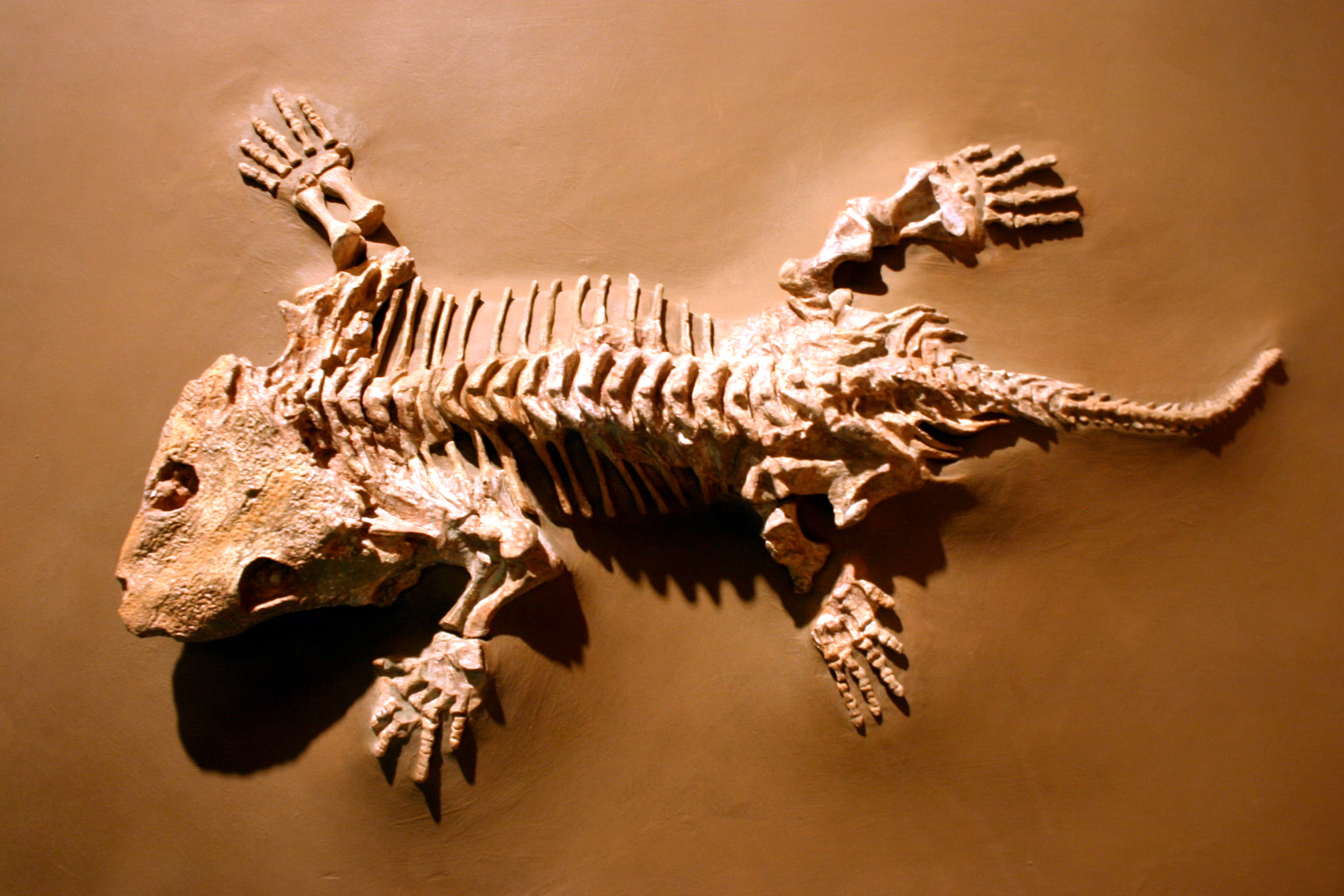
In that way, the early tetrapods were "amphibians" in the broad sense of the term. However, these were often scaly-skinned (like fish), unlike the naked-skinned Lissamphibia (frogs, toads, salamanders, etc.: the modern clade of amphibians). Carboniferous and Permian (298.9-251.902 Ma) Period primitive tetrapods included a great diversity: snake-like forms; primarily aquatic boomerang heads; alligator-like forms; and many others. But even for those forms which spent most of their adult lives on land had to come back to the freshwater to reproduce. While the members of the lineage that contains lissamphibians and those closer to amniotes underwent metamorphosis (where the larvae were sometimes limbless and always aquatic), earlier "amphibians" had larvae that looked just like tiny versions of the adults.
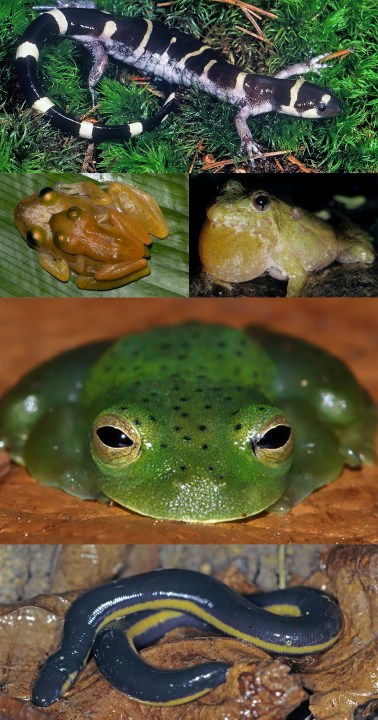

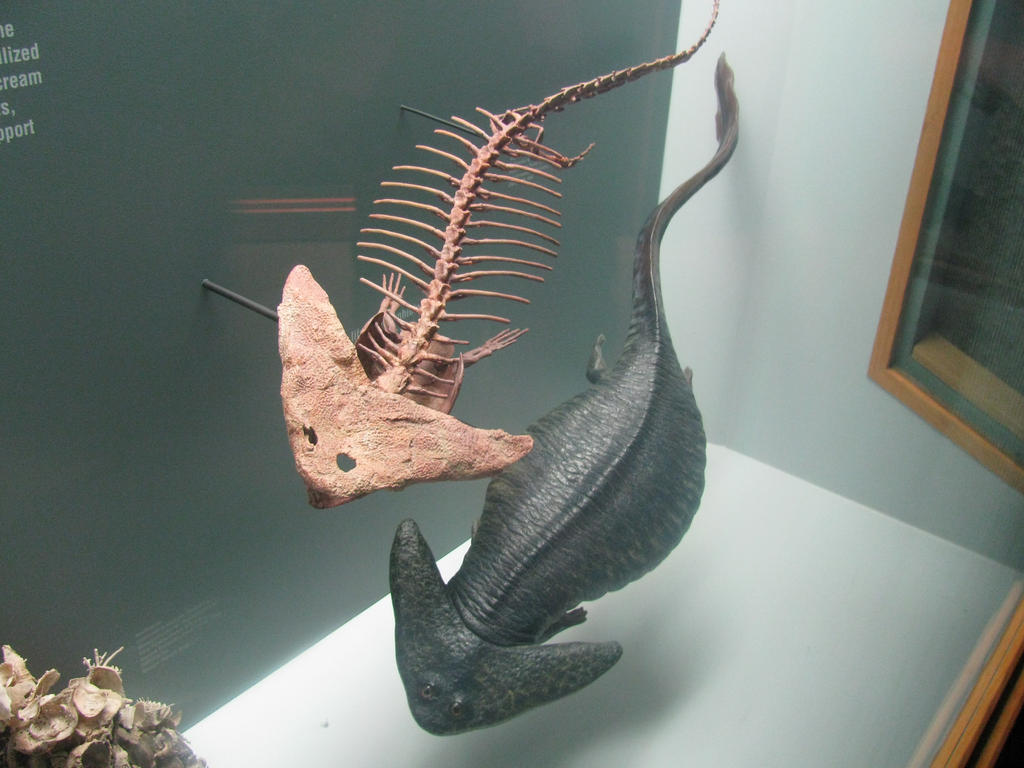

During the Carboniferous, however, one group of tetrapods evolved an adaptation that allowed them to break free of the pond: the amniotic egg. Instead of being a "naked" egg laid in a pond or stream, the amniotic egg had:

- A shell to prevent desiccation (ancestrally it is a leathery, parchment like shell; in some derived forms it is calcified and "crispy")
- A self-contained "pond" (the amnion) in which the embryo grew
- Tissues to deal with gas exchange and waste
In other words, tetrapods were now freed from the water. As such, the tetrapods with an amniotic egg did not have an aquatic larval stage, and so they were terrestrial for their entire life cycle. This adaptation marks the evolution of the most successful clade of tetrapod, the Amniota:
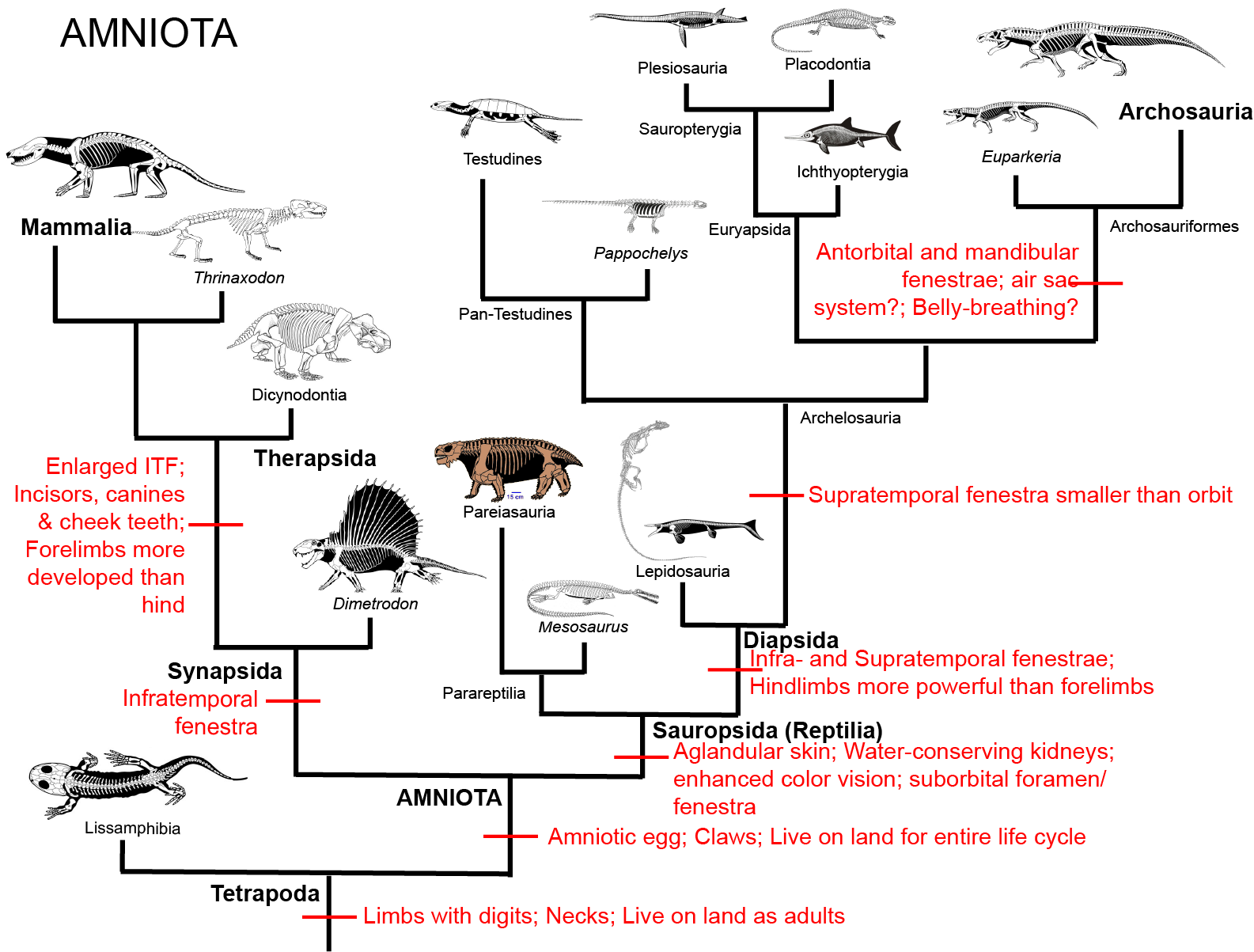
Other than the amniotic egg, amniotes are also characterized by keratinized skin (often organized into scales), keratinized claws and the presence of an infratemporal fenestra. (Well, and a bunch of other traits, too, but we are not going into that level of detail in this 100-level class!)
Life on Land Before the Dinosaurs
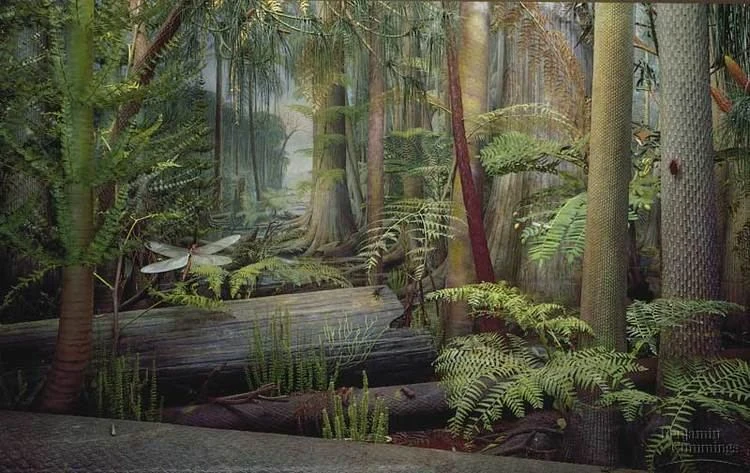
Amniotes first appear in the later Carboniferous Period. At this time, many low-lying parts of the land were covered in vast coal swamps (so called because the buried remains of these swamps make up the majority of the coal deposits of the Northern Hemisphere). While the fish-eating tetrapods stayed near the ponds, the amniotes were free to pursue other prey further onto land. With access to this new environment, the amniotes underwent a series of adaptive radiations.
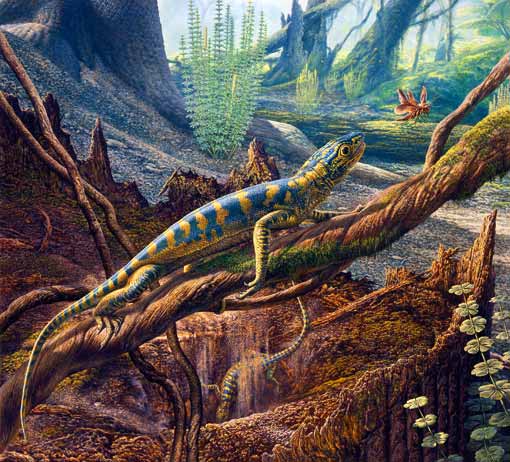
Amniotes divide into two major divisions:
- Synapsida, represented today only by mammals
- Sauropsida ("Reptilia" to some), represented today by turtles, lepidosaurs (lizards [including snakes] and tuataras), crocodylians, and birds
Of course, none of the Carboniferous Period amniotes had yet evolved into these particular modern amniote groups! The named groups all arose during the Mesozoic.
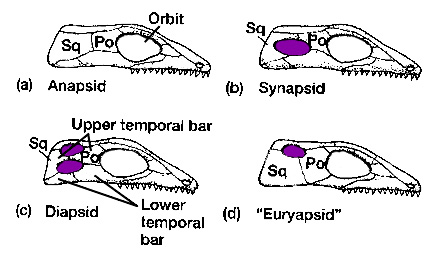
The synapsids were the first group to radiate. The name "synapsid" refers to a condition where the skull had a complete infratemporal fenestra with a lower bar but no supratemporal fenestra. However, it turns out that the "synapsid" skull condition is the basal state for Amniota. There are a bunch of other traits that unite the Synapsida, that these are outside the scope of this class.
During the Early Permian Epoch primitive synapsids radiated into many different forms, including:
- Caseidae, Small-headed, heavily-built herbivores
- Varanopidae, Slender 1- to 2-m long predators
- Ophiacodontidae, Semi-aquatic fish-eaters
- Edaphosauridae, Sail-backed herbivores
- Sphenacodontidae, Sail-backed carnivores with different-sized teeth in different parts of the jaw
- The sails of these latter two may have been used to catch sunlight allowing them to warm up faster than other animals and/or as display structures
- The different-sized teeth of the latter allowed more specialization of food processing: a trait passed onto later synapsids


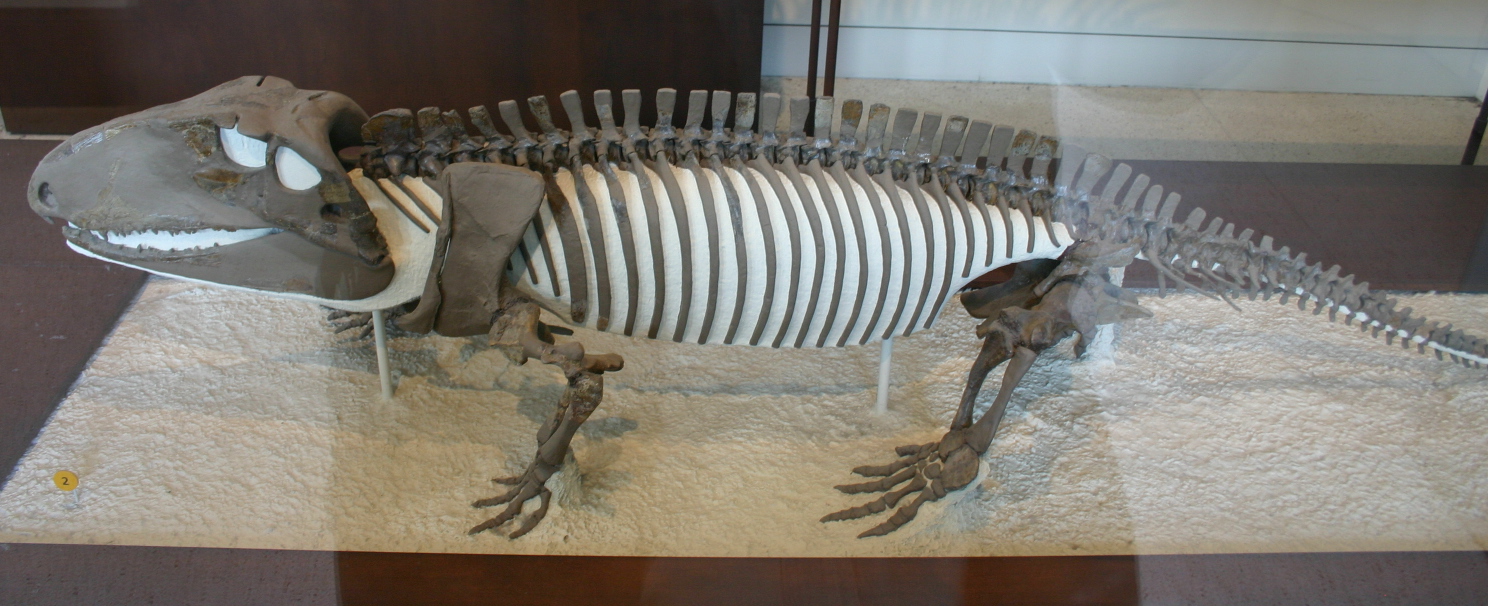
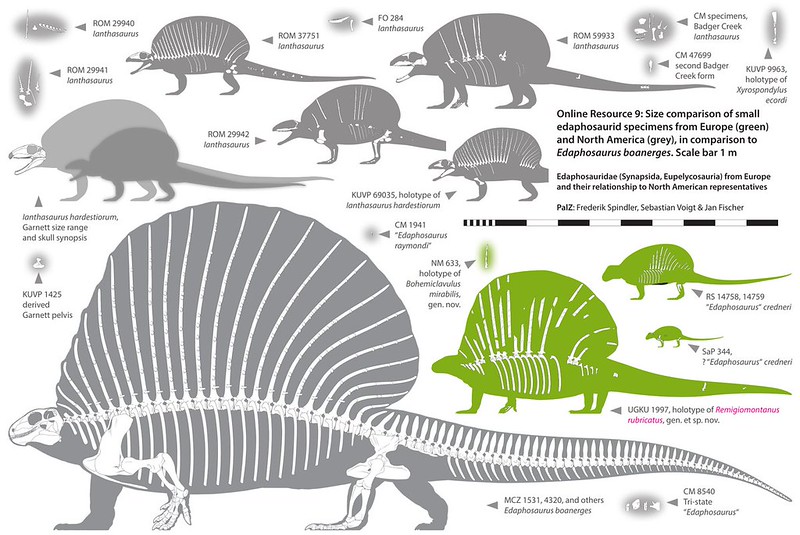

These early synapsids would have had the sprawling stance found in primitive tetrapods in general. They almost certainly would have been "cold-blooded" (the ancestral state for vertebrates). So traditionally these animals have been considered "reptiles". However, they lack the shared derived features of reptiles (see below), and are instead simply primitive synapsids. (In traditional taxonomy, these were put in the group "Pelycosauria", but this is a paraphyletic group: all synapsids except for therapsids). New discoveries show that even early synapsids had some parental care.
The early synapsids evolved themselves into extinction: that is, they were replaced in the Middle and Late Permian Epoch by the Therapsida: the advanced synapsids. Once called the "mammal-like reptiles", they are not true reptiles. Instead, they are the advanced branch of the synapsid phylogeny. They differed from earlier synapsids by:
- Greatly expanded infratemporal fenestra
- Teeth divided into nipping incisors, biting canines, and grinding cheek teeth
- Forelimbs more powerfully developed than hindlimbs
The Middle and Late Permian therapsids included:
- Dinocephalia, Large slow-moving herbivores and carnivores of the Middle Permian
- Gorgonopsia, the apex predators of the Late Permian
- Dicynodontia, the extraordinarily successful beaked, two-tusked burrowing omnivores and herbivores (which would persist well into the Triassic)
- and the oldest Cynodontia, initially smaller specialized carnivores and omnivores which eventually produced the mammals.
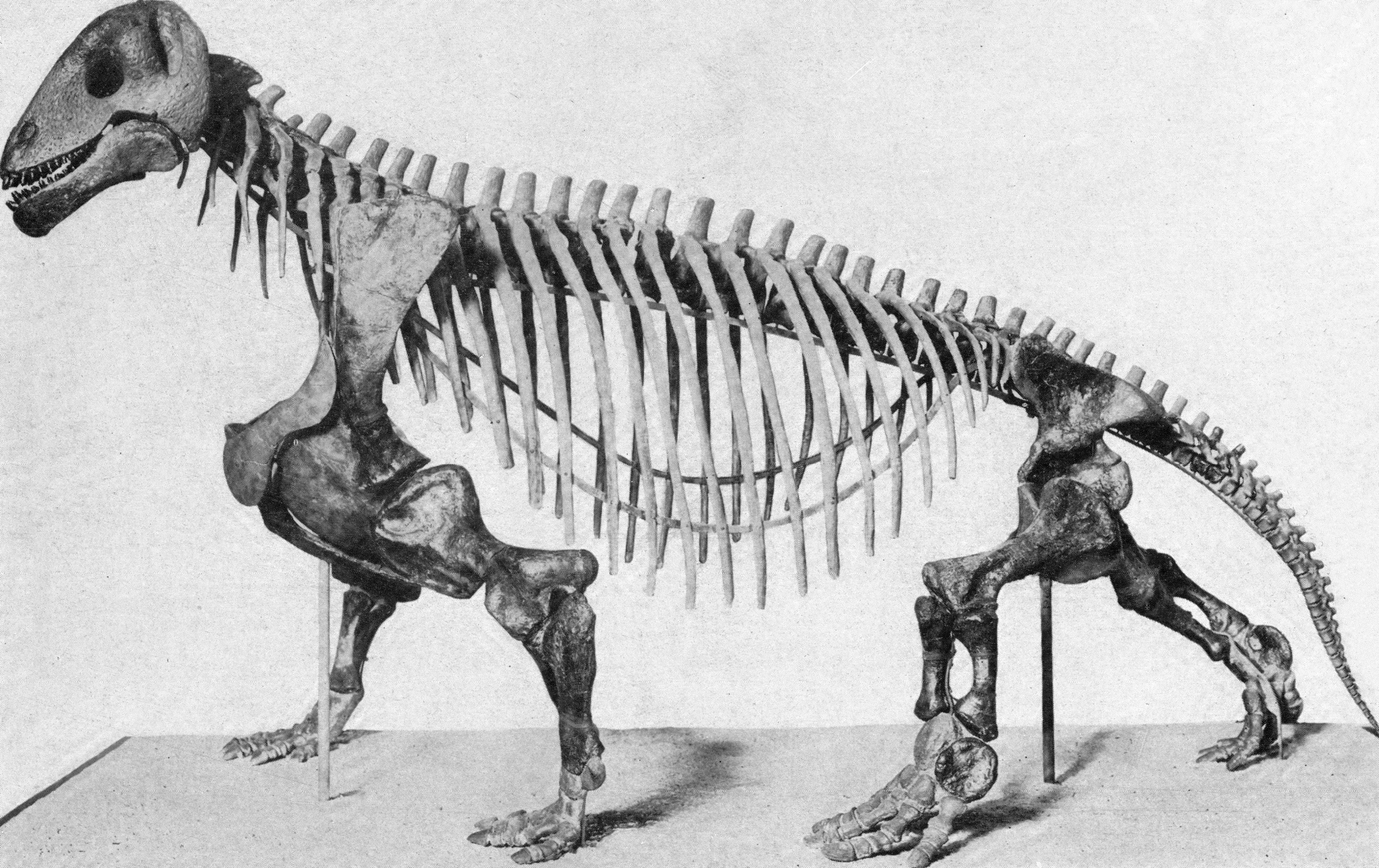

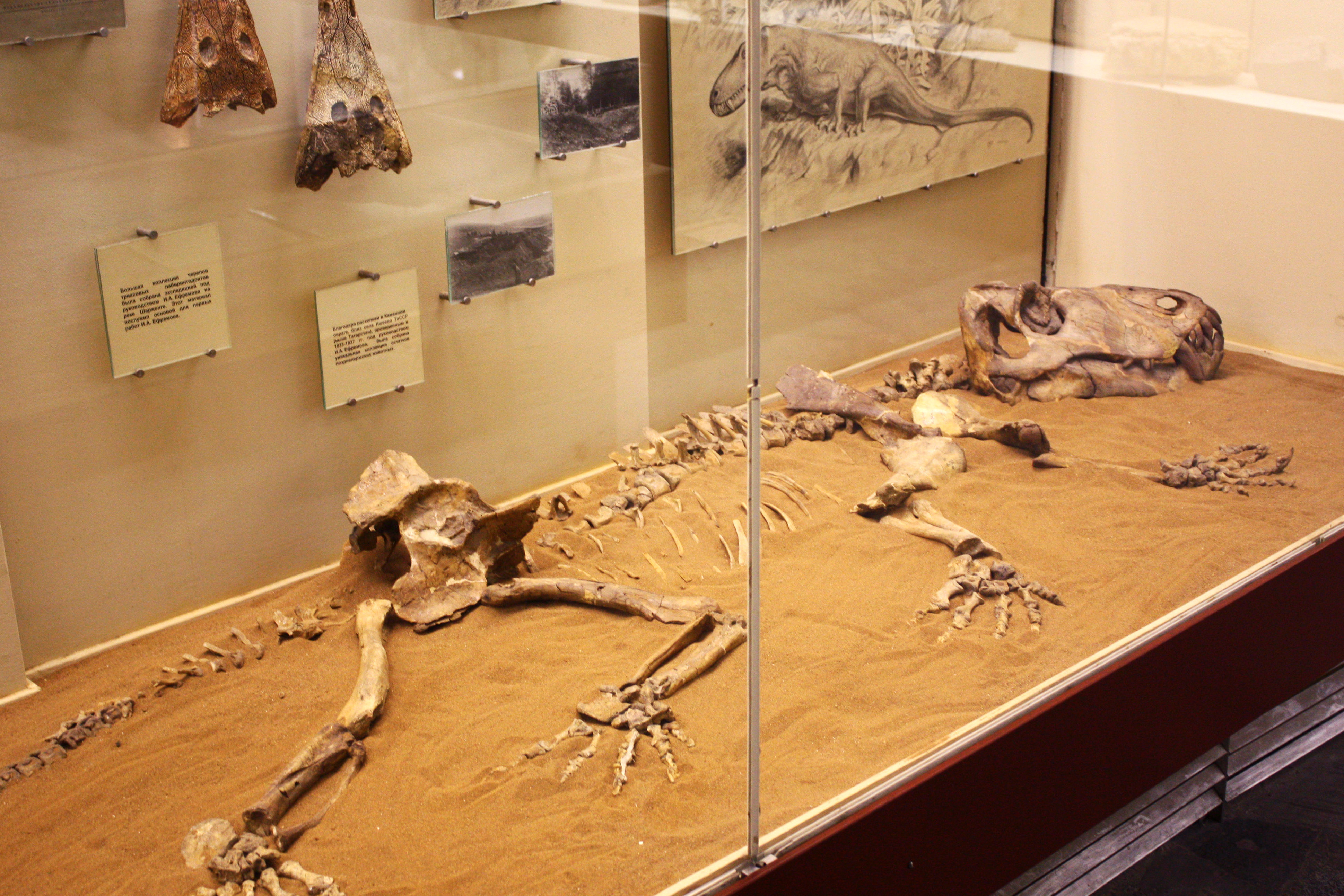


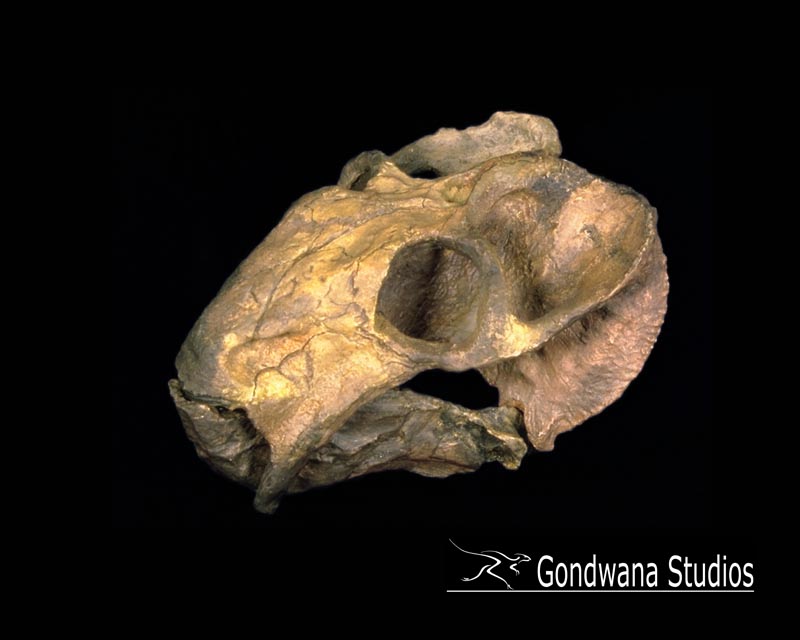
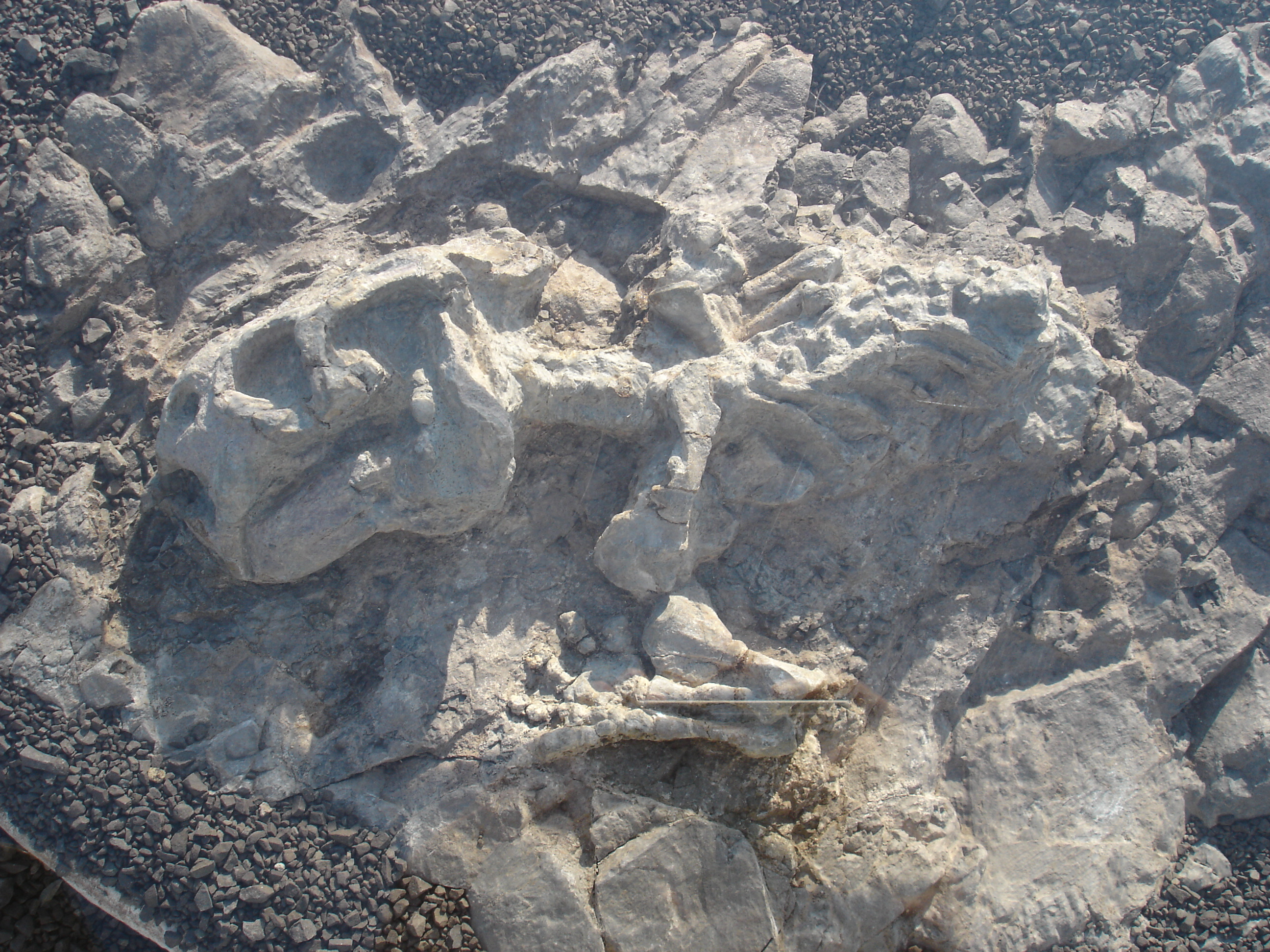
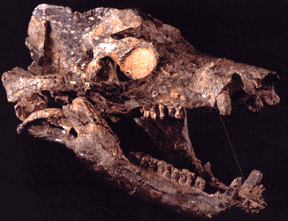
Ancestrally, all vertebrates are cold-blooded (warm their bodies primarily using sunlight). However, some evidence suggests that the advanced therapsids of the Late Permian may have had elevated metabolisms (that is, were at least partially warm-blooded):
- Some had a more upright stance than typically sprawling tetrapods
- Some may have had a diaphragm, allowing more effective breathing (more in the third part of the course)
- Similarly, some had a secondary palate, allowing them to breath while biting/feeding
- Additionally, the complex cheek teeth of most therapsids allowed them to grind food up more effectively
Additionally, some therapsids seem to have had parental care of the young, keeping them in burrows.
Sauropsids tended to be relatively rare in the Carboniferous and Permian Periods. Sauropsida is characterized by a number of particular skeletal features (which we aren't going to deal with here, as they are fairly technical). Modern sauropsids (and by inference, their concestor and all of its descendants: technically the clade Sauria) share a number of soft-tissue features:
- Aglandular skin: skin of fish, lissamphibians, and mammals have numerous glands (mucous, sweat, etc.). Sauropsid skin has few glands.
- "Waterproof" skin: sauropsid skin has a special form of keratin that makes it relatively stronger and less likely to lose moisture than in other amniotes.
- Water conserving kidneys: waste released as uric acid instead of urea (although turtles still primarily use urea)
- Excellent color vision: four-to-five type of color receptors, as opposed to the three of humans and many other primates and two in most placental mammals. (Once thought to be a shared derived feature of Sauropsida, but may simply be retained from the ancestral amniote: we'll see more when we look at the origin of mammals)
- And, to list a few skeletal features that are actually preservable in the fossil record, a suborbital foramen or fenestra ("So. f" in this figure (an extra opening on the palate of the skull) and a hook-shaped metatarsal V
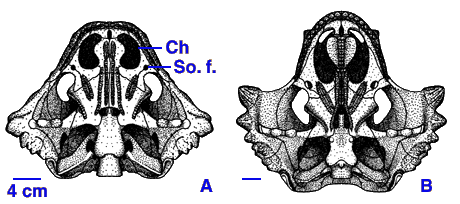
A skeletal trait that has long been thought of as helpful in understanding sauropsid relationships, yet which recently turns out to be convergently evolved (or reversed) in many different lineages is the supratemporal condition. Once thought to be restricted to Sauria--the group uniting Lepidosauria (snakes, other lizards, and tuatara) and Archosauria (birds and crocs and their extinct kin)--and their close kin, it is now known that the presence of the supratemporal fenestra (and thus the "diapsid" skull condition, where both the supra- and infratemporal fenestrae are present) evolves independently in several different sauropsid clades. In fact, the clade "Diapsida" as defined in the literature (all descendants of the concestor of the Carboniferous Petrolacosaurus and the lepidosaur-archosaur clade) turns out to include all known members of Sauropsida!

The relationships among Paleozoic and early Mesozoic sauropsids has gone through major revisions in the last few years. For example, it was once thought that there was a clade (Parareptilia) which included most of the Permian and several Triassic reptiles. Now, however, the "parareptiles" are found to be polyphyletic.
Among the non-saurian sauropsids are:
- Millerettidae, generally lizard-like forms, but with a wide-bodied Permian form with broad ribs that was convergent on shape on early turtles
- Bolosauridae, Carboniferous-to-Middle Permian long-legged, lizard-like runners
- Ankyramorpha, a Permian-Triassic diverse clade including most of the old "parareptiles", including:
- Procolophonia, a clade of squat insectivores, carnivores, and herbivores which actually survive until the end of the Triassic
- Pareiasauria, badger-to-ox-sized, squat, armored herbivores that were among the few successful sorts of sauropsids in the Permian
- Mesosauridae, web-footed needle-toothed swimmers
- And many other forms.

.jpg)
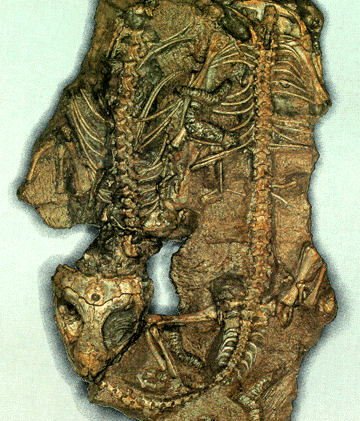


The classic old-style "Diapsida" comprises a clade known as Sauria. Saurians and their immediate outgroups possess:
- The diapsid skull condition, with both infratemporal and supratemporal fenestrae giving a fast and powerful bite (NOTE: in many, the lower bar beneath the infratemporal fenestra is no longer bone but rather just cartilage, as in modern lizards)
- Hindlimbs longer and more powerful than forelimbs, allowing them to shift from quadrupedal to bipedal mode when speed is needed
- In saurians, the muscles running from the femur to the tail are the main ones to provide thrust; consequently, saurians tend to have big muscular tails
During the late Paleozoic saurians were only a very minor part of the ecosystem.
In general, compared to typical Mesozoic and Cenozoic ecosystems, the late Paleozoic land vertebrates were smaller (few ox- or hippo-sized, none larger), slower (no real speed specialists), and close to the ground (only a few gliders and no powered fliers).
Supplementary Videos