Key Points:
•Evolution is the phenomenon where species are the product of descent with modification of older species.
•Many lines of evidence pointed to evolution, but it was the 19th Century naturalists Charles Darwin & Alfred Russel Wallace who discovered the primary mechanism of evolution: natural selection.
•Natural selection is the differential survival and reproduction of variants in a population, resulting in a change in the form of the descendants. It is the result of ecological sorting of the genetically-produced variation.
•Evolution produces changes in lineages over time. Some of these changes include divergence from common ancestors; convergence between different lineages due to similar life style; and more.
I. Descent with Modification What is Evolution?
Literally "unfolding" or "unravelling"
Pre-1860s, term used for development of an embryo
Generally used for "change through time":
Sometimes for predetermined set of changes, such as stellar evolution or evolution of a magma
Also for the general process of change, as in "evolution of the automobile"
More specifically, organic evolution, or the change of groups of living things through time
Often summed up in terms of genetics: "changes of gene frequency through time" (literally true, if a bit boring...)
Darwin himself used the phrase "DESCENT WITH MODIFICATION" rather than "evolution"
In other words, evolution in the broadest sense is no more than the observation that "none of us looks exactly like our parents."
Darwin (and Wallace) did not discover evolution, nor did its study stop with his work. At least some of the evidence for evolution was long known before his time (although we've added a LOT, even to these lines!)
Historically have been two primary competing views about life:
Species do not change, but are fixed.
Life changes over time.
Both ideas can be found in ancient Greek writing, and might have been even older.
Traditionally, most people accepted the fixity of species just as they accepted that the world today is pretty much the same now as
in the past.
Theological argument for fixity under the Biblical concept of the Plenum ("fullness"):
Ecclesiastes 1:9 and 3:14-15, if you want to look it up
"Nothing new under the sun": nothing has been taken from Creation, nor removed from it
Many early naturalists accepted the Plenum, but evidence of extinction (man-made, as in the dodo, and natural, as in fossils) showed that things could be removed from Creation. What about adding to it?
The discoveries of the early (18th and 19th Century) geologists put paid to the idea that the surface of the Earth was unchanging:
"These facts, unknown to the vulgar, but well known to all who observe nature, force the physical scientist to recognize that all the
surface of our globe has changed; that it has had other seas, other continents, another geography." --Nicolas Boulanger (1722-1759)
and
"Life, therefore, has been often disturbed on this earth by terrible events - calamities which, at their commencement, have perhaps moved and overturned to a great depth the entire outer crust of the globe, but which, since these first commotions, have uniformly acted at a less depth and less generally. Numberless living beings have been the victims of these catastrophes; some have been destroyed by sudden inundations, others have been laid dry in consequence of the bottom of the seas being instantaneously elevated. Their races even have become extinct, and have left no memorial of them except some small fragments which the naturalist can scarcely recognise." --'Preliminary discourse', to Recherches sur les Ossemens Fossiles (1812), trans. R. Kerr Essay on the Theory of the Earth (1813),
Baron Georges Leopold Chretien Frederic Dagobert Cuvier
While some thinkers once thought that life as we see it now is the way it has always been, the discovery of the fossil
record showed that strange creatures once roamed the Earth that are no longer there. Naturalist John Herschel (in an 1836 letter to Charles Lyell)
wrote:
"I allude to that mystery of mysteries, the replacement of extinct species by others. Many will doubtless think your speculations too bold, but it is as well to face the difficulty at once. For my own part, I cannot but think it an inadequate conception of the Creator, to assume it as granted that his combinations are exhausted upon any one of the theatres of their former exercise, though in this, as in all his other works, we are led, by all analogy, to suppose that he operates through a series of intermediate causes, and that in consequence the origination of fresh species, could it ever come under our cognizance, would be found to be a natural in contradistinction to a miraculous process -- although we perceive no indications of any process actually in progress which is likely to issue in such a result."
How to explain these observations? Two main possibilities:
The successive appearance and disappearance of different forms through time, without genetic connection (as supported by Owen, Cuvier, and others)
Transmutationism: direct lineal relationships between ancestor and descendant species. So living species are descendants of earlier distinct species, which themselves were the descendants of even earlier ones. "Transmutationism" became known as "evolution" after the work of Darwin and Wallace.
Transmutationism, a set of early evolutionary models, accepted by several prominent scientists by the late 1700s. Among them were Jean Baptiste Pierre Antoine de Monet, Chevalier de Lamarck (normally known as Jean Baptiste de Lamarck) and Erasmus Darwin (doctor, scientist, surgeon, abolitionist, and INCREDIBLY rich).
The Initial Evidence for Transmutationism/Evolution
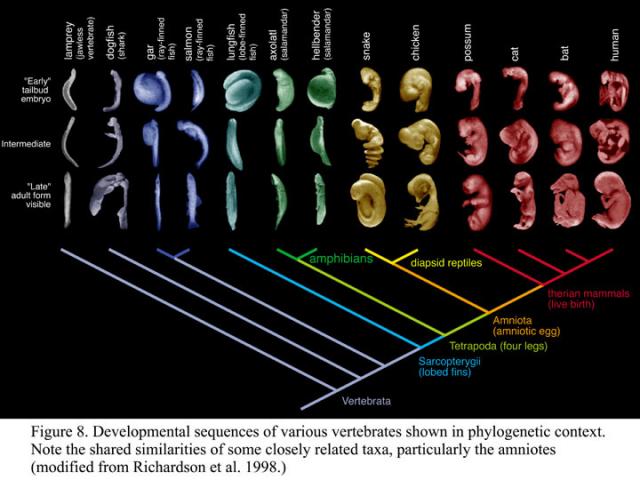
Homologies: the same anatomical structures ("body parts") are repeated in different organisms. This allows us to recognize how they differ from each other, and how they resemble each other.
Living things can be grouped using a nested hierarchy based on shared presence of homologous structures of similar form
System of classification codified by Carolus Linnaeus (18th Century Swedish botanist)
Many of his principles, such as Latin names for organisms, and the use of genus and species still used today
However, species are not fixed entities. They vary across their range, and they can often hybridize with closely related forms
Adaptations: any structure or behavior which allows an organism to interact with its environment in certain specific ways
Analogous structures: non-homologous structures found two or more organisms that are adapted for the same function
Vestigial structures: anatomical features which have some significant adaptive function in some forms, but are reduced and non-functional (or nearly non-functional) in a related form
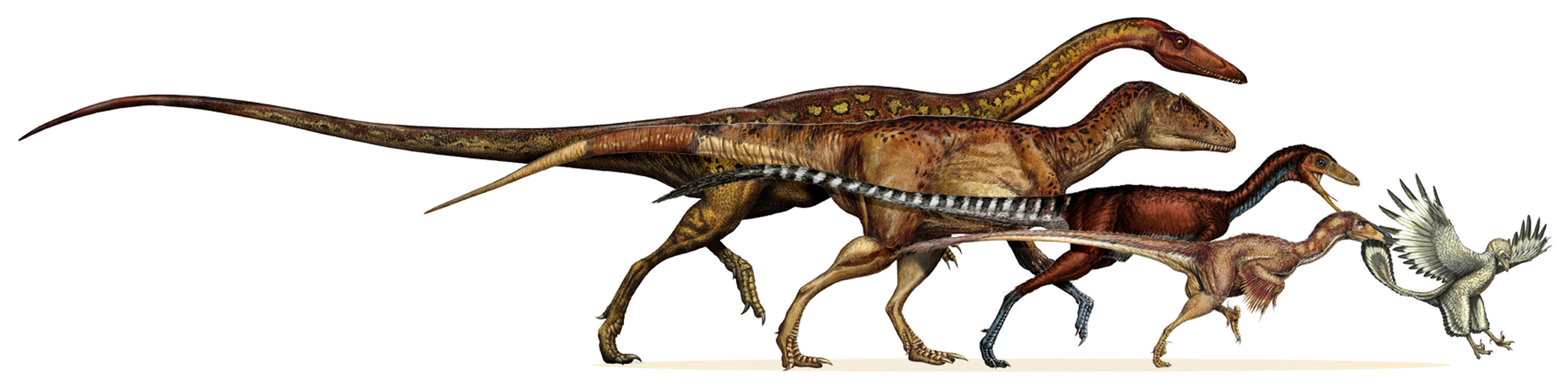
Transitional fossils: extinct species intermediate in morphology between now-distinct groups
Biogeography: the non-random distribution of living things over the surface of the Earth, both now and in the geologic past
William "Strata" Smith's Stratigraphic Principle of Fossil Succession, indicating a History to Life
Fossils demonstrated that the living component of the Earth changed through time; shared homologies showed connections between groups; adaptations showed organisms "fit" to their environment. Transmutationists already accepted the central tenets of Evolutionary
Theory:
The Diversity of Living Things is the Product of Descent with Modification
New species are the modified descendants of previously existing species
But what caused the modifications?
Transmutationist models:
Spontaneous generation of new lineages of organisms throughout time; thus, many living things represent separate origins at different points in Earth History
Within each lineage, "driving forces" impel organisms towards improvement (i.e., simple forms become complex) down predetermined pathways
Inheritance is from use and disuses: characters acquired during the lifetime of an individual are passed onto descendants
Problems with these ideas, however:
Spontaneous generation doesn't work
"Driving forces" never identified, and are more metaphysical than naturalistic
Continuity of lineages through long periods of Earth history, rather than appearance, transformation, and reappearance:
Also, fossils documented linkages between groups rather than separation
Inheritance doesn't happen by use & disuse; transformations to adult are not passed onto offspring
II. On the Origin of Species by Means of Natural Selection
The discovery of the primary mechanism of evolution was the work of two English naturalists:
Both studied natural history, including geology, in the UK
Thus, both were familiar with fossil organisms and with the (then-new) ideas of geologic time
Both traveled to distant lands (Darwin to South America, the Galápagos Islands, and various other localities in the Pacific Ocean; Wallace to Amazonia and Indonesia)
Both made collections of organisms, and so had direct experience with the varieties of nature
The two made the same sets of important observations independently, and independently came up with the same mechanism to explain evolution. Darwin (older than Wallace) had developed his ideas earlier, but kept them secret. In 1858 when Wallace asked Darwin for advice about his ideas, Darwin went to other scientists to present both his and Wallace's ideas at the same time, so that they both got credit for their independent discovery. (However, Darwin's book On the Origin of Species by Means of Natural Selection sold extremely well, so more people then and now know Darwin's name.)
Their model was called Natural Selection, and was analogous to "artificial selection" (e.g., domestication). Darwin and Wallace's observations:
Variability: There is variation in all populations.
No two members of a population are totally identical.
Some sources of variation include age and sexual differences; the results of factors that happened during the lifetime (differences of nutrition, disease, accident, etc.); individual difference in inherited traits; etc.
The idea that individual variation was significant was a blow to previous models of Nature. Most earlier natural historians believed in perfect types, and thought variation was degeneration from those types. Darwin and Wallace documented that the variation is the reality, and the "perfect types" were just myths.
Heritability: Some (but not all) variation is inherited.
Causal mechanism of inheritance unknown in Darwin's time.
Discovery by Gregor Mendel of genetics came later, and discovery of DNA came later still
Heritable traits are coded in DNA and passed on to descendants
Note that DNA is NOT a "blueprint" as commonly thought: it is a set of instructions for putting bodies together and maintaining them after they've been built
Each little instruction is called a gene: a piece of code that helps the cell to build a protein
Most genes have slightly different versions called alleles that produce different end products
It is these alleles (one copy for each gene per parent) that is passed on to offspring
Different combinations of alleles result in different traits being expressed (that is, different phenotypes). Depending on the particular combination of alleles an offspring gets, they might have the same trait as their mother, their father, or something different than either.
This was the major source of individual variation that Darwin & Wallace never knew about!
Mutations are new variations in heritable traits, caused by miscopied DNA (duplication of parts of genes; miswritten code; etc.)
Some mutations may be deleterious (they result in harm to the organism)
Many mutations may be neutral (they don't benefit the organism in an obvious way, nor hurt it)
A small number of mutations may wind up being beneficial (the variation they produce allow it to do better somehow in the world)
Superfecundity: Organisms produced far more offspring than can possibly survive
Application of demographer Thomas Malthus' reproductive excess concept to Nature
Violated another previously-held belief: that Nature was perfect and everything had its place
Thus, IF some variation gives the individual a slight advantage (bigger, stronger, smaller, smarter, less tasty, whatever) at surviving; and IF that variation is heritable; THEN there is a somewhat better than average chance that organisms with that variation will survive to bear the next generation. Over the long expanse of geologic time, the accumulation of these variations will change the population from one form to another: the origin of species.
Hence, Natural Selection is the differential survival and reproduction of variants in a population resulting in a net change in phenotype
of the descendants.
(Short form: "Natural selection is the differential survival and reproduction of variants in a population.")
Another way of thinking about this is paleontologist's Leigh Van Valen's observation: Natural Selection is the Control of Ecology on Development.
If Evolution can be summarized as "no one is identical to their parents", then Natural Selection can be summarized as "no one is identical to their siblings, either; plus, life's hard!"
Key points of Natural Selection:
Does NOT happen to individuals, only to populations (lineages)
Analogous to "artificial selection" (domestication), but operates:
On all traits rather than a few (humans can keep alive crops, farm animals, or pets that might otherwise die in the wild; obviously, wild plants and animals don't have that help!)
Over vast amounts of geologic time, rather than just a few generations
Does NOT require simple things evolving into complex: sometimes a simplified mutation of a structure might be advantageous than the ancestral complex one (hence, vestigial organs)
Cannot evolve towards something with a goal in mind; only favors variations that are advantageous at the time of selection
"Survival of the Fittest"?: Not as such. Phrase not in the earlier editions of the Origin, nor was it coined by Darwin. Comes from economist/philosopher Herbert Spencer:
Darwin and Wallace observed that some individuals might be better "fit" to the "circumstances of life" (what we would now call the "environment" or "ecosystem"), but also that environments change over time, so that there is no absolute measure of "fitness" as such
Thus, unlike popular idea, evolutionary fitness is NOT being the biggest, strongest, fastest, etc. It is being better suited to the environment in
some fashion relative to other members of your population.
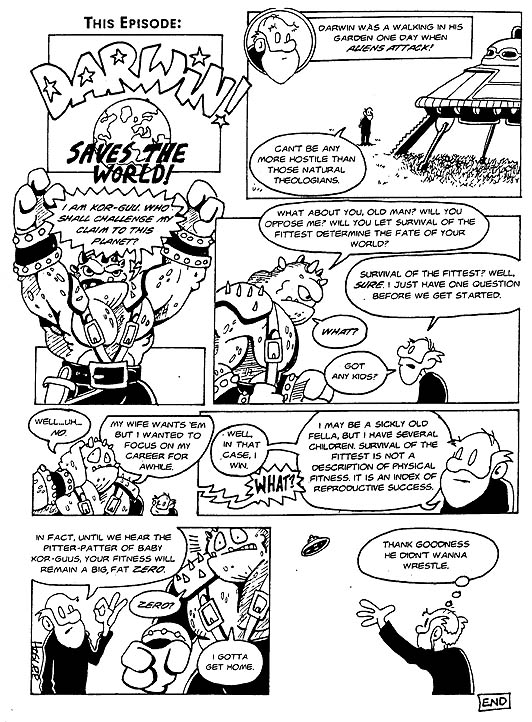
So a great grandmother with dozens of children, grandchildren, and great grandchildren is far more "fit" (in evolutionary terms) than all the childless Nobel prize winners and Olympic athletes put together!
From Darwin and Wallace, we get the beginnings of modern evolutionary theory. It has five major components:
Evolution is descent with modification: that is, the anatomical traits and other features of populations change over time from generation to generation
These modifications occur relatively slowly on average: small incremental changes added up over many generations
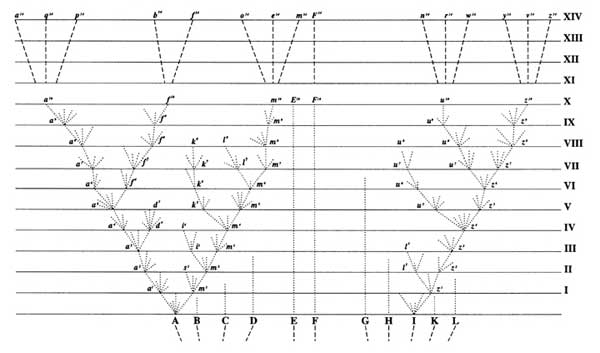
Populations may diverge into two or more distinct lineages (which may or may not produce their own descendant branches)
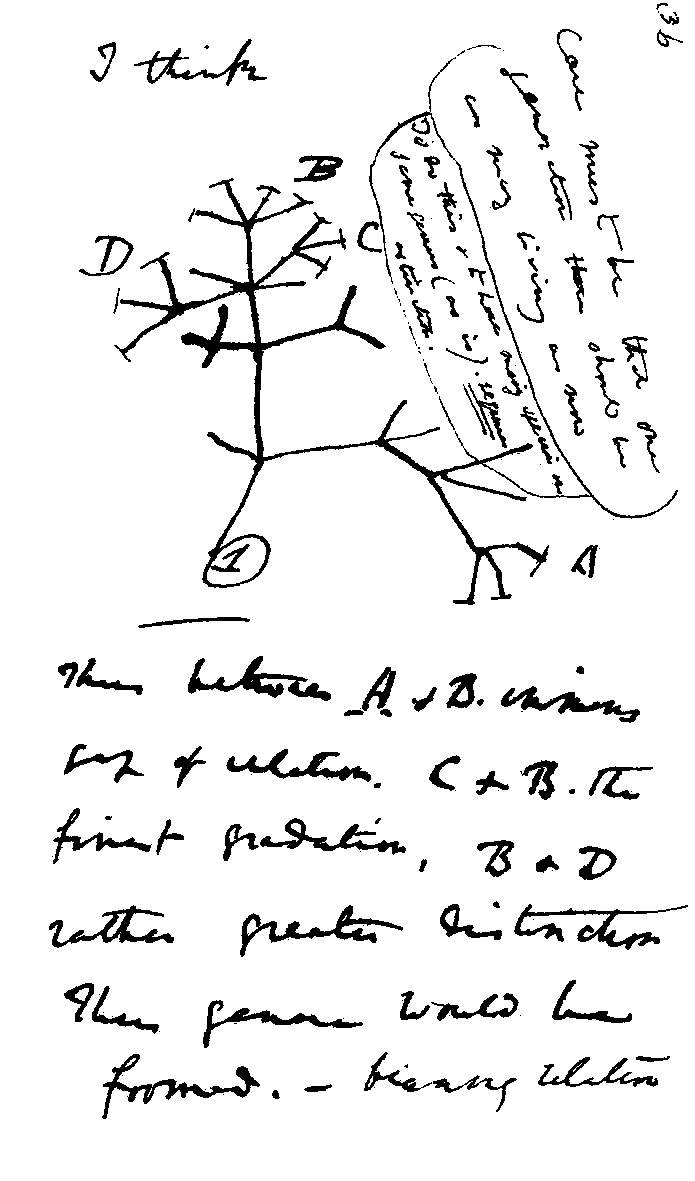
All species share a common ancestry: thus, the shape of the history of lineages can be seen as a Tree of Life
Much (although not all) evolutionary change is due to natural selection, which is the sole process for producing adaptations
III. Patterns and Processes
With the discovery of evolution by natural selection, biologists from Darwin and Wallace's time onward have documented many different patterns and processes in evolution. Sometimes they refer to "microevolution" (changes within an species) and "macroevolution" (patterns on the larger scale; changes from one species to another, or between different lineages of ancestors and descendants). It is important to remember that "micro-" vs "macro-" is just a matter of scale and perception: at the level of individuals and populations, there is just variability, heritability, and superfecundity.
Two (or more) distinct variations in an ancestral population convey their own advantage against the rest of the population
Over time, these two (or more) variations will become more distinct from each other
If they diverge enough, they will no longer be able to mate with each other: will be different species
Divergence can also occur (perhaps more commonly!) if an ancestral population is divided into two or more by changes in geography: because natural selection works by chance survivals, it is unlikely that exactly the same variations of the ancestral population will survival in the two or more separated populations. Over time, if the populations meet again, the accumulation of variations may be significant enough that they are distinct species.
Common Ancestry
Closely related species are close because their common ancestor diverged relatively recently in Earth history
Other species are more distantly related because of divergences of THEIR common ancestors even farther back in time
No separate origins for different groups; instead, patterns of common ancestry and diverging descendants
Thus, the basic pattern of the history of living things is a Tree of Life, where the trunk and stems are lineages of ancestors, the branching points representing divergences between lineages, and the tips of the branches living species (or extinct species that died without descendants).
Other important patterns and processes:
Sexual Selection, a variation of Natural Selection recognized by Darwin, where the variation is "being more sexy" (and thus have better than average chance of breeding, and thus passing on "sexiness", compared to other members of the population [increased reproductive success]).
Explains many extravagant display structures and behaviors (such as peacock tails, bird song, lion manes, etc.)
Correlated Progression: Ancestor and descendants form a lineage (historical line). Sometimes a particular life habit favors the slight increase in multiple different traits (e.g., longer and longer legs, more compact body, more efficient heart and respiration for fast running; longer and longer necks, longer legs, better cropping teeth and/or grasping tongue for browsing in trees; more and more streamlined body profile, more paddle like legs, more dorsal nostris, etc. in swimmers; etc.) Traits that go against the general trend will be selected against; traits that go with the general trend will be selected for. (For many people, this series of trends in adaptations represents the totality of evolution)
Adaptive Radiation: If a population evolves some significant new adaptation, or colonizes a region without competitors, or is present when competitors die off, many different variations from that common ancestral population might survive (fill new or unoccupied "niches" (ways of life) in environment). Over a geologically short period time, a common ancestor can radiate into many very different descendant lineages.
Niche Partitioning: during an adaptive radiation, the early members of the divergence will (naturally) still be relatively similar to each other (and to their common ancestor) in terms of size, shape, behavior, etc. Over time, those variations in each lineage that are least like their relatives will more likely survive, because they will have less competition. Consequently, the different species will "partition" (divide up) the niches and the resources.
Convergence: Some adaptations are mechanically advantageous and easy to produce developmentally. Different lineages of organisms can independently develop some of the same features, even though ancestors were quite different (i.e., streamlining in sharks, tunas, ichthyosaurs & dolphins).
Co-evolution: Selection of one species due to activity of an interactor leads to counter-selection in response of the first species
For example, plant species develop traits (shapes, colors, tastes of nectar) that favor a select few number of pollinators, thereby promoting
greater chance of getting their own pollen rather than some other plant's
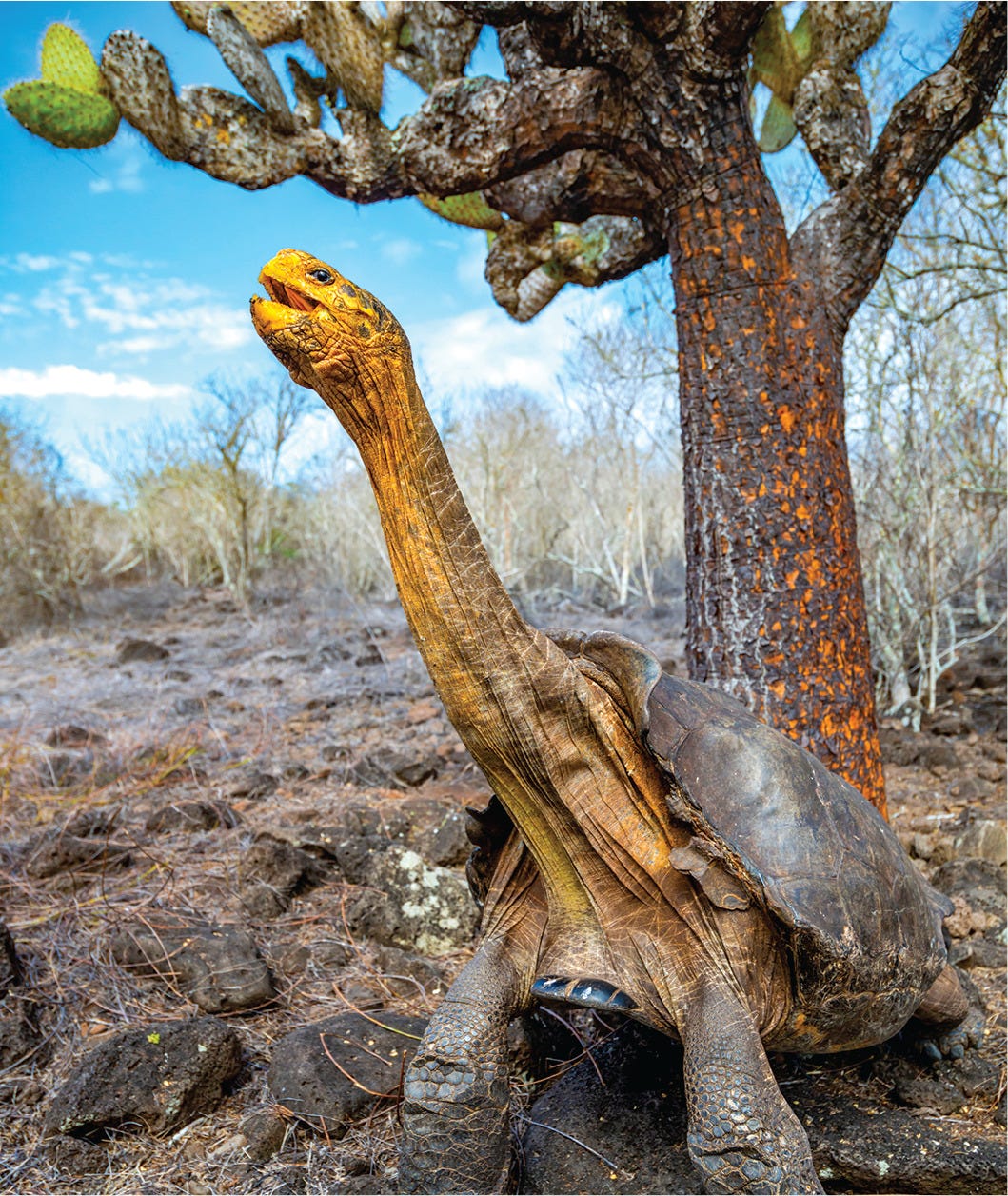
Or, in the Galápagos: drier islands have fewer small plants, so tortoises preferentially feed on Opuntia cacti. Cacti on these
islands have evolved taller woody trunks, and in response the tortoises have evolved a "saddle-backed" shell that allows them to
reach higher than dome-backed ancestors.
Exaptation: Formerly called "preadaptation", the co-option of a structure that previously had some entirely different function for a new use. Seems to be the more common pattern of evolution than the appearance of entirely novel structures. For example, the wings of birds and bats were initially arms and hands; the mouthparts of various arthropods were legs; etc.
Heterochrony: Evolution by changes in rate of development from embryo to adulthood. Two major forms of heterochrony:
Paedomorphosis: descendant populations will retain some juvenile features into adulthood
Peramorphosis: descendant populations will develop structures beyond the adult form of ancestor
Extinction: The termination of a lineage. (If a species "dies out" by evolving into another species, this is more properly called a pseudoextinction). Extinctions occur throughout Earth History. What is more remarkable is Mass Extinction: the geologically-sudden disappearance of many diverse groups of organisms, which are not immediately replaced by ecological equivalents. Some mass extinction events seem to correlate with asteroid impacts; many with major volcanic episodes; others with glaciation.
There are many more aspects to evolutionary biology, but these basics will help us study the history of dinosaurs and their place in the world.
Here is a summary of evolution and how it works:
And here is another summary of evolution and how it works (and how it ISN'T like the parody-version of evolution which Creationists claim scientists believe):