Key Points
- Neornithischia is the sister-group to Thyreophora. It contains Marginocephalia, Ornithopoda, Thescelosauridae, and a series of basal forms.
- Thescelosauridae was a diverse clade of small (almost always smaller than humans) bipeds. Many of them show evidence for burrowing ability, making them sort of "dinosaurian rabbits"
- Ornithopoda was one of the most successful of all dinosaur herbivore groups. Primitive members were small obligate bipeds, but many evolved into facultative quadrupeds. Some include the largest land animals other than sauropods of all time.
- Ornithopods showed extensive modification of their chewing ability, culminating in the mobile skulls and dental batteries of Hadrosauridae.
- The Hadrosauridae of the Late Cretaceous was the most speciose branch of Ornithopoda. These "duck-billed" dinosaurs are known from the entire life cycle, and from entire herds. Both major clades--hollow-crested Lambeosaurinae and broad-snouted Saurolophinae--show extensive features for some form of visual (and/or auditory) displays, suggested complex social interactions.
What Exactly is an Ornithopod? The Incredible Shrinking Ornithopoda
Phylogeny of Neornithischia
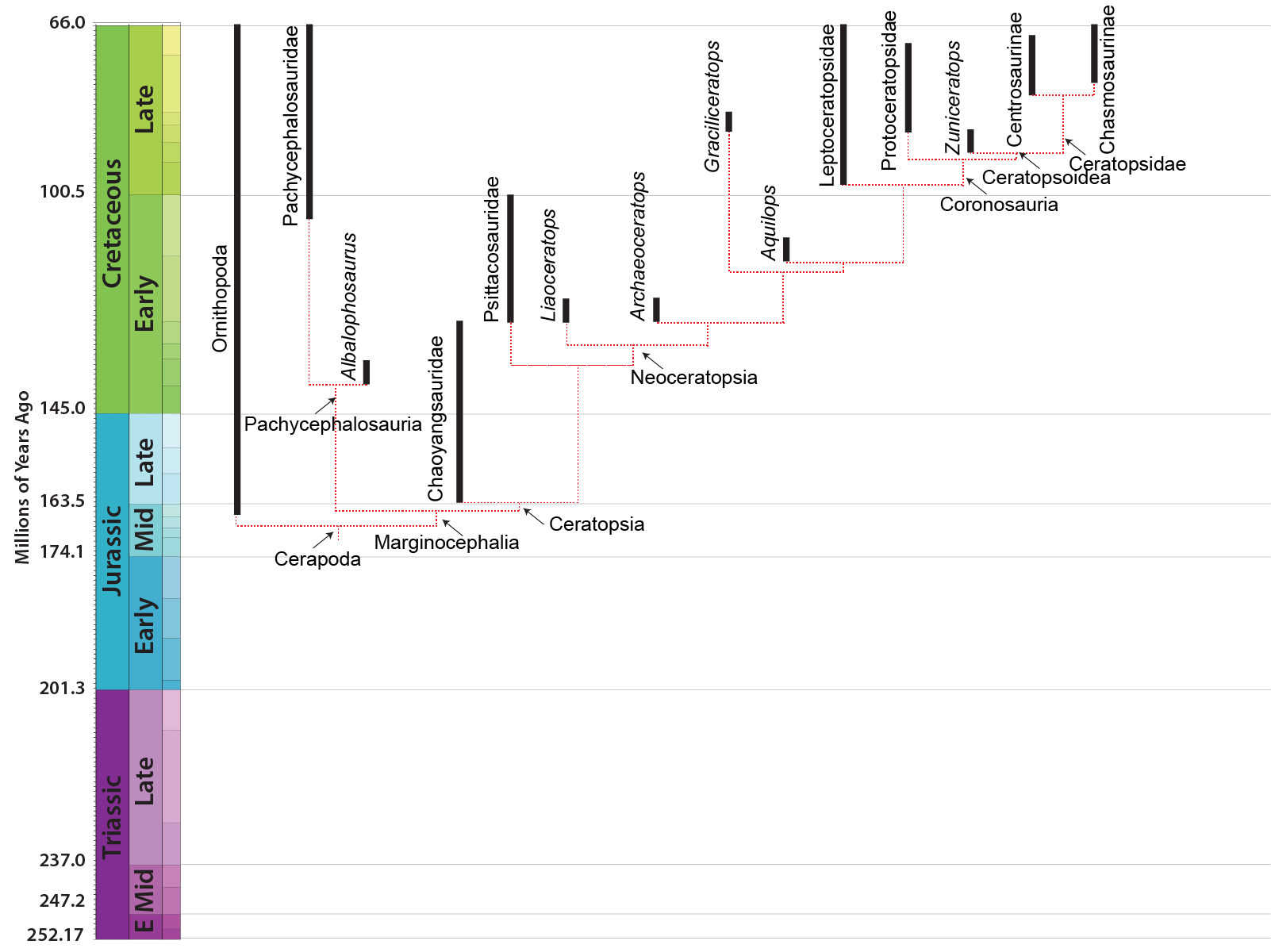
Traditionally, Ornithopoda ("bird feet") comprised all ornithischians that weren't stegosaurs, ankylosaurs, or neoceratopisans. Eventually, pachycephalosaurs were recognized as their own distinct clade, and psittacosaurids as ceratopsians. With the development of cladistic analysis, it was recognized that Scutellosaurus and Scelidosaurus belonged with the stegosaur-ankylosaur clade, and that Pisanosaurus and Lesothosaurus (both of which were originally called "fabrosaurs") were primitive ornithischians outside of all the other major groups.
But even at the dawn of the 21st Century, Heterodontosauridae was still generally considered as sharing a more recent common ancestor with the "hypsilophodonts" and iguanodontians than with any other group of dinosaur: thus, the heterodontosaurids were thought to be the oldest branch of Ornithopoda. More recently, however, heterodontosaurids have been recognized as splitting from other ornithischians at a very basal divergence, and thus are no closer to ornithopods than to marginocephalians or to thyreophorans. So there are at present no recognized Late Triassic or Early Jurassic ornithopods.
All ornithischians closer to the hadrosaurid Parasaurolophus than to thyreophorans form the clade Neornithischia. Neornithischians have less closely packed premaxillary teeth than in other dinosaurs, and a humerus longer than the scapula.
In recent years, most phylogenies recover a series of Jurassic forms as neornithischians outside of the thescelosaurid-cerapod clade Pyrodontia. Some of these have only been described very recently, and as their anatomy becomes better known we should be better resolution of the relationships among early ornithischians. Chinese Pulaosaurus is known from a nearly-complete skeleton, and Thailand's Minimocursor nearly so. Other basal neornithischians include Middle Jurassic Chinese Agilisaurus, Hexinlusaurus, and four meter long Yandusaurus. There are small ornithischian fossils from the Late Jurassic western North American Morrison Formation referred to by some as Nanosaurus, but formerly called by a number of names, including Othneilia, Laosaurus< and Othneilosaurus. However, a recent review found that the holotype specimens for all these names are undiagnostic, and that some of these specimens are likely juveniles of larger contemporary forms like Dryosaurus. Enigmacursor does appear to be a diagnostic basal neornithischian from the Morrison, and there are as-yet unpublished specimens which might represent others.


So what IS an ornithopod, then? Ornithopoda is defined as Parasaurolophus and all taxa closer to it than to Triceratops. The latest studies (from 2020 onward) have tended to find either re-expanded Ornithopoda to include most of the classic "hypsilophodont"-grade (i.e., non-iguanodontian) ornithopods or versions where Thescelosauridae (among others) are excluded from Cerapoda; the latter is what we are following here.
Simplified cladogram of Thescelosauridae and Ornithopoda
Thescelosauridae, the Burrowing Dinosaurs
Thescelosauridae is a clade of Cretaceous bipedal forms, generally smaller than an adult human being. Thescelosaurids share fused premaxillae, expanded scapulae, and a series of other adaptations. There are three major clades of thescelosaurids, whose relationships vary depending on the analysis. Outside the three major clades, at least some analyses find Early Cretaceous Chinese Changmiania as the basalmost branch; other analyses have it as a thescelosaurine. Orodominae is a clade of small Asian and North American forms, including Early Cretaceous Chinese Yueosaurus, Late Cretaceous Haya, burrowing Oryctodromeus and Zephyrosaurus of the Early Cretaceous of western North America, Koreanosaurus of the Late Cretaceous of (not surprisingly) Korea, Late Cretaceous North American Orodromeus, among others. Jeholosaurinae ("Jeholosauridae" in some phylogenies) includes Early Cretaceous Chinese Jeholosaurus, and Late Cretaceous Chinese Changchunsaurus.

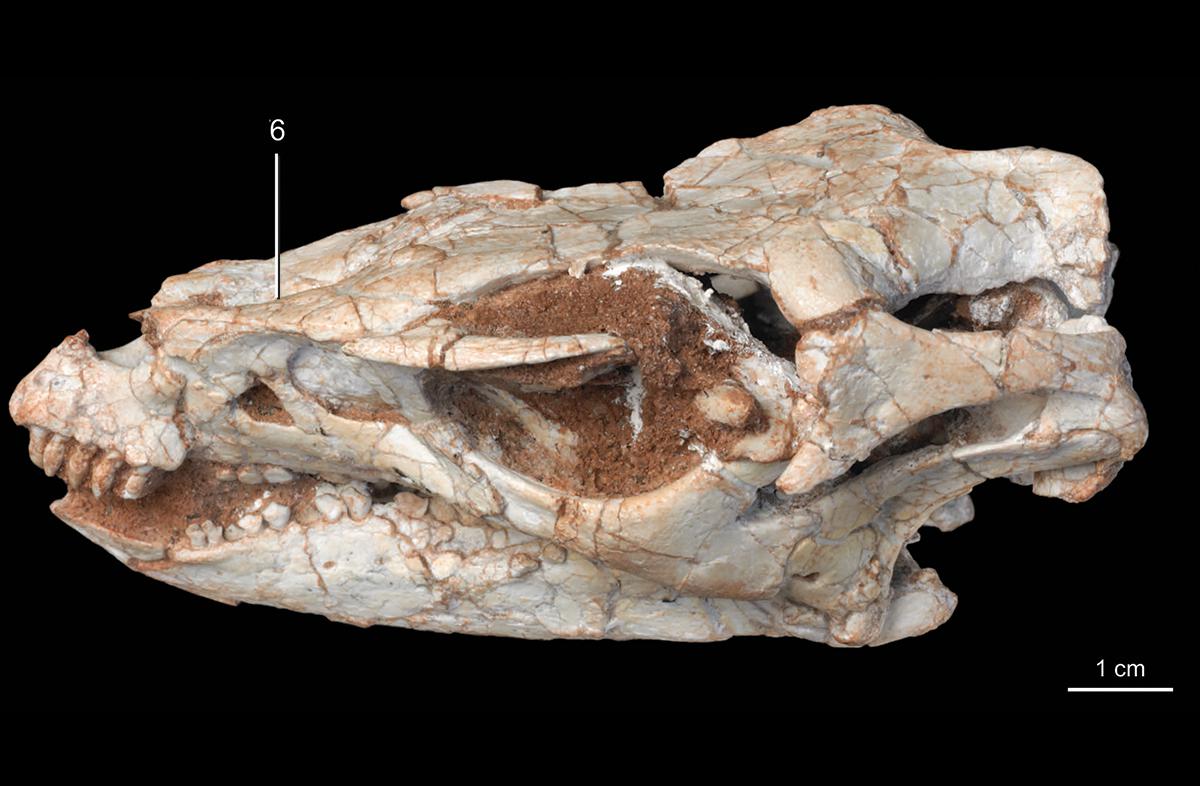


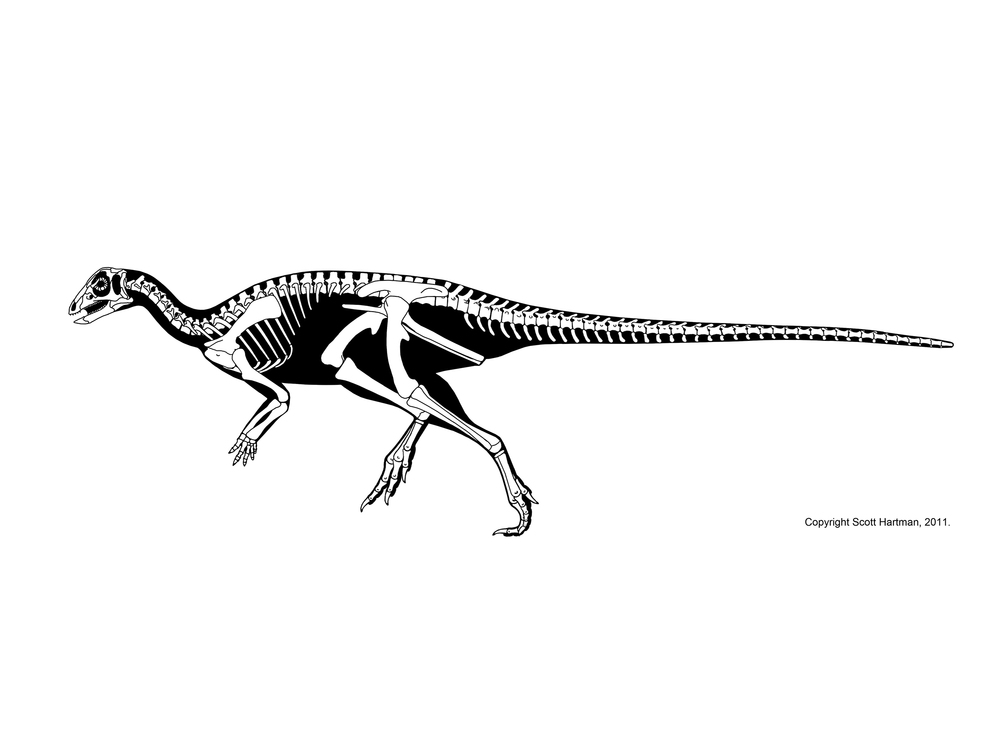
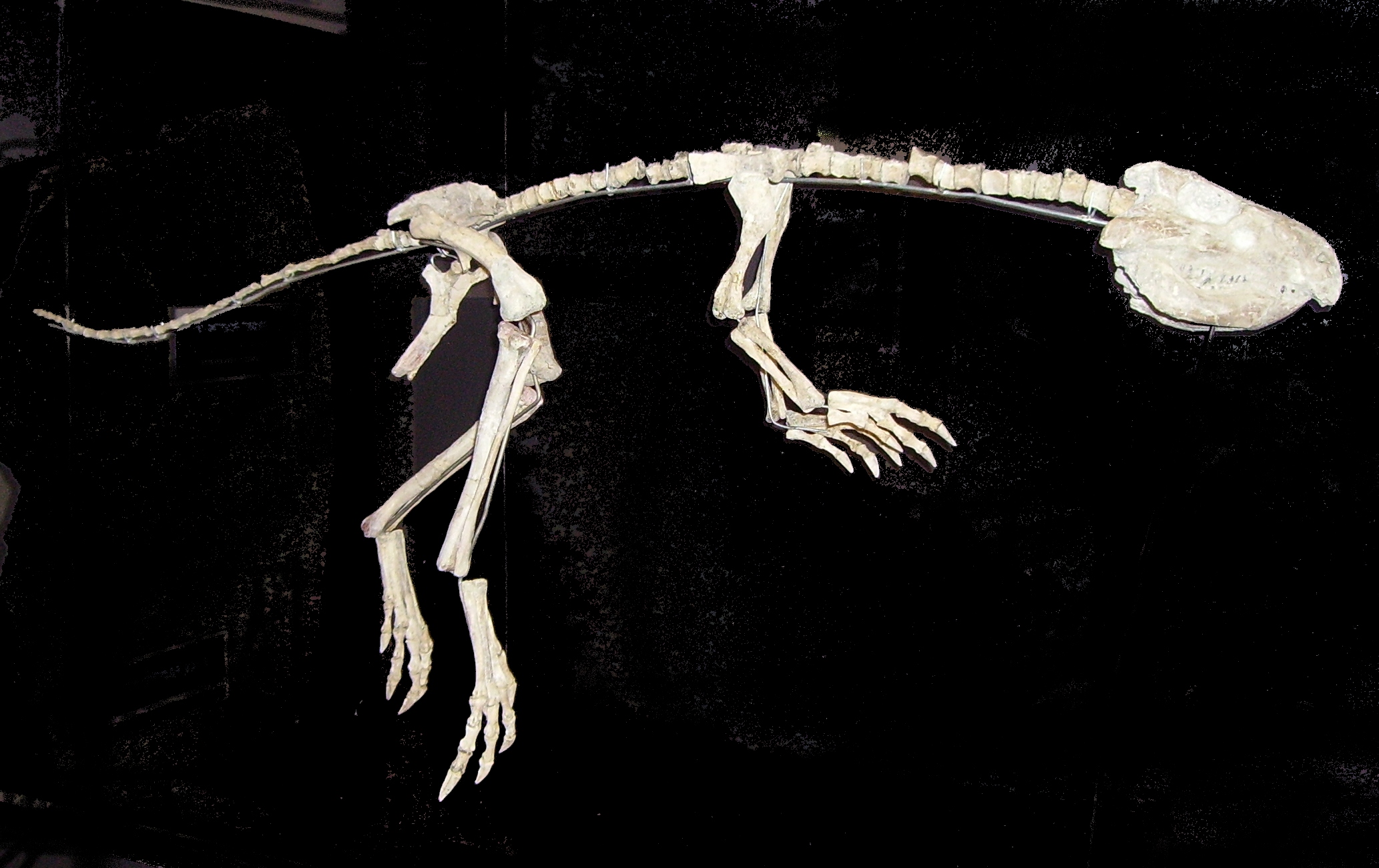

Thescelosaurinae itself includes tiny Early Cretaceous Doolysaurus of Korea and larger Fona of western North America. The best known thescelosaurines are Late Cretaceous North American Parksosaurus and long-snouted latest Cretaceous western North American Thescelosaurus, the largest of all thescelosaurids (at 3-4 m long and 200-300 kg, the only thescelosaurid larger than a human when fully grown).
.jpg)

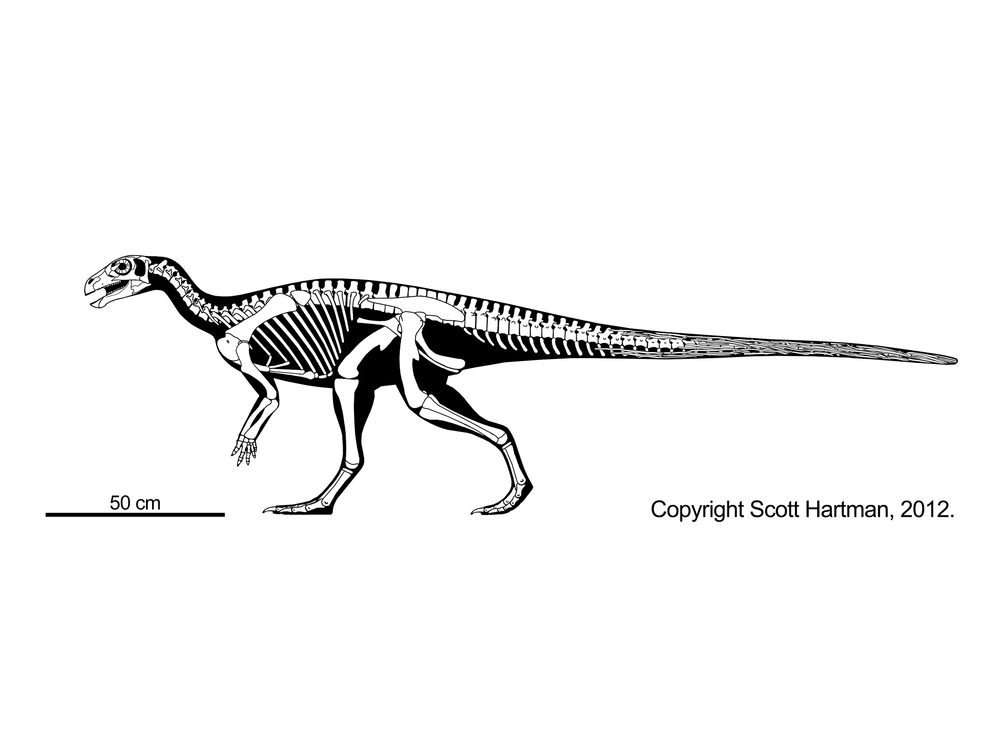

The anatomy of thescelosaurids (particularly their powerful scapulae and other features of their limbs; fusion of the premaxillae to help shovel dirt; a highly increased sense of smell; etc.) suggest that many of these are powerful burrowers. In some orodromines there was a special articulation between the pubis and the sacrum which might have helped reinforced their pelvis when using it to brace the body while digging. Oryctodromeus was actually found preserved in its burrow, and Koreanosaurus is found associated with burrows as well. Thescelosaurids might have been the dinosaurian equivalent of rabbits, gophers, or marmots: (relatively) small, numerous burrowing herbivores.
Ornithopoda, the Beaked Dinosaurs (with a focus on Iguanodontia)
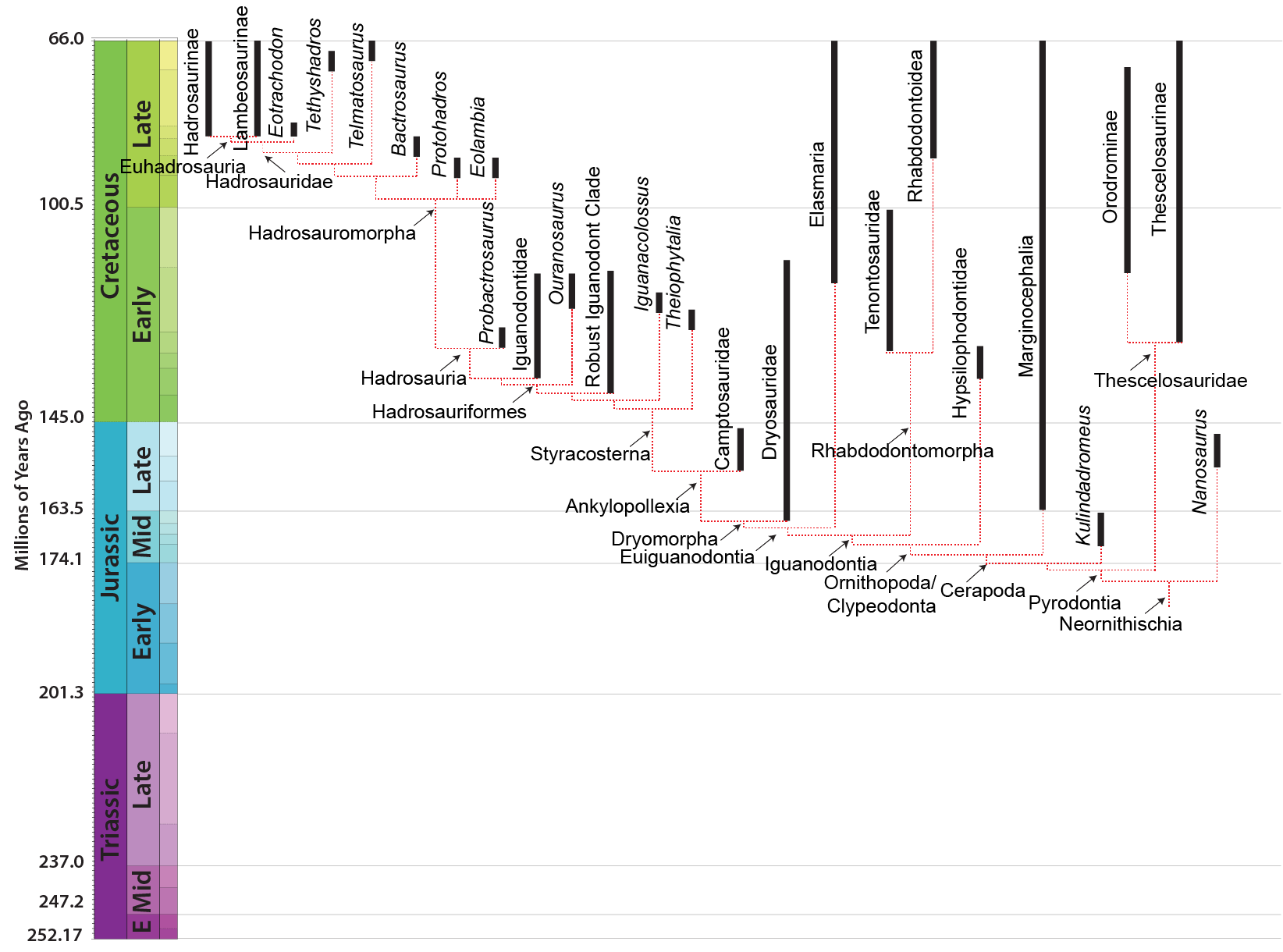
Phylogeny of Ornithopoda
The marginocephalian-ornithopod clade Cerapoda is characterized by:
- Asymmetrical teeth with enamel on only one side, allowing them to be ever-sharpening
- A prominent ridge on the enameled surface of the teeth
- An olecranon process on the ulna (the "funny bone")
- And a few other traits.
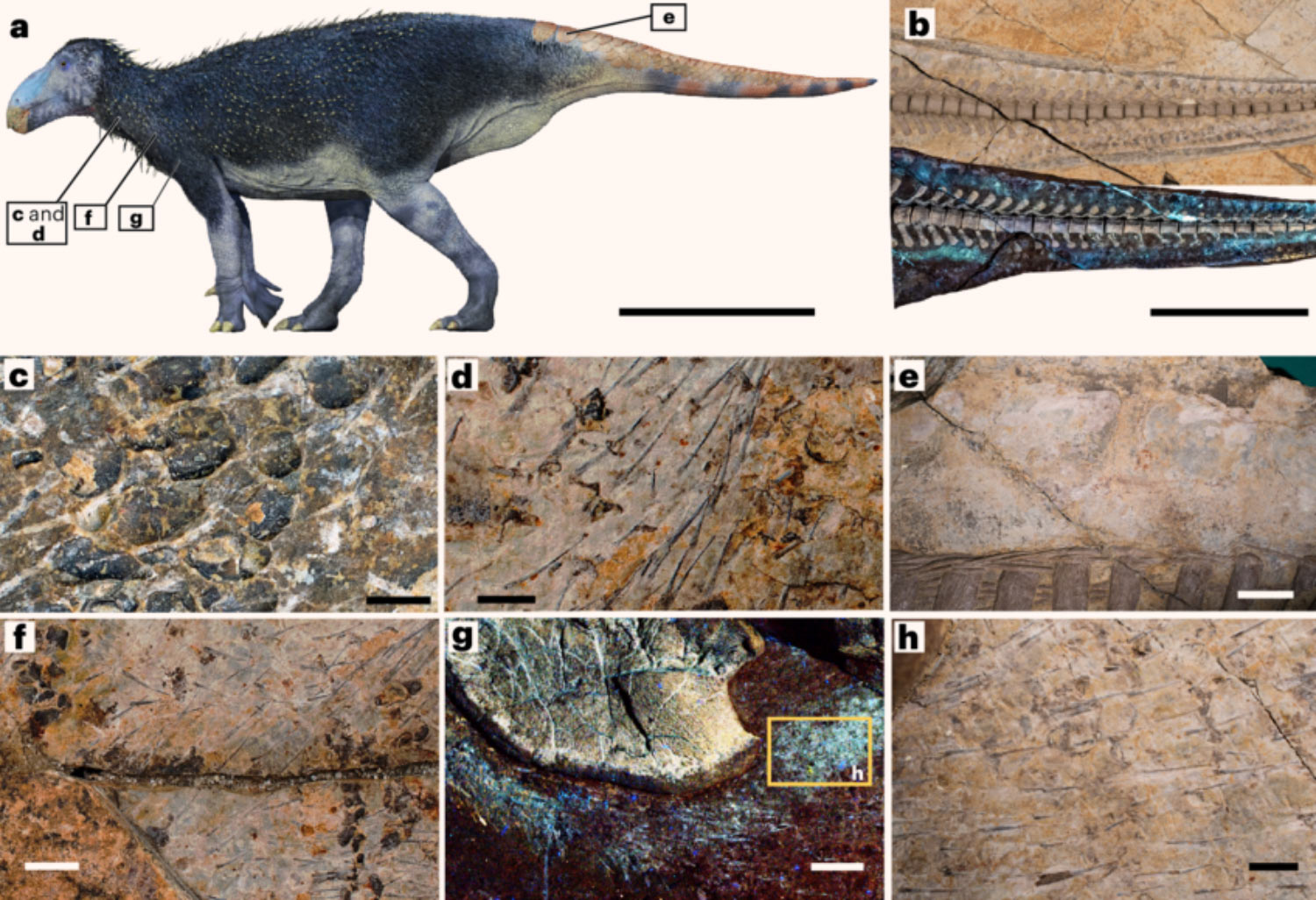
Early Middle Jurassic Siberian Kulindadromeus has recently been recognized as the sister taxon to Cerapoda. It is a noteworthy animal: not so much in terms of its skeleton (which is boringly standard for a neornithischian), but for its behavioral evidence and integument. Firstly it was found in bonebeds of many dozens of individuals, so it is very likely it lived in groups. More interesting than that, though, is its body covering. It is found in an environment which fine details can be preserved. It has some parts of its body (bottoms of the feet) there are simple scales; on the front of the legs and on top of the tail are more plate-like scales; on other parts of the body are simple filaments; and then there are odd plates with fuzz coming off them (unlike any structure known in other dinosaurs). So small ornithischians show complex types of integument beyond scales (and beyond fuzz).

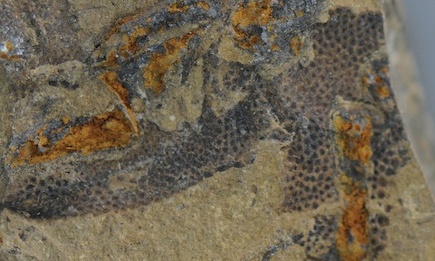
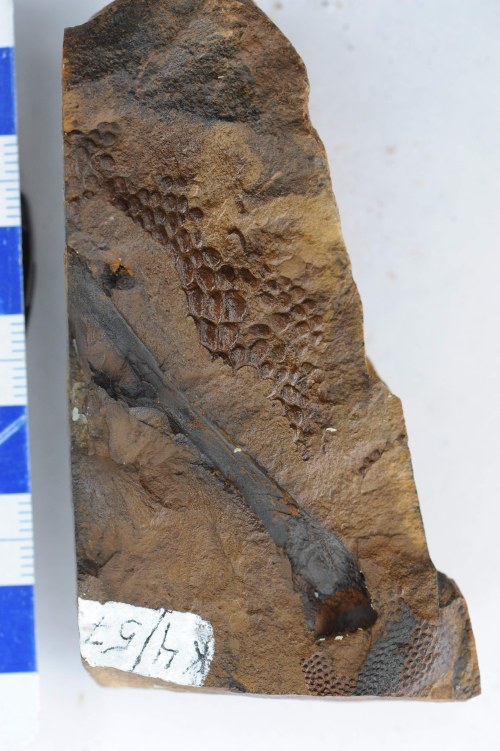


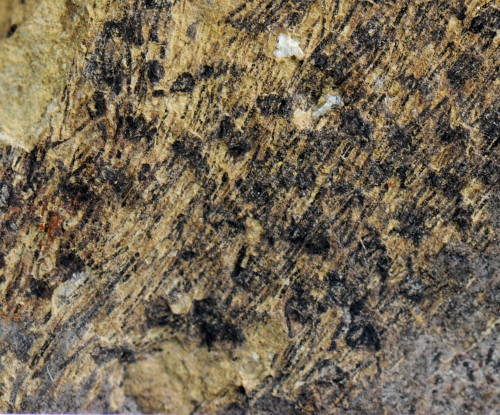
We'll cover Marginocephalia next lecture. Now, onto Ornithopoda proper.
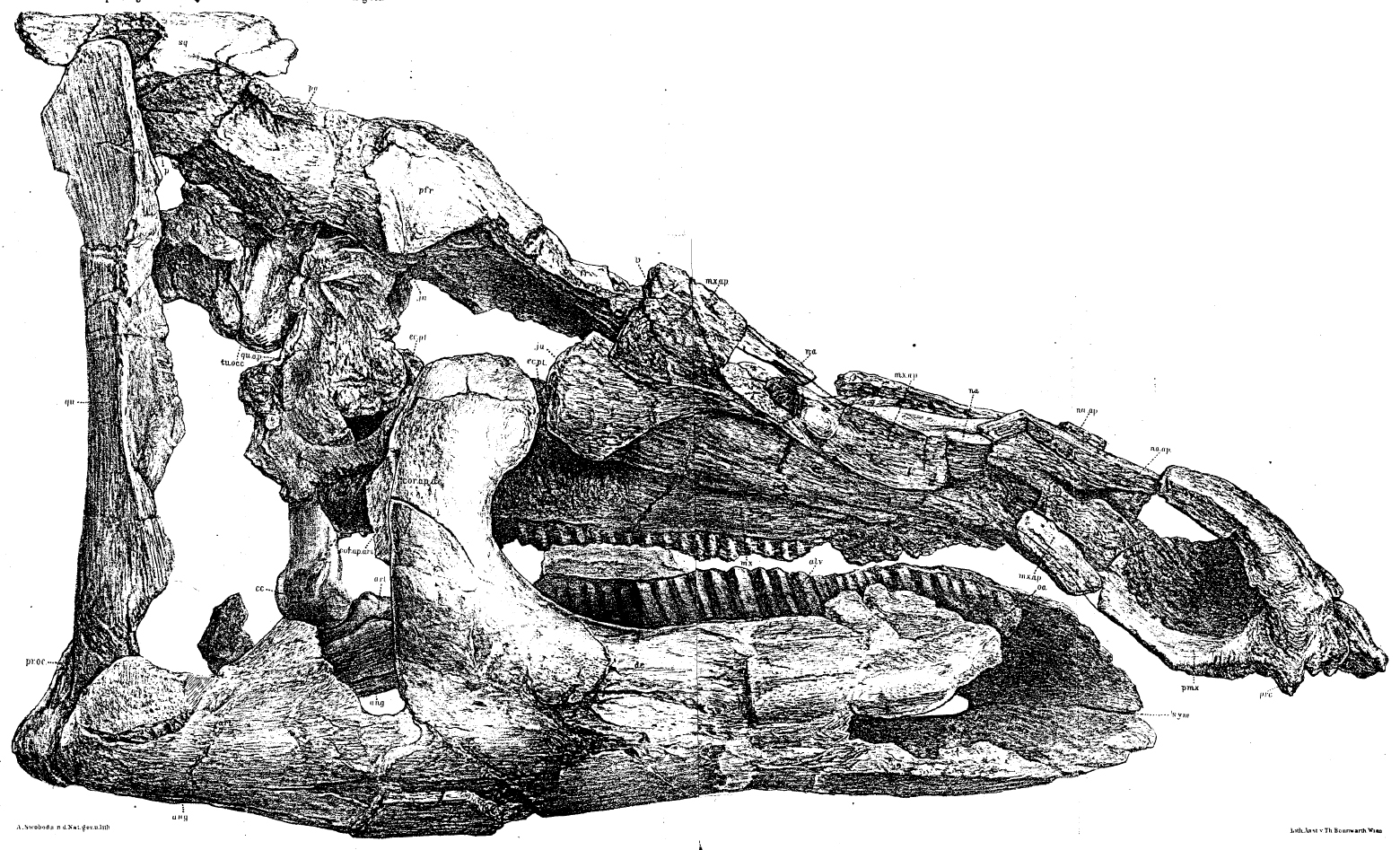
Ornithopods have a jaw joint ventral to the dentary tooth row, giving them a more specialized bite. (Derived heterodontosaurids independently evolved this trait.) Also, the shaft of their ulna is somewhat bowed. Additionally, ornithopods have a more complex chewing (grinding of upper teeth against lower ones) than other dinosaurs. A hinge is present between the premaxilla, upper part of the jaws, and braincase on the one side and the maxilla and bones of the cheek region on the other. It was once thought that this had a simple out-and-back motion to help grind the teeth while chewing. As we will see below, however, the motion is more complex. In any case, even early ornithopods seem to be able to grind up their food to a finer degree than most dinosaurs, allowing them to more quickly nutrients from that food.
(A note on the name "Ornithopoda": advanced iguanodontians do indeed have three-toed feet something like birds, as seen in these tracks. But basal ornithopods have four forward-facing toes, and no ornithopod seems to have the backwards-facing digit I of birds. In fact, it is kind of a lousy name for the clade, but rather late in the game to change it...)

Early Cretaceous Hypsilophodon was one of the first discovered ornithopods other than Iguanodon and the hadrosaurids, and for a long time it, "Nanosaurus", and Dryosaurus were the only known small-bodied ornithischians. It forms a clade Hypsilophodontidae with Spanish Gideonmantellia.

Large (7-8 m long, 7-9 tonne, hook-snouted Early Cretaceous Australian Muttaburrasaurus has traditionally been considered an iguanodontian (either a rhabdodontoid or an elasmarian.) But newly described fossils show it retained (or re-evolved?) premaxillary teeth, suggesting it branched off before the rise of Iguanodontia. Alternatively, it is an iguanodontian which underwent a reversal with regards to its premaxillary teeth.

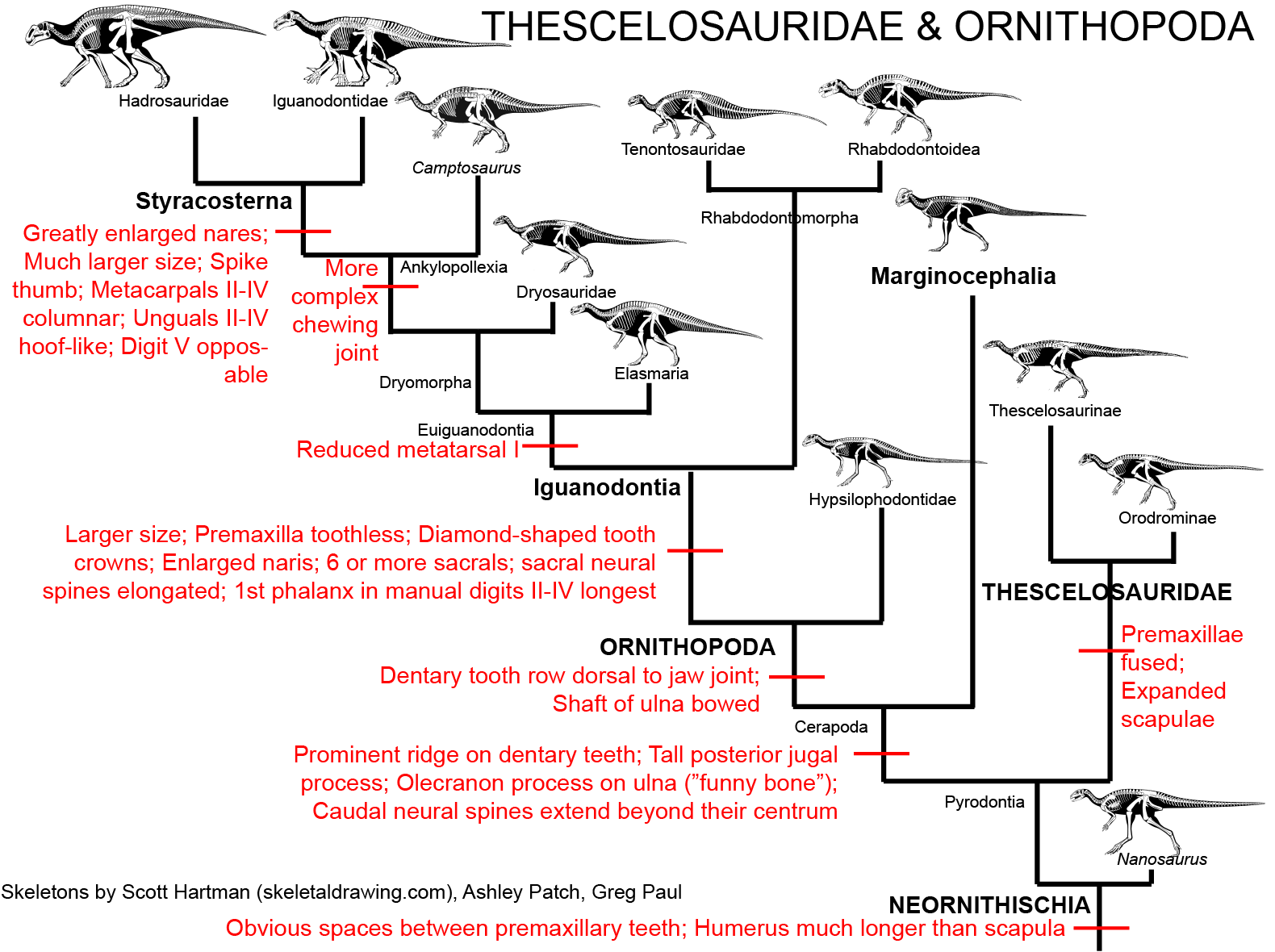
All the remaining ornithopods form a clade Iguanodontia. The members of Iguanodontia were transformed from their "hypsilophodont" cousins by a number of features:
- Larger and more heavily built
- Enlarged naris
- Toothless premaxilla
- Diamond-shaped tooth crowns
- Six or more sacrals
- Sacral neural spines which are elongated
- The first phalanx in manual digits II-IV the longest (suggesting that these fingers were being used at least in part to support weight)
- Increased sideways and backwards motion of the dentaries during chewing
- Well-developed pleruokinetic hinge in upper jaw, allowing lateral motion of the maxillae and other facial bones during chewing


Basal branches of Ornithopoda were obligate bipeds, but many of the iguanodontians were facultative bipeds only, spending a sizable fraction of time on all fours. (Very derived ones were essentially just quadrupeds.)
The oldest iguanodontian known is the Middle Jurassic dryosaurid Callovosaurus. Iguanodontians become more common in the Late Jurassic, but really come into their own in the Cretaceous. In many ecosystems the iguanodontians are the most abundant large animals, displacing sauropods and stegosaurs.
The first major branch of iguanodontians is the deep-skulled Rhabdodontomorpha. Its primary component is the Late Cretaceous European Rhabdodontidae, including Zalmoxes. Early Cretaceous Foskeia of Spain is small, early branch of rhabdodontomorph.
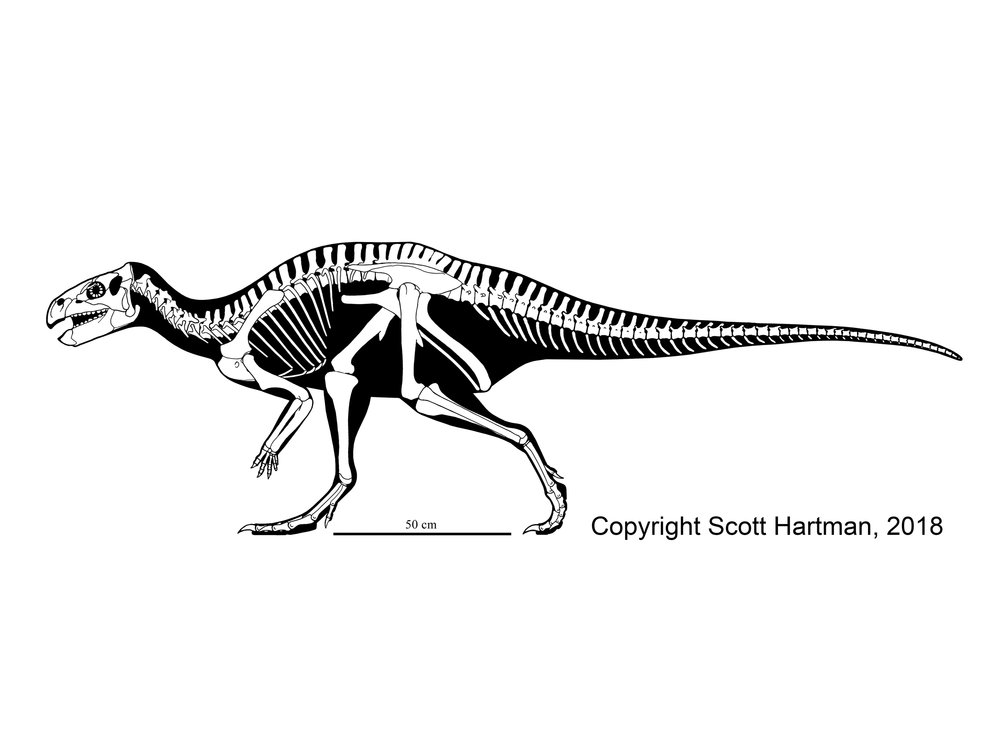
Once thought to be part of Rhabdodontomorpha, Tenontosauridae now appears to be closer to the euiguanodonts. Tenontosaurids are a North American clade of Early-to-earliest Late Cretaceous forms including small Convolvosaurus, intermediate-sized Iani, and larger Tenontosaurus.


The remaining iguanodontians are the Euiguanodontia, in which metatarsal I is greatly reduced (and thus the foot is tridactyl). One branch of euiguandontian is the Southern Hemisphere Elasmaria. South American (Talenkauen, Notohypsilophodon, Anabisetia, and Macrogryphosaurus, among others), Antarctic (Trinisaura), and Australian (Weewarrasaurus, Atlascopcosaurus, Qantassaurus, ultra-long tailed Leaellynasaura, and others) taxa. Most elasmarians were 2-6 m long.

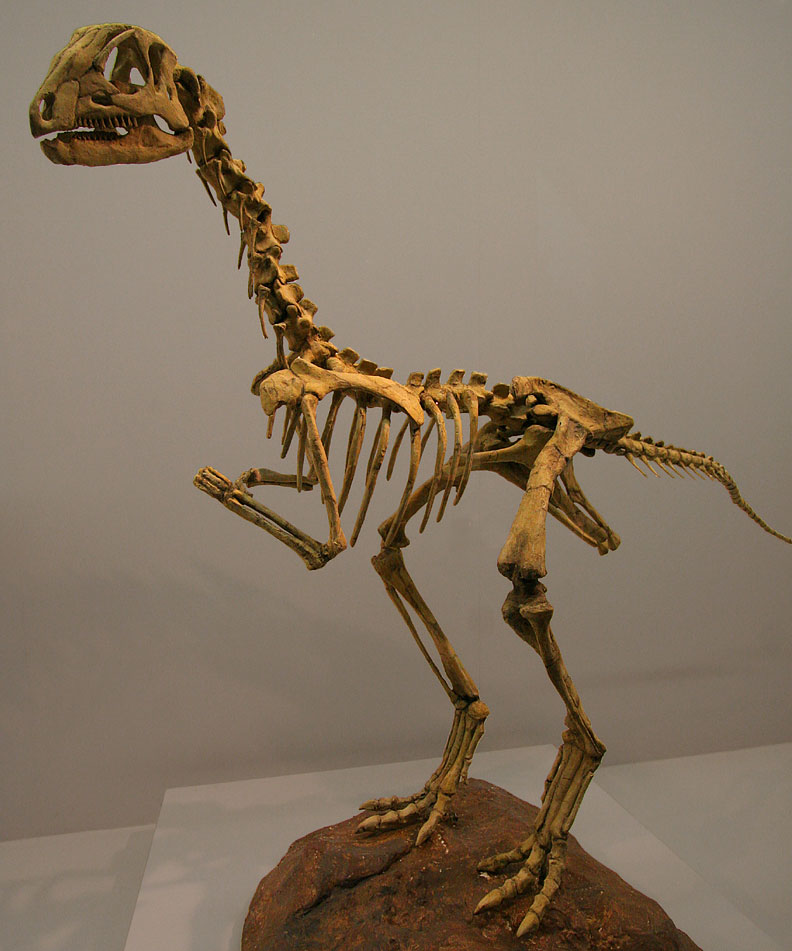
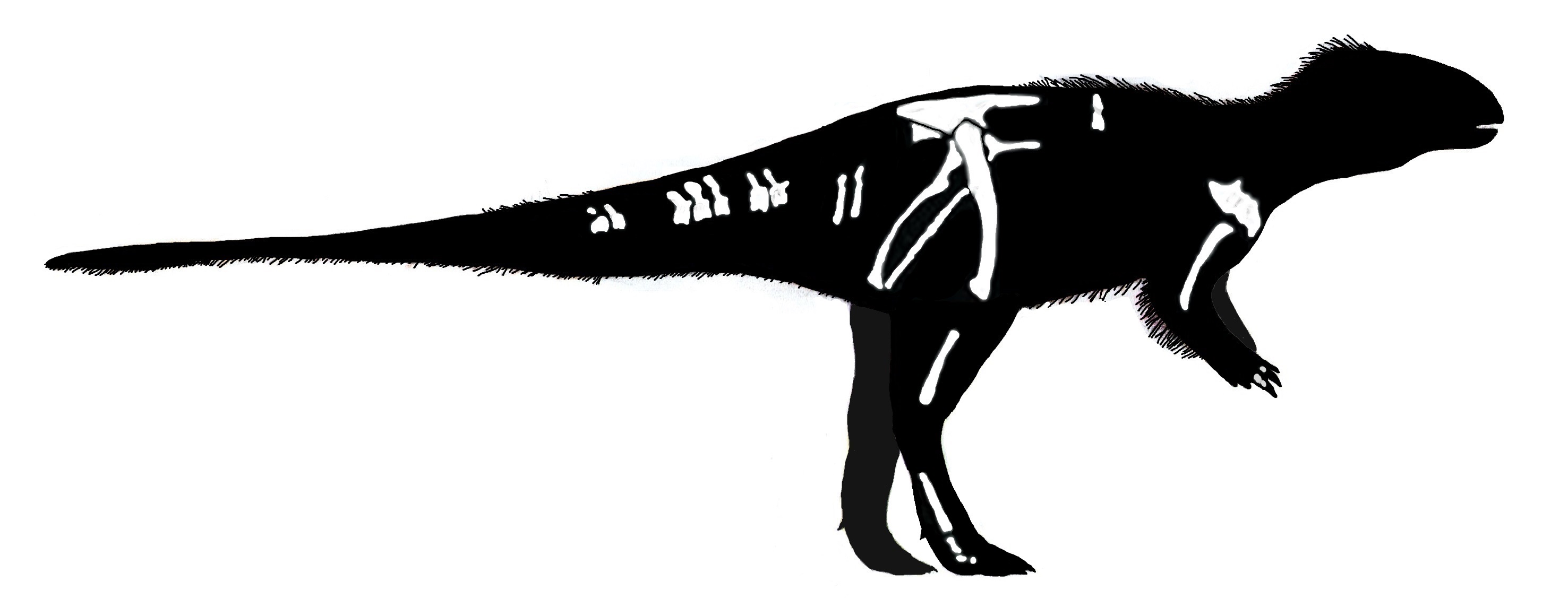

The remaining euiguanodontians are the clade Dryomorpha. The oldest known branch, and the one with the smallest body sizes, are the Middle Jurassic-to-Early Cretaceous Dryosauridae, best known from as Late Jurassic American Dryosaurus, African Dysalotosaurus (once thought to be the same genus as Dryosaurus), European Eousdryosaurus, and Early Cretaceous Valdosaurus of Europe and Elrhazasaurus of Africa.


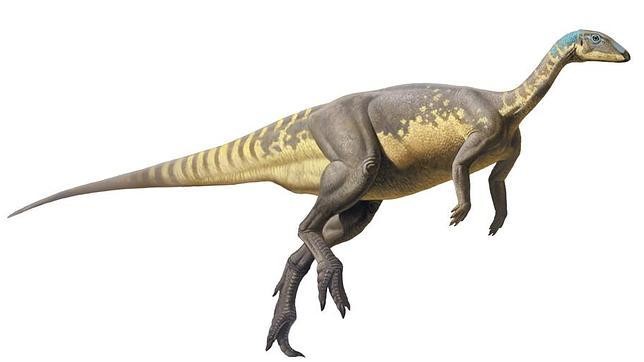
The remaining dryomorphs are the Ankylopollexia. The oldest and most primitive of these are the Late Jurassic, very likely paraphyletic, "Camptosauridae". Camptosaurus itself is the best known example of these, with several other taxa (Uteodon of North America and Cumnoria and Draconyx of Europe) either as separate species of Camptosaurus or a grade of near- and early styracosternans

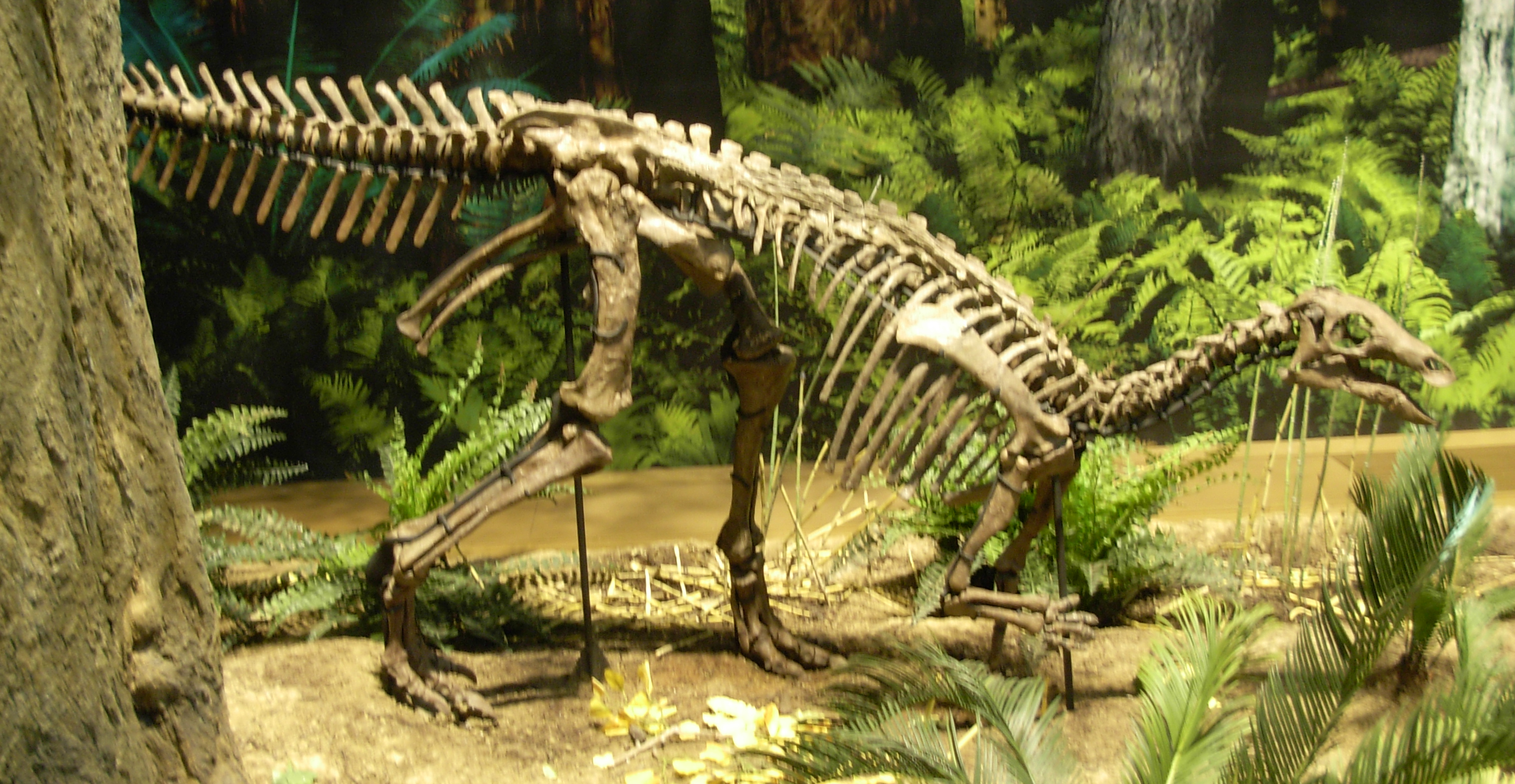
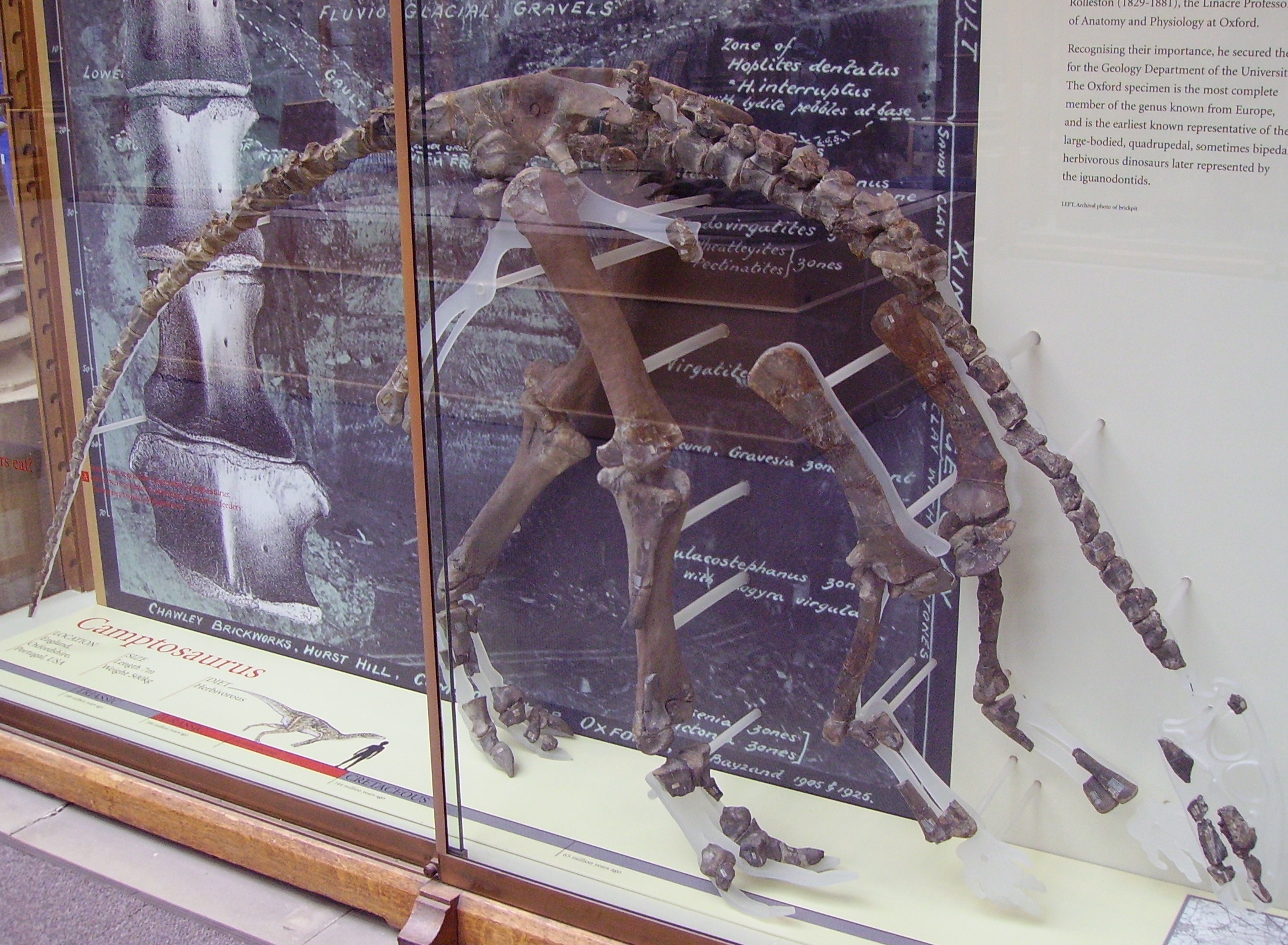
Styracosterna, the Quadrupedal Iguanodontians
The remaining ornithopods form the specialized Cretaceous clade Styracosterna. Their snouts have become longer and broader-ended with a better developed grinding jaws, while their hands have become better adapted for absorbing weight. These transformations are more fully developed in the hadrosauriforms.
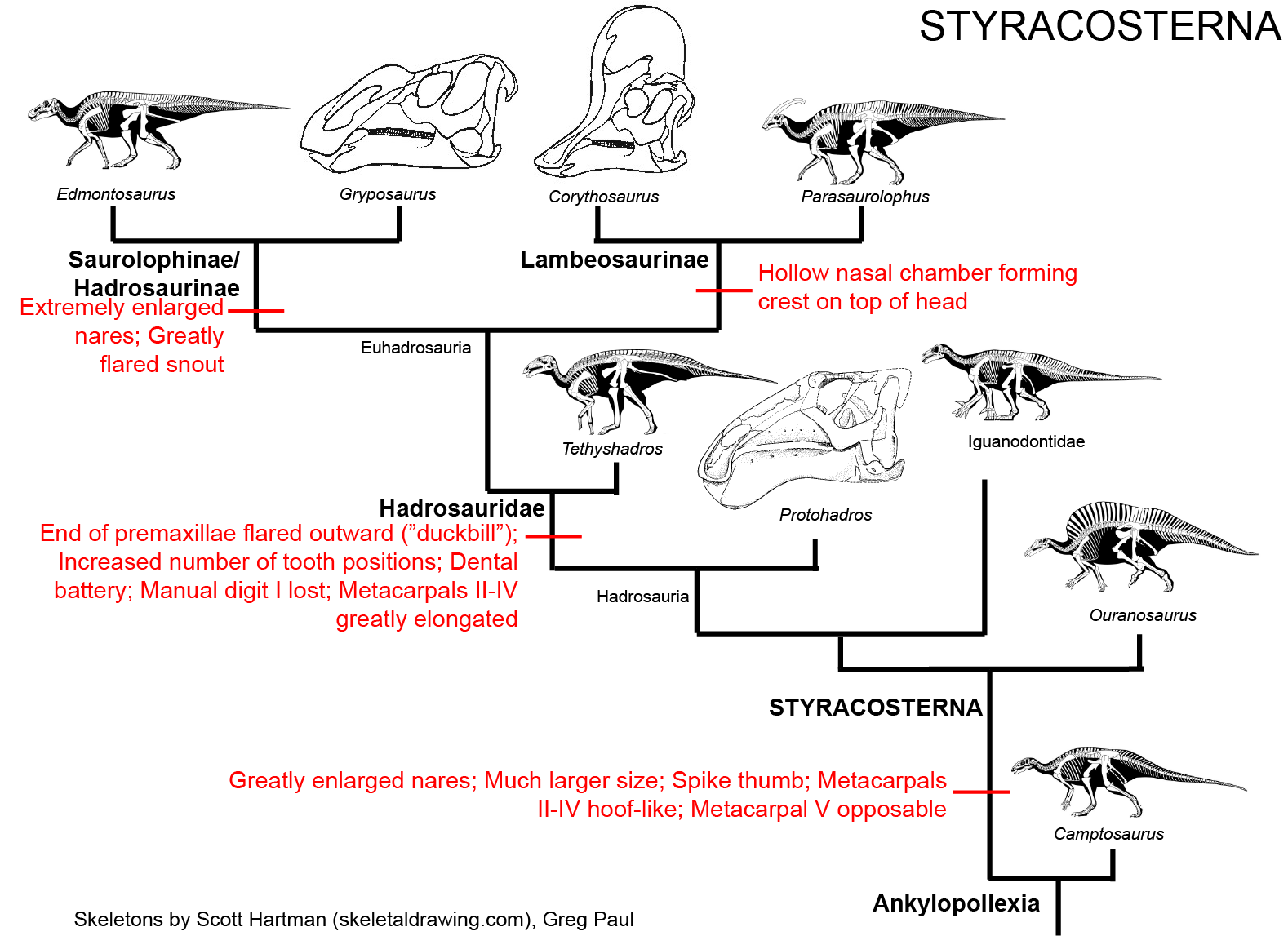
Simplified cladogram of Styracosterna
This represents the clade comprised of Hadrosauridae and all taxa closer to hadrosaurids than to Camptosaurus. The primitive styracosternans were once all grouped together as "Iguanodontidae", at least some of the old "iguanodontids" turn out to be paraphyletic with respect to hadrosaurids. Styracosterna is by far the most successful radiation among the ornithischians.
Styracosternans show the following transformations from the ancestral state:
- Much larger size: often 6 m or more, typically in the 8-10 m range, and a few surpassing 14 m!
- Greatly enlarged nares
- The "Swiss Army" hand:
- Thumb transformed into a spike of uncertain function
- Metacarpals II-IV columnar, functioning as weight support (basically transformed into metatarsals)
- Unguals II-IV hoof-like
- Opposable digit V

The major transformations of the forelimb and manus show that styracosternans were essentially quadrupedal animals all of the time. They could definitely rear up on their hind legs, and may have walked bipedal on occasion, but the trace fossil and biomechanical evidence shows them to be four-legged the vast majority of the time.
The combination of their great size, ability to rear on their hindlegs, and powerful beaks with grinding teeth allowed styracosternans to be excellent browsers of both low and high vegetation. At least some seem to have lived in herds.
Styracosternans are known from most of the Cretaceous world, but are most particularly common or diverse in Europe, North America, Asia, and (in the Early Cretaceous) northern Africa. Among the diversity of Early Cretaceous styracosternans are:
- Dakotadon, of Early Cretaceous North America (until 2007 considered a species of Iguanodon)
- Hippodraco and Theiophytalia of Early Cretaceous North America. (Theiophytalia was for a long time thought to be a specimen of Camptosaurus)
- Iguanacolossus, also of North America
- Squat heavily-built Lurdusaurus of northern Africa, which might form a clade with a few more poorly-known robust forms
- Fukuisaurus, from Japan
- Proa of Spain
- Lanzhousaurus of China, with the largest teeth of any herbivorous dinosaur
- Slender sail-backed Ouranosaurus of northern Africa and its European relatives Morelladon and Brightstoneus (and possibly Hypselospinus), collectively the Ouranosauria
- Iguanodontidae, including:
- European Iguanodon itself, the largest non-hadrosaurian ornithischian known
- Comparably large Magnamanus and Delapparentia of Early Cretaceous Spain
- Robust Barilium and slender Mantellisaurus of Early Cretaceous Europe, both until relatively recently considered species of Iguanodon
- Dollodon, either another slender European styracosternan once considered a species of Iguanodon or simply another species of Mantellisaurus
- And possibly others

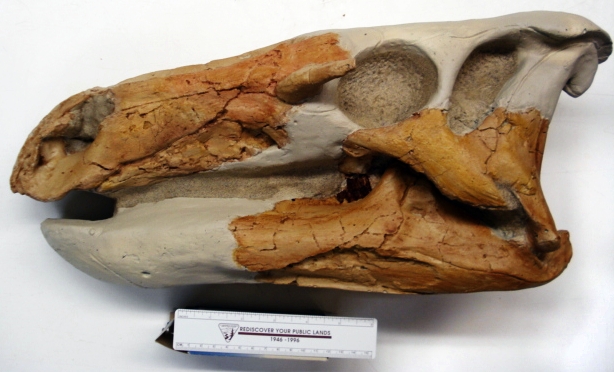


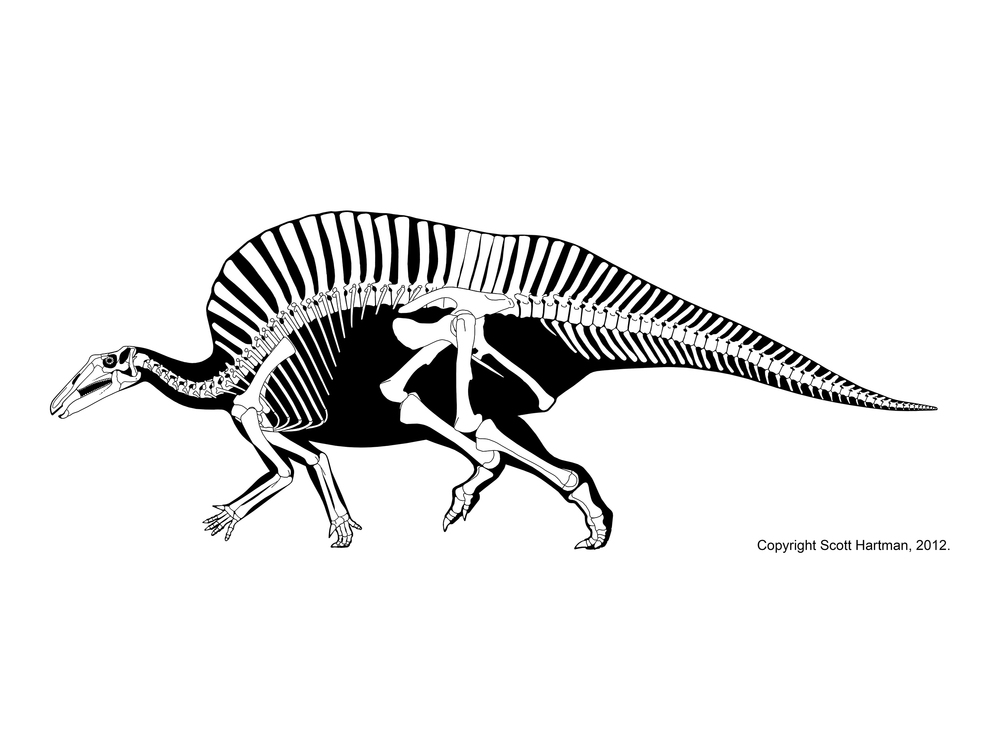

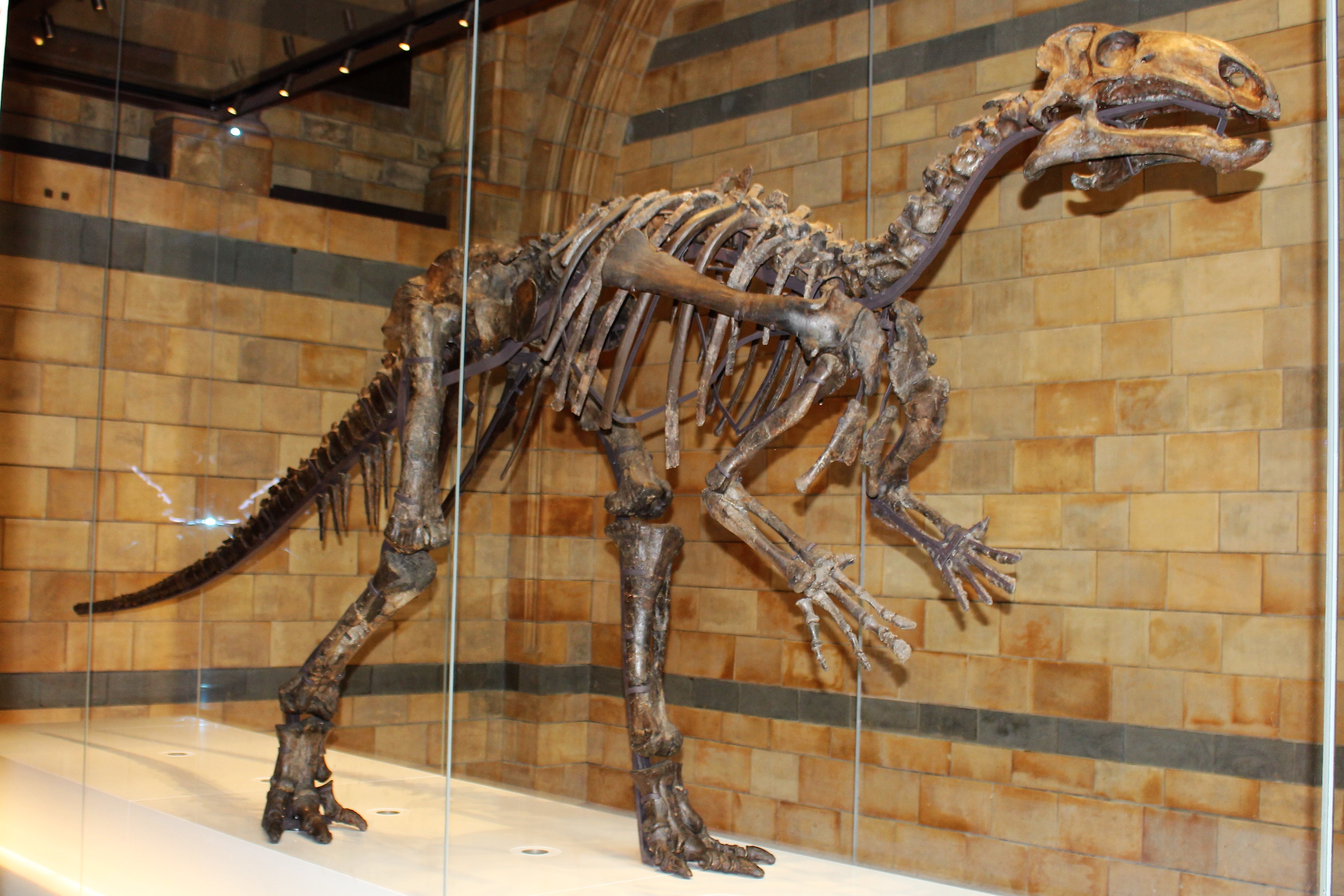

One subset of styracosternans (Hadrosauroidea) in particular shows a series of transformations including an increase in the number of tooth positions in the jaws and expansion of the snout. These dinosaurs are on the lineage which leads to the duckbilled dinosaurs (Hadrosauridae). Among the precursors and cousins of the hadrosaurids are Early Cretaceous tall-snouted Altirhinus of Asia (once considered a species of Iguanodon), Jinzhousaurus, Bolong, Gongpoquansaurus, and Probactrosaurus of China; Eolambia and Equijubus of western North America; Early-to-Late Cretaceous Protohadros of western North America; and Late Cretaceous Bactrosaurus and Plesiohadros of Asia. (These latter two fall out within Hadrosauridae proper in some analyses). There are many others, and more are being named every year.

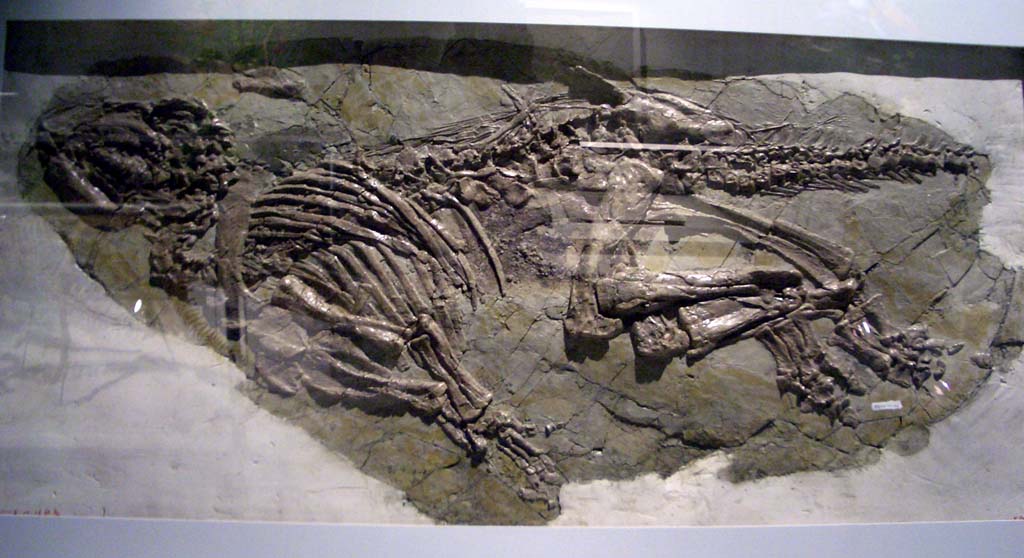


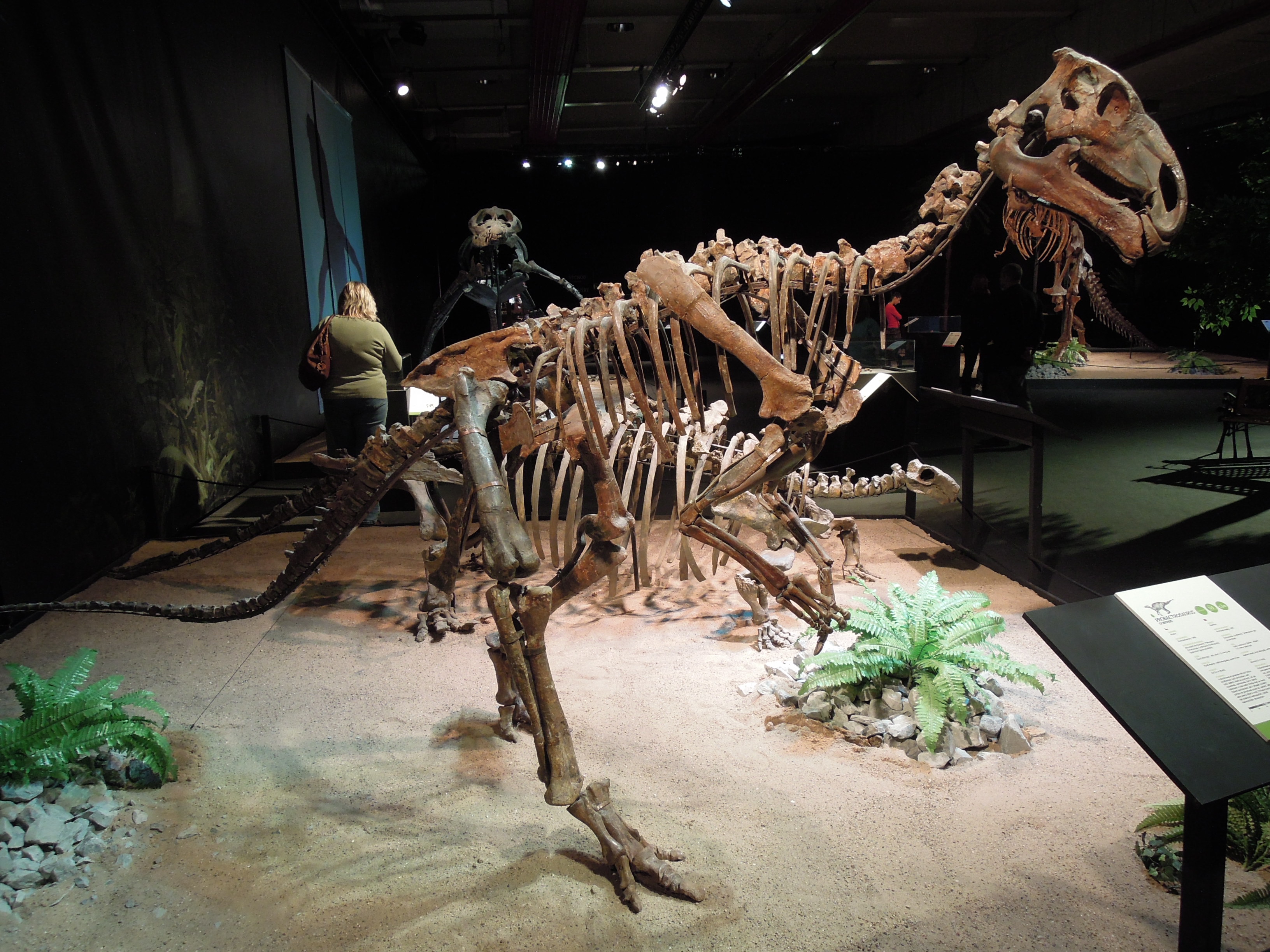


Some of these newly discovered hadrosauroids have given us new insights into the biology of these dinosaurs. For instance, Early Cretaceous Haolong, whose fossils shows that it was covered both in scales (long known in ornithopods) as well as hollow quills. Given that it is one of the only members of this clade preserved in an environment which would preserve quills, these might actually be FAR more common than we currently believe. Late Cretaceous Qianjiangsaurus has a tall hollow nasal crest which seems to be convergently evolved with corythosaurian lambeosaurine hadrosaurids.

Qianjiangsaurus is part of a paraphyletic series of Late Cretaceous taxa running up to Hadrosauridae proper. Many of the genera in this part of the tree have at some point been considered in Hadrosauridae before that clade got its proper definition (the clade comprised of the concestor of Hadrosaurus, Lambeosaurus, and Saurolophus and all of its descendants.) Among these are Eotrachdon of Alabama; the European clade Telmatosauridae (containing Italian Tethyshadros and Telmatosaurus of Romania); and others.


Hadrosauridae, the Duckbilled Dinosaurs
True Hadrosauridae is the most speciose and specialized branch of the ornithopods. All known members of Hadrosauridae proper are from the Late Cretaceous. Although known from Europe, South America, and Antarctica, the main diversity of hadrosaurids is in Asia and North America.
The transformations of hadrosaurids relative to their ancestors include:
- Further expansion of the end of the snout (the "duck bill")
- Further increase in the number of tooth positions
- Development of a grinding dental battery: closely interlocked teeth forming a continuous grinding surface
- Teeth of greater structural complexity than all other vertebrates (more complex than the molars of grazing mammals, and only approached in complexity by ceratopsids)
- Loss of the thumb spike (hadrosaurids were thumbless)
- Elongation of metacarpals II-IV

Hadrosaurids see the fullest expression known of the ornithopod grinding mechanism. As mentioned above, it was once thought that the motion was relative simple: the side unit would move outwards when the lower jaw was brought up, giving a side-to-side grinding of the teeth during chewing. This model (proposed during the 1980s) was called "pleurokinesis" (or "side-motion"). Here is a video of a computer animation of this interpretation:
However, more detailed study using CT scans and more complete computer models show the motion is really a LOT more complex. Pleurokinesis plays a part in it, but there are other directions as well. No name is given at present for this form of jaw mechanics, but below is a preliminary model of how it works:
But wait! There's more (or perhaps "less", in terms of motion). Even more recent study suggests that motion at the joints above was limited at best. Instead, these studies suggest that the maxillae and other facial bones remained fixed in position, but that the mandible moves either by rotation along the long axes (pivoting at the predentary) and/or moving forward and backwards. Here is an animation showing one example of this:
Obviously there is ongoing work on this topic, so we'll see how it resolves over time.
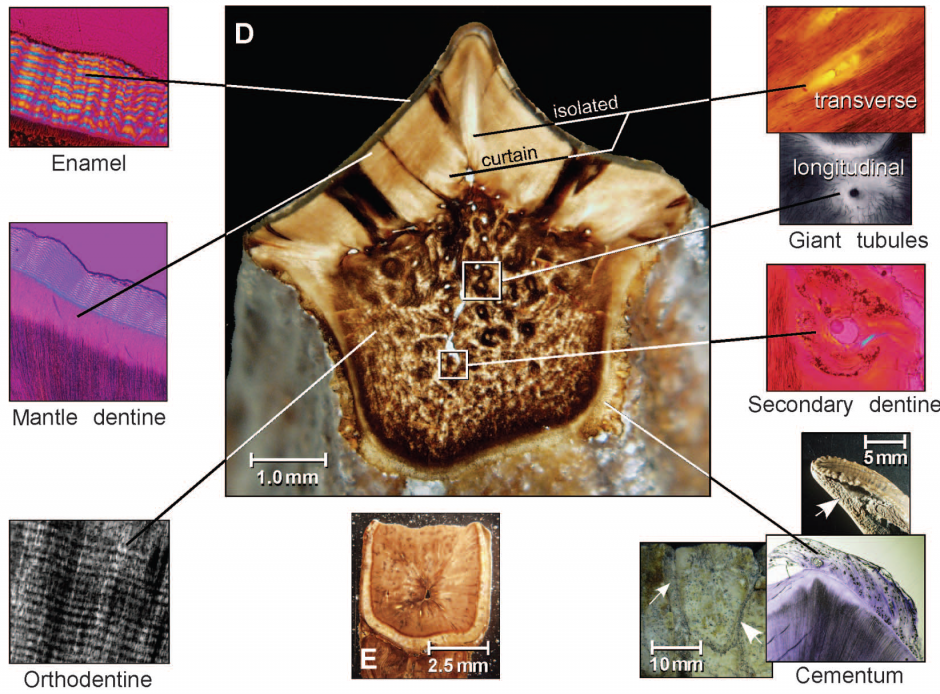
Hadrosaurids had exceedingly complex tooth stuctures--which were made of six different tissue types, rather than the standard two of most tetrapods--which maintained a good girding surface as they wore down.
Hadrosaurids include some definite herd dwellers. The entire life cycle of hadrosaurids is preserved: nests, eggs, embryos, hatchlings, juveniles, subadults, and adults. Hadrosaurid footprints and isolated hadrosaurid teeth are among the most common Late Cretaceous fossils of North America. Skin impressions and even mineralized soft tissue are known for duckbills.
The latest on-going phylogenetic analyses show two major subclades of Hadrosauridae: crested Lambeosaurinae and broad-snouted Saurolophinae. The latter group has sometimes been called "Hadrosaurinae", because older analyses found Hadrosaurus of New Jersey to be a member of this group. However, most recent studies find that Hadrosaurus lies outside the Lambeosaurinae-Saurolophinae clade (Euhadrosauria, or "Saurolophidae" to some researchers.) Both the major clades are known from a great number of excellent skeletons.

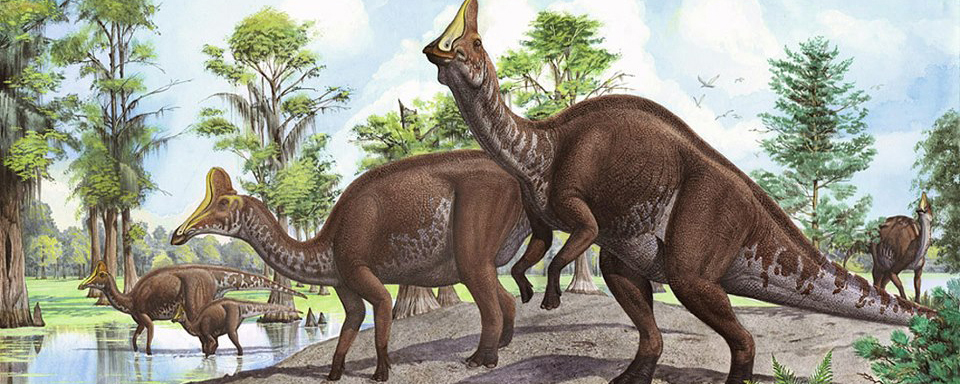
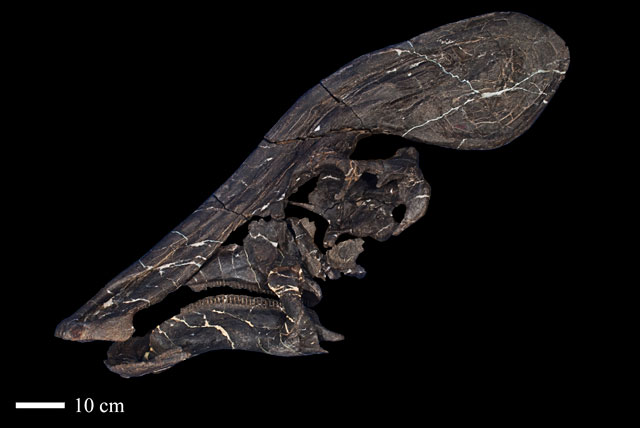
Lambeosaurines are characterized by a hollow crest covering the nasal passage. These crests, which vary between species, may have had both a visual and sound display function. Baby lambeosaurines lacked this structure.


CT scans allow for the pathways of these passages to be studied in greater detail:
Differences in crest size and shapes within some populations may reflect sexual and/or ontogenetic variations.

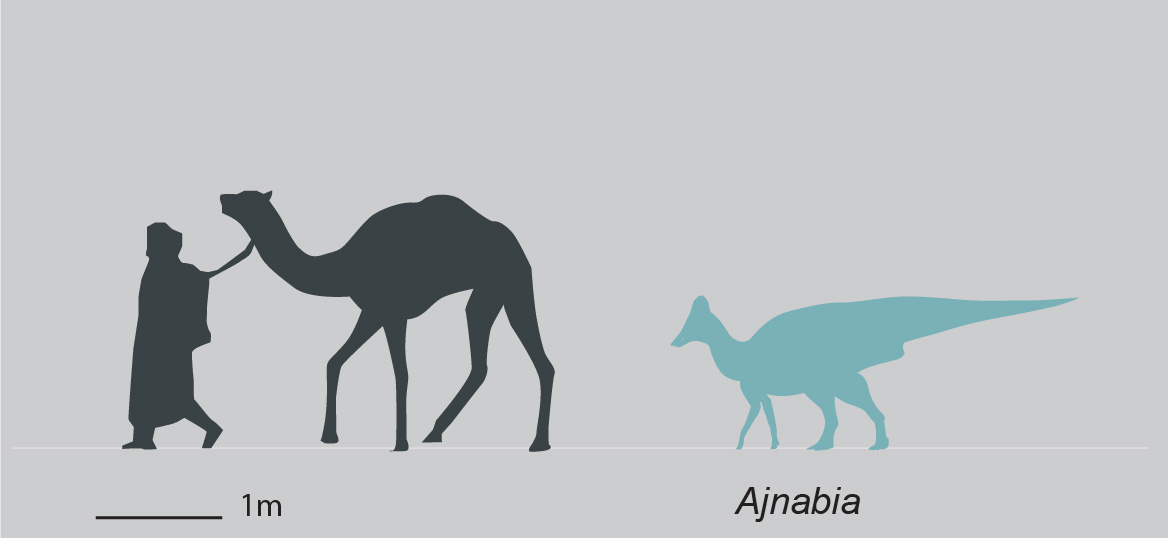
There appears to be several early branching subdivisions from Eurasia: Aralosaurini, Tsintaosaurini (which have a tall crest), and Arenysaurini (which may include Japanese Nipponosaurus). Arenysaurini includes the first known African hadrosaurid, Ajnabia. The vast known diversity of lambeosaurines is the clade Corythosauria, containing two large subclades: tube-crested Parasaurolophini and helmet-crested Lambeosaurini.


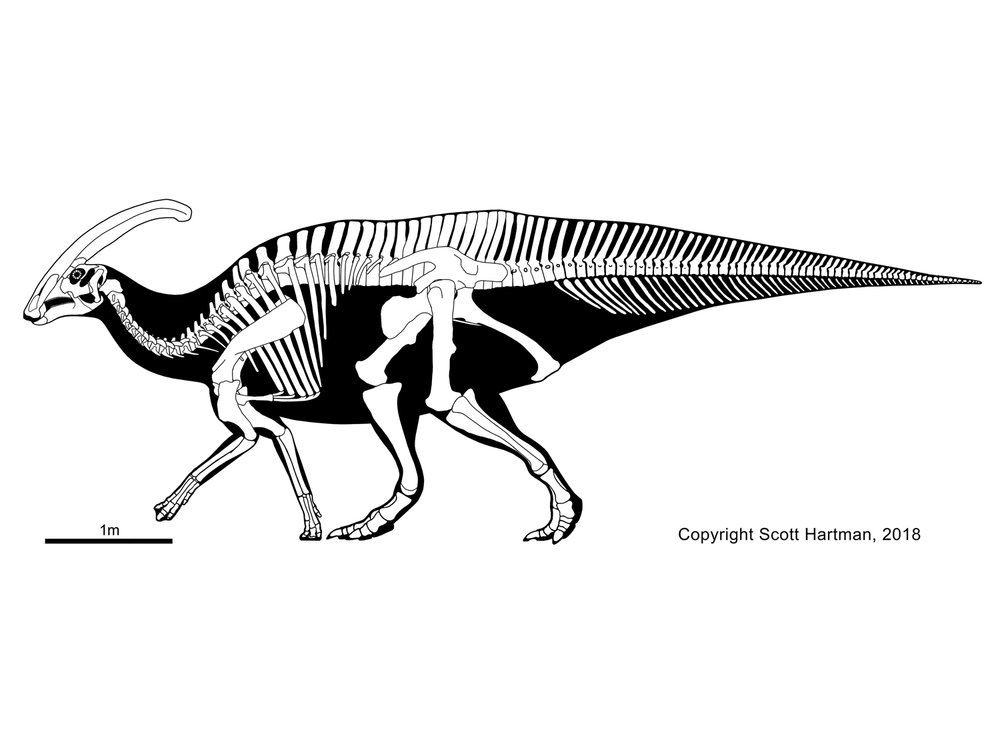
Among the better known parasaurolophinins are Charonosaurus of Asia, Tlatolophus of Mexico, and Parasaurolophus of western North America. Among the lambeosaurinins are Olorotitan, various species in the genera Corythosaurus and Lambeosaurus, Hypacrosaurus, Velafrons, and GIGANTIC Magnapaulia of North America.


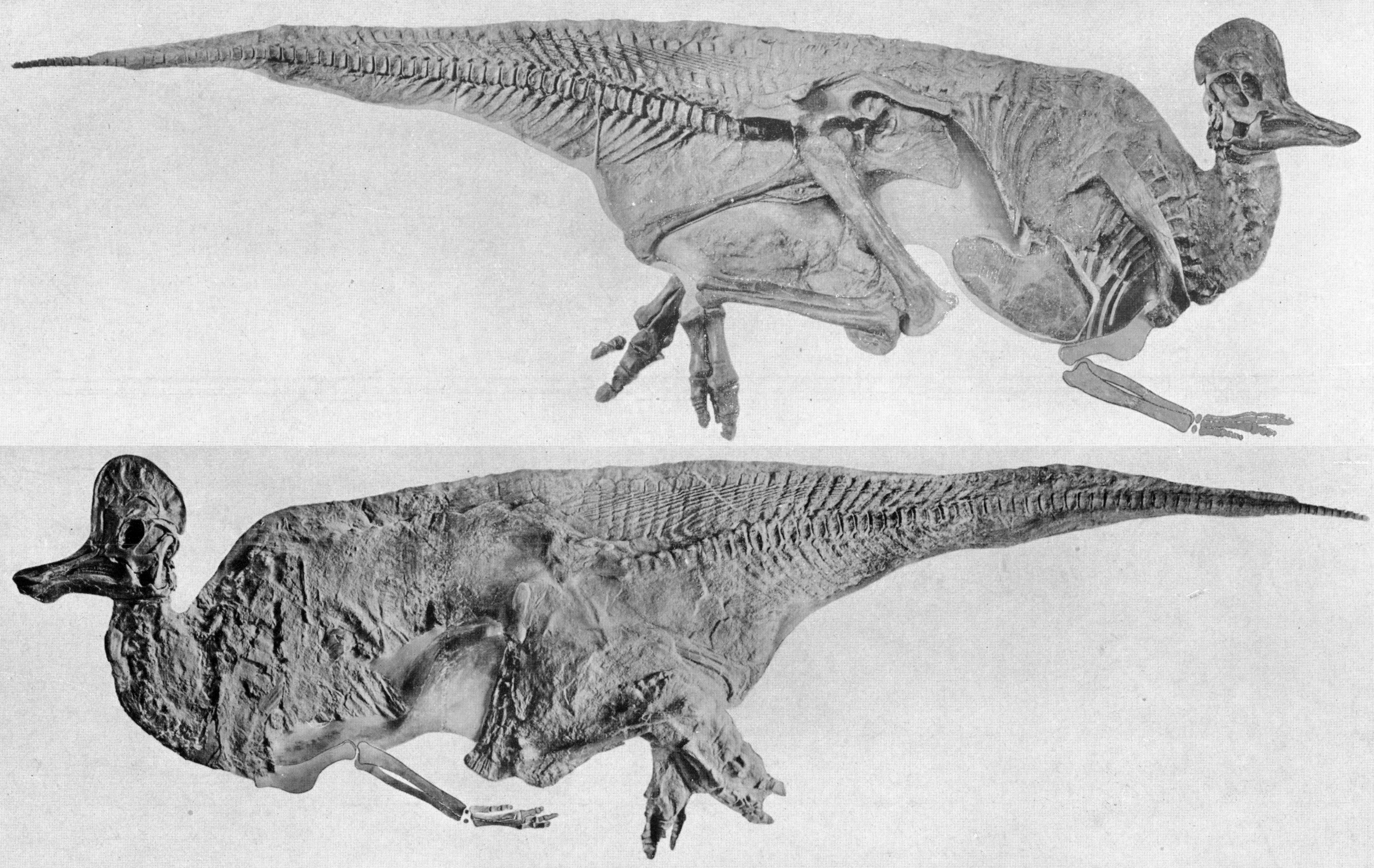


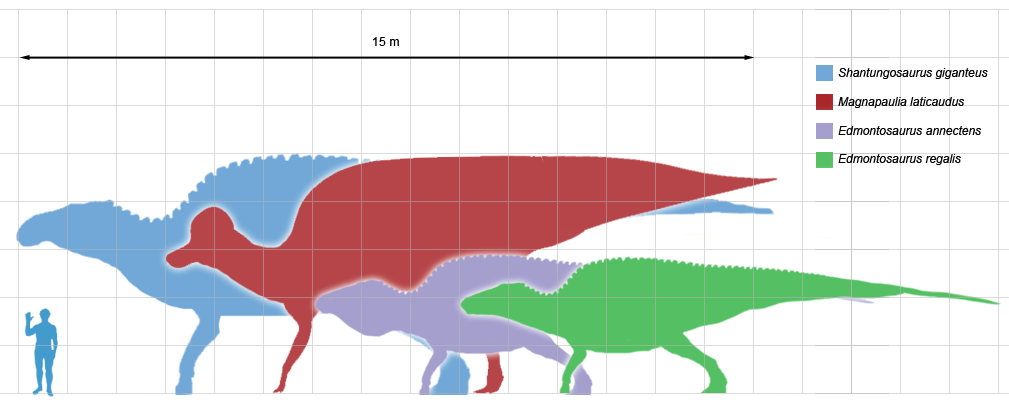
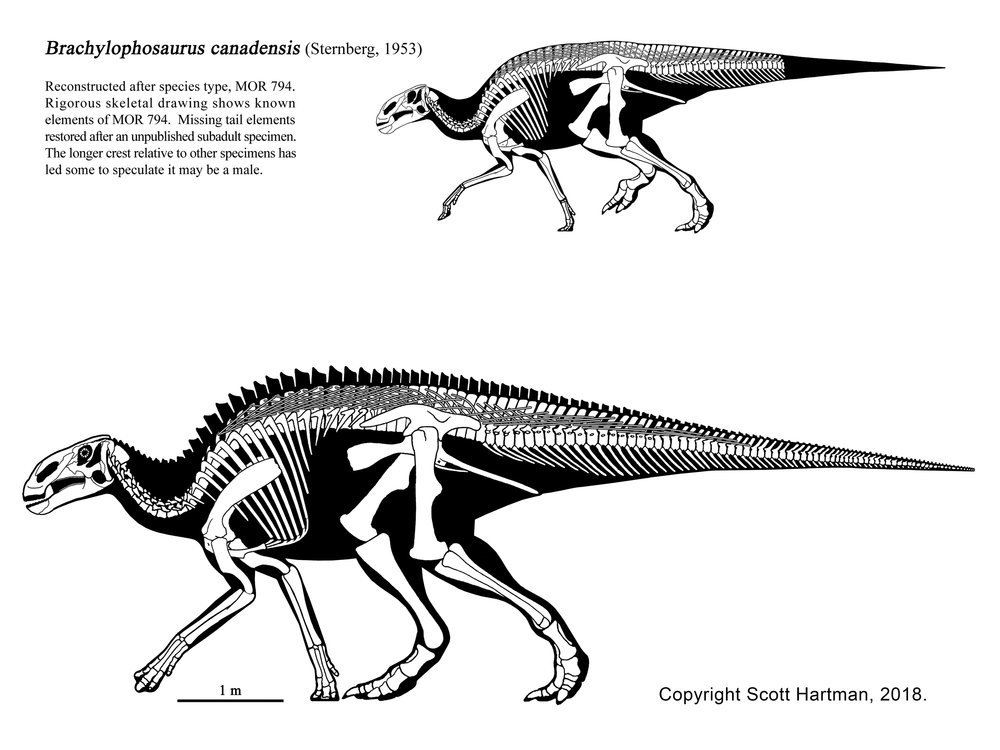
Saurolophines (aka "hadrosaurines") differ from their relatives by greatly flared snouts and greatly expanded nares. Some saurolophines had (relatively) short snouts: North American Gryposaurus and Brachylophosaurus, for instance. Others had longer snouts: North American Maiasaura and Prosaurolophus and transcontinental (Asia and North American) Saurolophus. The extreme development of the duckbill can be found in the Edmontosaurini, a group containing sauropod-sized Shantungosaurus (largest of all ornithischian dinosaurs) of China, Kamuysaurus of Japan, and North American dwarf Ugrunaaluk (which is possibly just Edmontosaurus) and giant (but not quite as big as Shantungosaurus) Edmontosaurus proper. Babies of even the long-snouted saurolophines had relatively short faces.

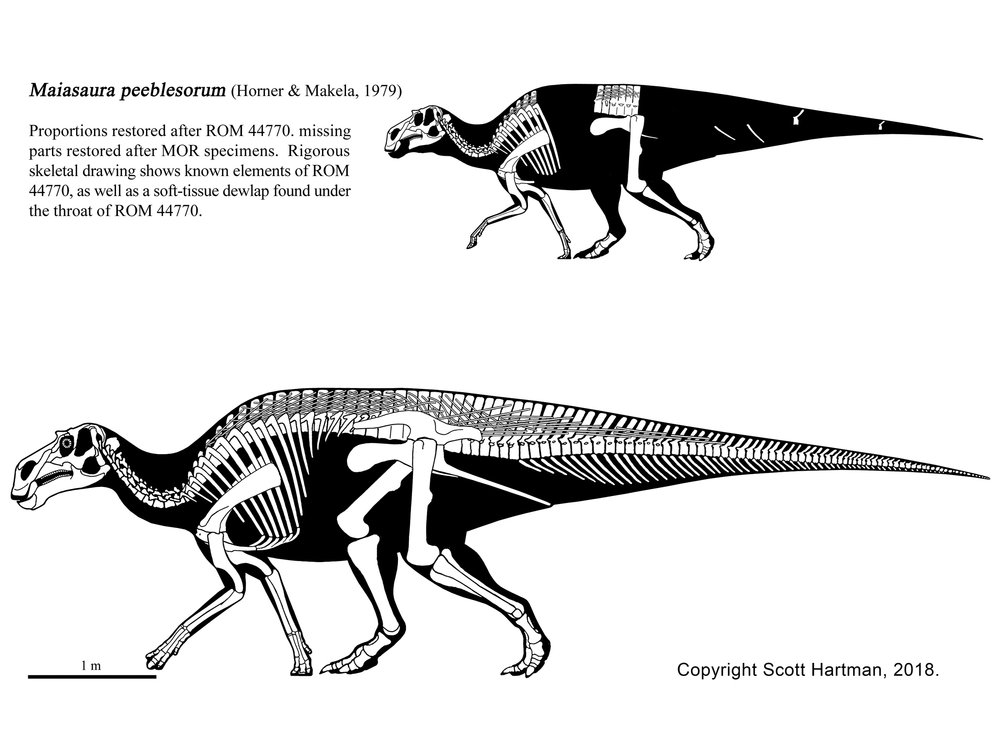
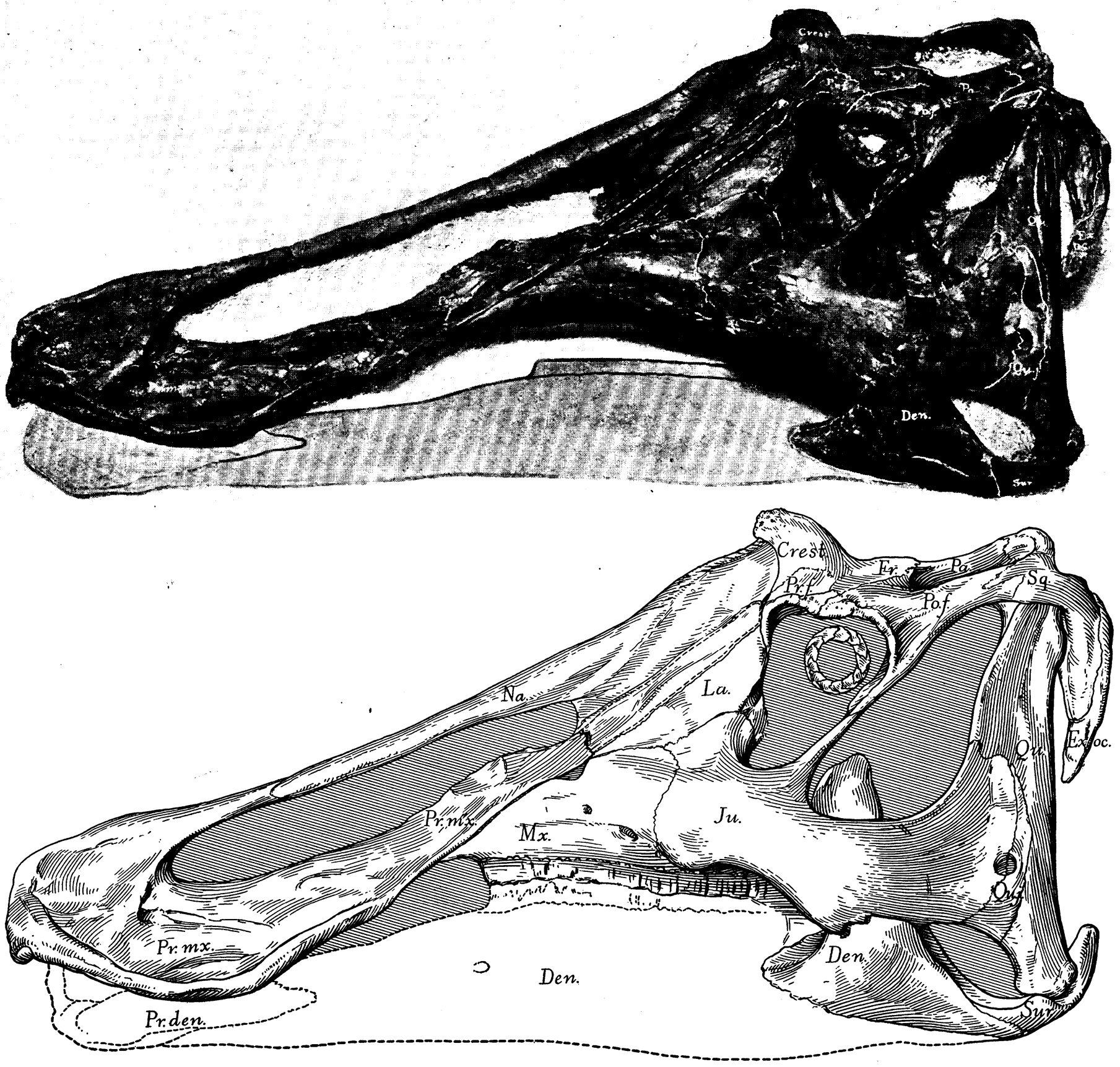
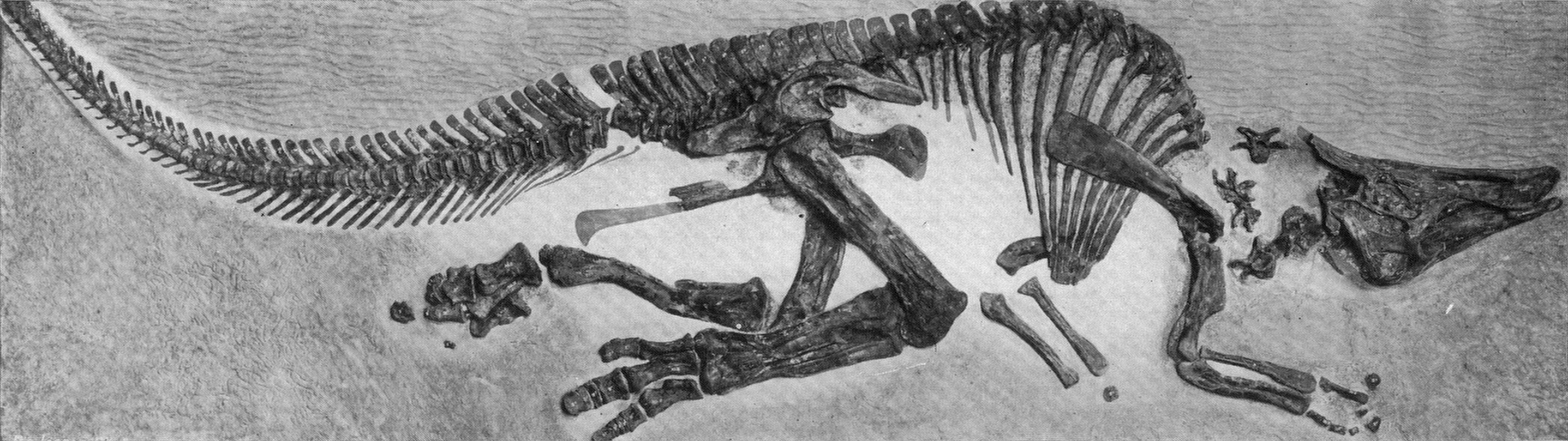
.jpg)
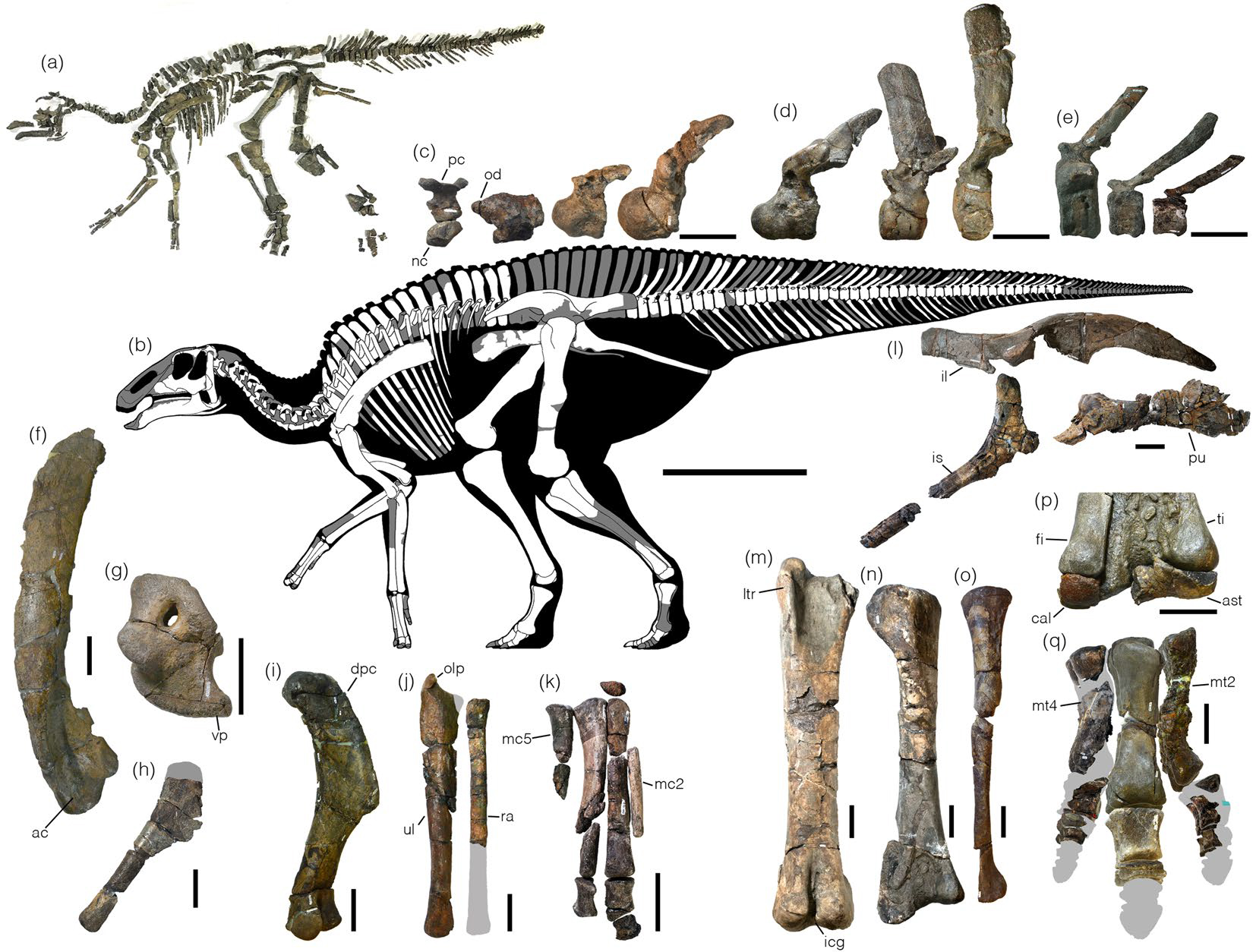


Both saurolophines and lambeosaurines produced giants of greater than 13 m in length. These represent the largest animals other than sauropods that have ever lived on land, and the heaviest (potential) bipeds in Earth's history.
Microwear analysis of the teeth of hadrosaurids is consistent with their complex chewing patterns. In at least the broad-billed edmontosaurs there is a great degree of scratching on the teeth, suggesting that they were primarily low browsers of tough vegetation ("grazers"). (Given the wide snouts of Edmontosaurus, Shantungosaurus, and so forth, this makes a lot of sense.) Studies have not yet been published to see if most hadrosaurids were primarily low browsers, or if some of them might have been mostly high browsers. Given the diversity of bill shapes and snout lengths (and the diversity of species overall), there was probably a number of different diets among the hadrosaurids.
Evolutionary Trends in Thescelosauridae and Ornithopoda
Feeding adaptation transformations
- The modified jaw/tooth position and pleurokinetic hinge allowed basal ornithopods to process food more efficiently than typical ornithischians
- Basal neornithischians and small primitive ornithopods had relatively narrow snouts, and so were probably more "choosy" feeders
- Larger iguanodontians (with broader beaks and greater feeding height range) may have had a more general diet
- Increasing pleuokinetic hinge ability, broader bill, and development of the dental battery allowed the styracosternans (and most especially the hadrosaurids) to become some of the most efficient herbivores in amniote history.
Locomotory changes
- Basal neornithischians and basal ornithopods retained the dinosaurian obligate bipedal habit
- Iguanodontians became facultative bipeds, with at least some hand function becoming locomotory
- Styracosternans were essentially obligate quadrupeds
Social behavior in Ornithopoda
Neornithischians (in particular ornithopods (in particular iguanodontians (in particular hadrosaurids (in particular lambeosaurines)))) have abundant evidence for socially-related adaptations, including: herding; visual (and possibly aural) displays; species recognition structures; possible sexual dimorphism. We will discuss these more fully in the third section of the course.
Heterochrony, size, and ornithopod history
In general, peramorphosis seems to play an important role in neornithischian evolution. Hatchling iguanodontians tend to resemble adult "hypsilophodonts", while hatchling hadrosaurids tend resemble young primitive iguanodontians, and young hadrosaurids tend to resemble the immediate outgroups of Hadrosauridae.
Basal neornithischians and basal ornithopods were small (comparable to basal members of other ornithischian groups). But at the base of Iguanodontia and the base of Styracosterna there are major size increases. Additionally, various different styracosternan lineages independently achieved very large (>12 m) size.