Quaking the Delaware
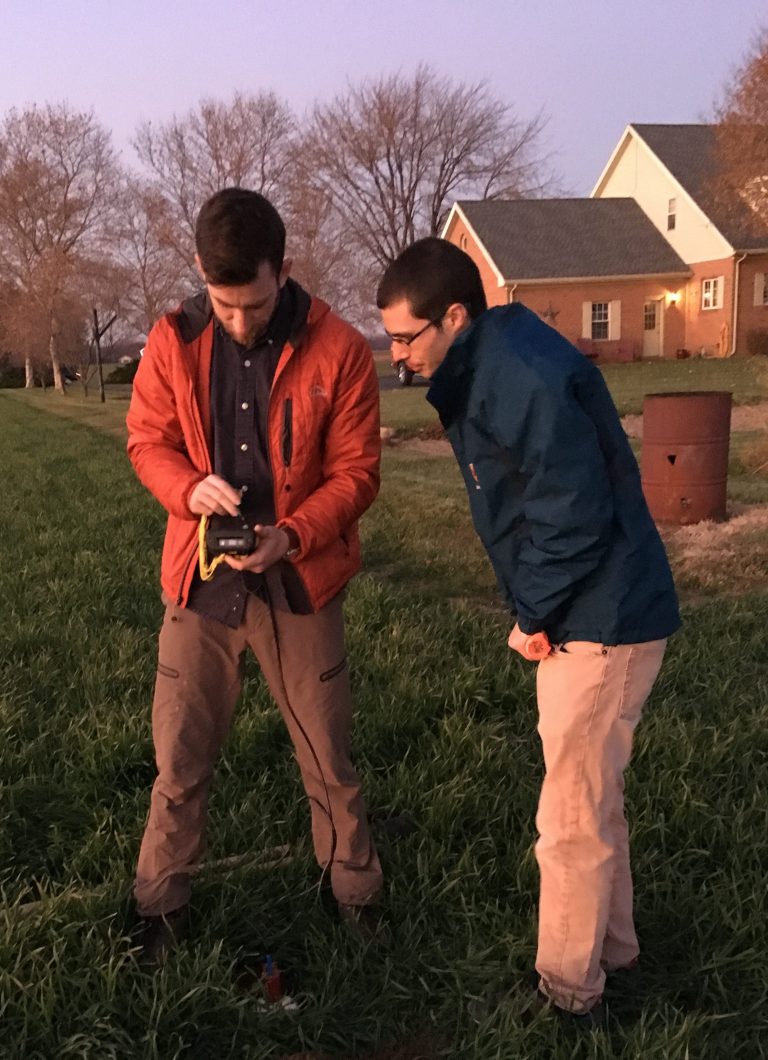
Graduate students at the University of Maryland Seismology Lab sprung into action following the M4.1 earthquake that struck Dover, Delaware on November 30, 2017. The very next day, they were out in the field, deploying seismometers that would be recording aftershocks for the next 6 weeks. Thank you …
Things to consider when interpreting Sp receiver functions…
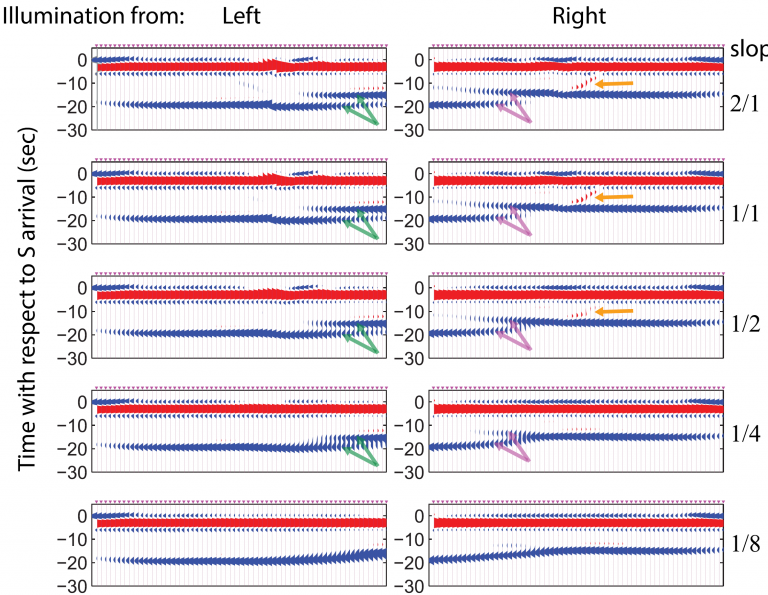
Conversions of shear waves (S) to compressional waves (P), often analyzed as Sp receiver functions, are useful for studying upper mantle layering, and have been used to map upper mantle seismic impedance interfaces in various tectonic settings. Recently, common conversion point stacking of Sp …
About those amplitudes…
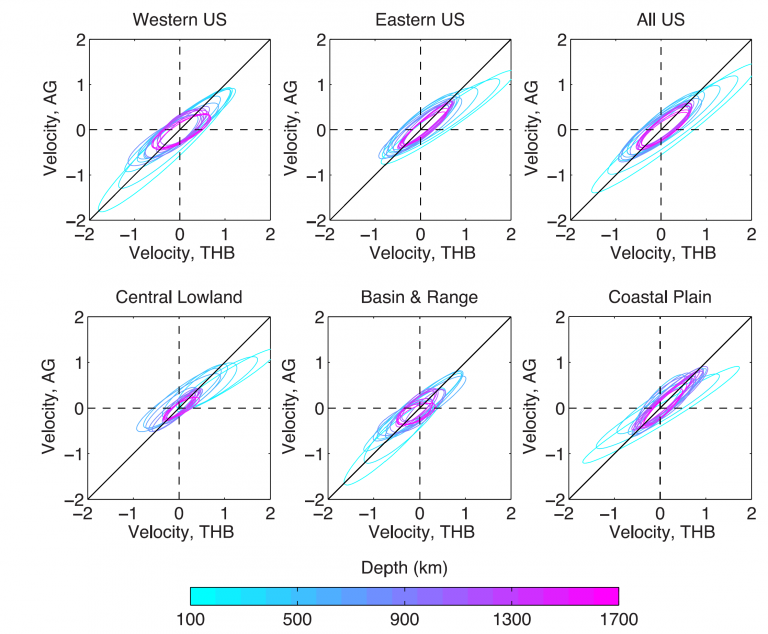
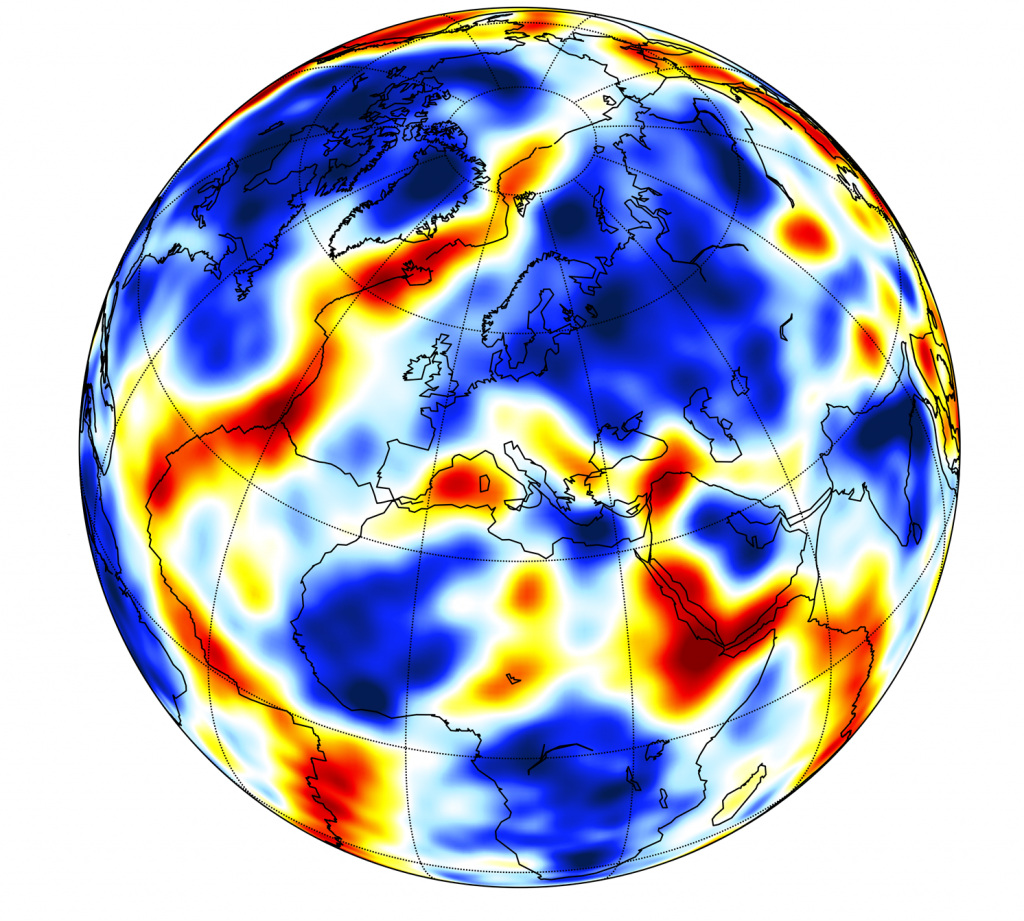
It is well known, at least among tomographers, that our images of the Earth’s interior are washed out. Lateral variations in seismic velocities are likely to be weaker in our models than in the actual Earth due to explicit and implicit regularization needed to obtain a solution to our …
Improvement in P-wave tomography due to EarthScope
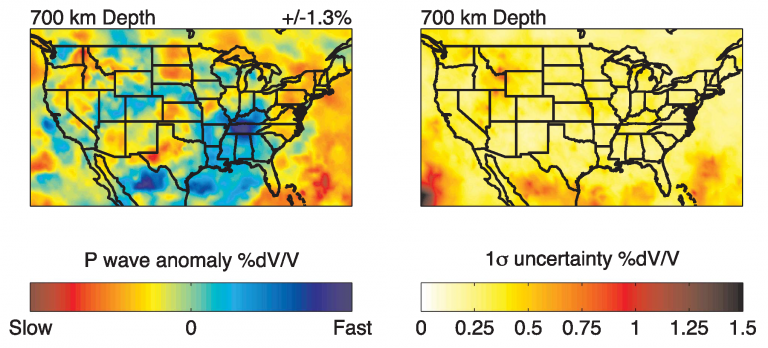
The EarthScope project has been described as the Apollo program of the solid Earth community. It has enabled an unprecedented investment in seismic instrumentation, and the creation of a uniform and high-quality network covering the United States. Data collected by this network transformed our …
Congratulations and Best of Luck to Sutton Chiorini!
Sutton Chiorini, who has been an undergraduate researcher in our lab for three years, has graduated and started a Master’s program at Miami University of Ohio. We wish her the best of luck in her future studies and research and will miss her engaging presence, excitement, and (s)warmth!
Pair of IRIS summer interns joins the group
This summer, we had the pleasure of hosting two summer undergraduate interns: Anant Hariharan from Cornell, and Brittany Washington from Rugters, Newark. While Anant worked on analyzing the lengthscales of heterogeneity in mantle models constructed from long and short period data, Brittany …
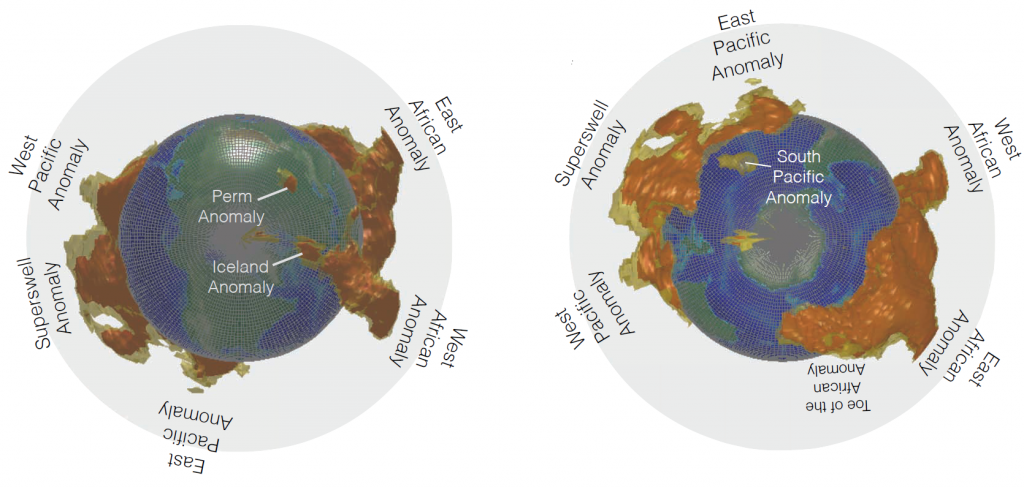
Reference Model of LLSVP Morphology
Using depth-dependent clustering analysis of global Vs and Vp tomographic models, we have constructed a new reference model for LLSVP shape and volume. We obtain new, much larger estimates of the volume/mass occupied by LLSVPs—8.0 % ±0.9 (μ ± 1σ) of whole mantle volume and 9.1 % ±1.0 (μ ± 1σ) of …
Congratulations to Anthony Mautino
This month, Anthony Mautino obtained his MS in Geology with a thesis about characterizing spherical Couette flows with acoustic normal mode splittings. Here, we are gathered to celebrate Anthony’s achievement, as well as bid farewell to Andrew Eagon who was a summer intern in the lab from …
3D Reference Earth Model
REM-3D is a project funded by the National Science Foundation and carried out by Raj Moulik, Ved Lekic, Barbara Romanowicz, and Adam Dziewonski. If you have questions, please do not hesitate to contact us. You might find the answer you are looking for in our new FAQ section. The aim of the project …
Dr. Pritwiraj Moulik joins Maryland Seismology as a Postdoctoral Fellow
We are pleased to welcome Raj Moulik to the lab, and look forward to working with and learning from him in the coming years! Raj will be leading the NSF-funded 3D Reference Earth Model project. You can learn more about him here.