A Molten Layer Above Mars’s Core
When we publish papers, we hope they can get read, cited, or even built upon. It’s rare that a paper gets argued with in print and at length, which is probably a sign that the paper was worth writing! A couple of years ago, Henri Samuel, at the Institut de Physique du Globe de Paris,
The Gradiometer Has Finite Size
There are something like a hundred million unexploded landmines and pieces of ordnance in the ground worldwide, most of them small, shallow, and made of enough metal to have a magnetic signature. But reliably finding them with a magnetometer is far from easy. Heidi Myers, a former Ph.D. student …
A Method Built for Mars, Focused Back onto the Moon
On Earth, a straightforward way of measuring the thickness of the crust beneath a seismometer is to look for converted waves — a P wave that turns into an S wave at the crust-mantle boundary. The method is simple, reliable, and used everywhere. On the Moon it has never really worked for P-to-S …
An Iron-Rich Root Beneath Hawai’i
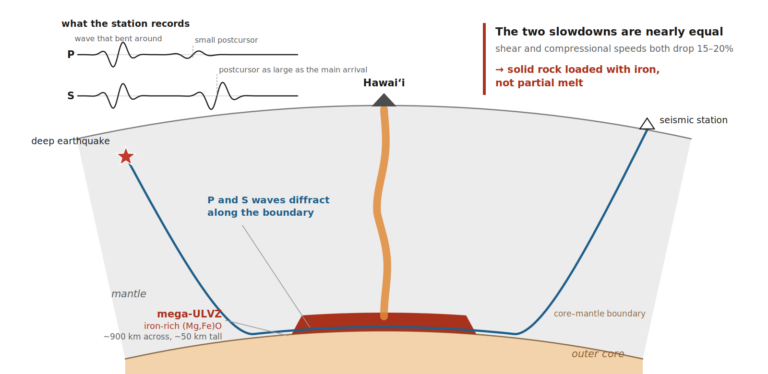
Sitting at the very base of the mantle, directly beneath Hawai’i, is a patch of rock where seismic waves slow down dramatically. Structures like this — ultralow-velocity zones, or ULVZs — are found in many places along the core-mantle boundary, but the ones beneath major hot spots are exceptionally …
When the Average Isn’t a Solution
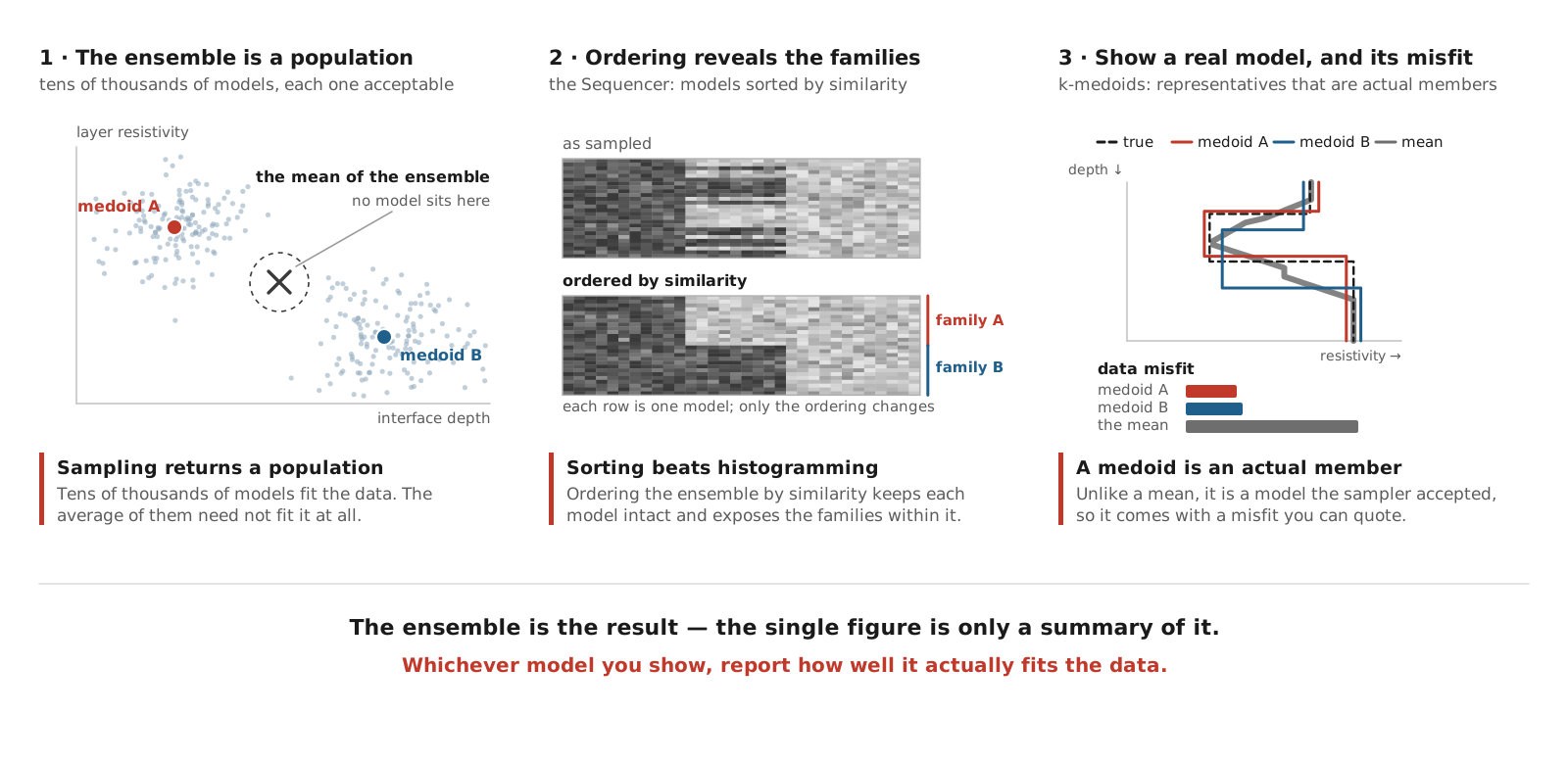
Bayesian sampling methods have entered the geophysical toolkit due to their versatility and power at quantifying uncertainty. Our lab has spent a decade contributing to them: transdimensional deconvolution of receiver functions, self-parameterizing inversions of surface waves, Bayesian tomography …
Rehearsing for the Moon
Three papers led by Jingchuan Wang (formerly a postdoc at Maryland, currently at Caltech) appeared in 2025 — one in JGR: Planets, one in Geophysical Research Letters, one in Earth and Space Science. They describe fieldwork at sites hundreds of miles apart and they read, at first glance, like three …
A Hidden Fault and Missing Aftershocks Beneath Delaware Bay
Eight years ago, the day after a magnitude 4.2 earthquake struck east of Dover, Delaware, graduate students from this lab were in the field installing seismometers alongside collaborators from the Carnegie Institution for Science, the Delaware Geological Survey, the U.S. Geological Survey, Lehigh …
Constraints on Martian Core from First Observations of SKS Waves
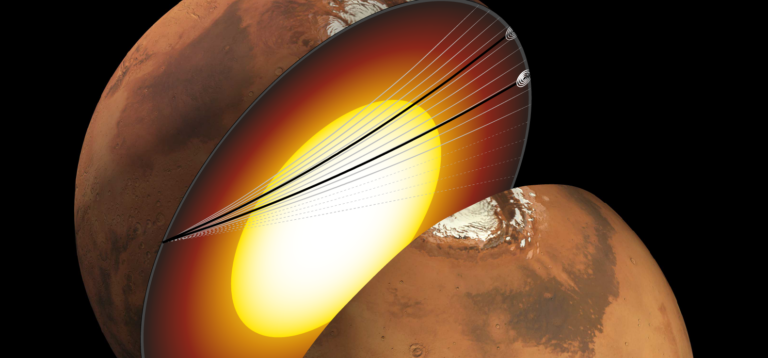
Mars has a liquid iron alloy core at its center. Using seismic data gathered by the InSight mission, we have made the first observations of seismic waves traveling through Mars’ core. We use the travel times of core-transiting seismic waves, relative to ones which remain in the mantle, to constrain …
Spurious Low Velocity Zones in Joint Inversions of Surface Waves and Receiver Functions
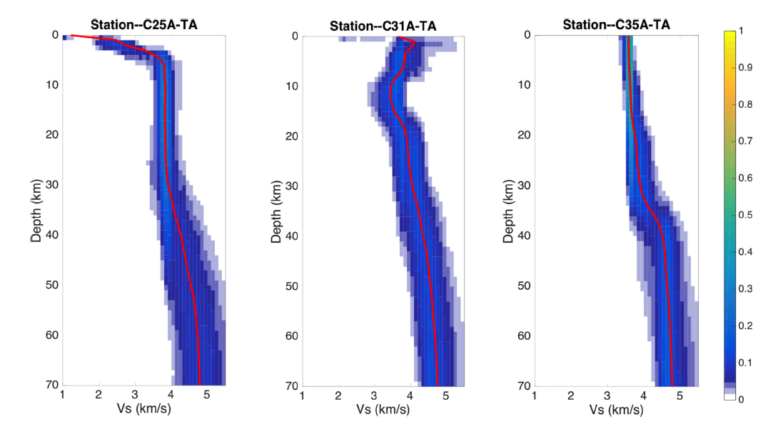
Low-velocity layers within the crust can indicate the presence of melt and lithologic differences with implications for crustal composition and formation. Seismic wave conversions and reverberations across the base of the crust or intracrustal discontinuities, analysed using the receiver function …
First Tomographic Model of the Inner Core!
With collaborators Scott Burdick at Wayne State University and Lauren Waszek at New Mexico State University — both former Maryland postdocs — we just published the first tomographic model of Earth’s inner core in Earth and Planetary Science Letters. Seismic body wave and normal mode analyses have …