
Key Points
- Taxonomy (biological nomenclature) is a way of having a universal set of names for groups of living things.
- A formal set of rules exists for naming and organizing taxa (named groups of organisms). Among these are that taxa are named in Latin (or at least in Latinate style) and that they are organized as a nested hierarchy.
- Species represent a fundamental unit in taxonomy. Species are grouped into genera.
- There is no single universally recognized method of identifying when two individuals are in the same species This is even more problematic for fossils, where some relevant information (such as interbreeding, DNA, and so on) is not available.
- Taxonomic differences are not the only reason that two individuals might be different: ontogenetic, sexual, geographic & individual variations have to be considered as well.
Taxonomy
Taxon (pl. taxa): a named group of organisms. From this term, we get taxonomy: the study and principles for applying names to groups of organisms.
Traditionally, each culture had its own name for the animals, plants, and other organisms in their region. But EACH culture had its own set of names, so the same type of animal might have many different names. During the 1600s and 1700s, methods were proposed for a formal scientific set of names.
Carlos Linnaeus developed a universal set of rules in the Systema Naturae ("System of Nature") in 1758; later workers added and modified the system (primarily with the addition of new "ranks").
Some of the Linnaean rules:
- All names are in Latin or Greek, or are modified into Latin form
- Each name must be unique
- All names are fit into a nested hierarchy (species into genera, genera into families, and so forth)
- In traditional Linnaean taxonomy, there is a set of official ranks (from smallest to largest, species, genus, family, order, class, phylum) (later workers added additional intermediate ranks, such as tribes, subfamilies, superfamilies, subphyla, etc.)
- The primary unit is the species (pl. species):
- Refers to a "specific" kind of organism
- Definition of a "species" varies from biologist to biologist; some definitions ("naturally occurring interbreeding populations") cannot be tested for fossils!
- More about species below
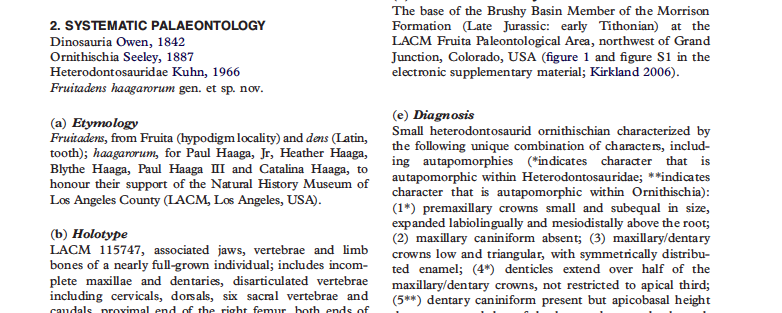
- Each species has a type specimen accessioned in an appropriate institution (museum, zoological or botanical garden, or other such collection)
- Whoever describes the type specimen of a new species has the right to name that new species (following the rules below)
- The next higher unit, the genus (pl. genera) is composed of one or more species
- Refers to a more "generic" category than species
- Definition of a "genus" is problematic as well, since it is composed of one or more "species"
- Each genus has a type species: all other species are assigned to the genus based on their similarity to the type species;
Linnaean taxonomy has its own special set of grammatical rules:
Because there is disagreement about the features used to define a particular species or genus, different biologists and paleontologists will sometimes disagree about which specimens belong in a particular species, and which species belong in a particular genus (and so forth).
- Taxonomists who consider a particular set of specimens to represent many taxa are called splitters; those who consider a particular set to represent few taxa are called lumpers
- If a taxonomist feels that some specimens of a genus belong to an as-yet unnamed species, they can split these specimens off as a new species (which a new type specimen)
- On the other hand, if a taxonomist considers that two previously named species are not distinct enough from each other to truly be distinct species (that is, the taxonomist regards the two names as synonyms), they may lump them together
- In these cases, the Rule of Priority is used: whichever of the names was published first, even if only by days, is the name that must be used
- The same case applies to genera: if two genera are thought to represent the same genus, the first named genus name is the one that is used.
For those interested in a website concerning some unusual Linnaean species names, click here.
What Are Species?
What is a species? Above we see the rules for these names, but it doesn't tell us about what it is being named.
Linnaeus' "species" were taxa like lions, tigers, black bears, etc. These were assemblages of individuals that share certain attributes:
- Similar appearance
- Similar habits and behaviors
- Similar habitats
Darwin did not regard species as a distinct "kind" of biological entity. Instead, he considered them as essentially the same thing as geographic or stratigraphic variations (see these below), but ones in which extinction has removed the intermediate forms that otherwise would blend into the closest living relative group.
20th Century biologist Ernst Mayr (and most contemporary biologists) formalized their definition of a species as a "naturally occurring populations that interbreed and produce viable fertile offspring".
But there are some problems with this. For one: hybrids (crosses between two separate species) do occur naturally, and many of these are actually fertile! And for paleontologists: we can't test interfertility between populations because they are dead!
So we are stuck looking only at shapes (and in fact, only the shapes of those hard parts that survive fossilization).
The question then becomes: how different do two individuals, or two populations, have to be for us to consider them different species? This is actually a terribly difficult question even with living organisms!! There are several sources of variation:
- Sexual dimorphism: different sexes are different sizes and shapes and have different structures
- Ontogenetic (growth): babies look different from juveniles look different from subadults look different from adults (can be even more extreme in animals that undergo metamorphosis, like amphibians and many insects)
- Geographic: populations in different regions might have slightly different sizes, color patterns, proportions, behaviors, etc. For example, some biologists consider the populations of orangutans, tigers, African elephants, etc. as distinct species; others simply regard them as regional variants
- Stratigraphic: lineages (ancestor and descendant populations) may shift in some traits or characteristics over time
- Individual: one of the great "discoveries" of Darwin and Wallace, the recognition that no two individuals in a population are identical! (Before them, many people thought that there existed the perfect "type" of each kind of organism, and all variation is degeneration from that perfection. Darwin and Wallace showed that the variation is the reality)
In fact, the recognition that species were NOT absolute kinds, but instead have "fuzzy" boundaries that blend into each other, is one of the main clues to the discovery of evolution.
Supplementary Video