Eight years ago, the day after a magnitude 4.2 earthquake struck east of Dover, Delaware, graduate students from this lab were in the field installing seismometers alongside collaborators from the Carnegie Institution for Science, the Delaware Geological Survey, the U.S. Geological Survey, Lehigh University, and the Lamont-Doherty Earth Observatory. That deployment has now produced its full accounting. With Karen Pearson (Ph.D. 2021) and Lara Wagner at the Carnegie Institution for Science, we report the aftershock sequence of the 2017 Delaware earthquake: an order of magnitude more aftershocks than the regional network detected, a previously unmapped fault plane beneath Delaware Bay, and an aftershock sequence that was unusually, and interestingly, unproductive.
Earthquakes in the central and eastern United States matter out of proportion to their size. The crust here is old, cold, and efficient at transmitting seismic energy; the building stock is old too; and the population density is high. But associating an eastern earthquake with a causative fault is often impossible, because the faults are not mapped. The 2017 event is an extreme case having occurred beneath the Atlantic Coastal Plain, in the Salisbury Embayment, where there are no mapped faults in the USGS Quaternary database, and it was the largest event beneath the Coastal Plain so far this century.
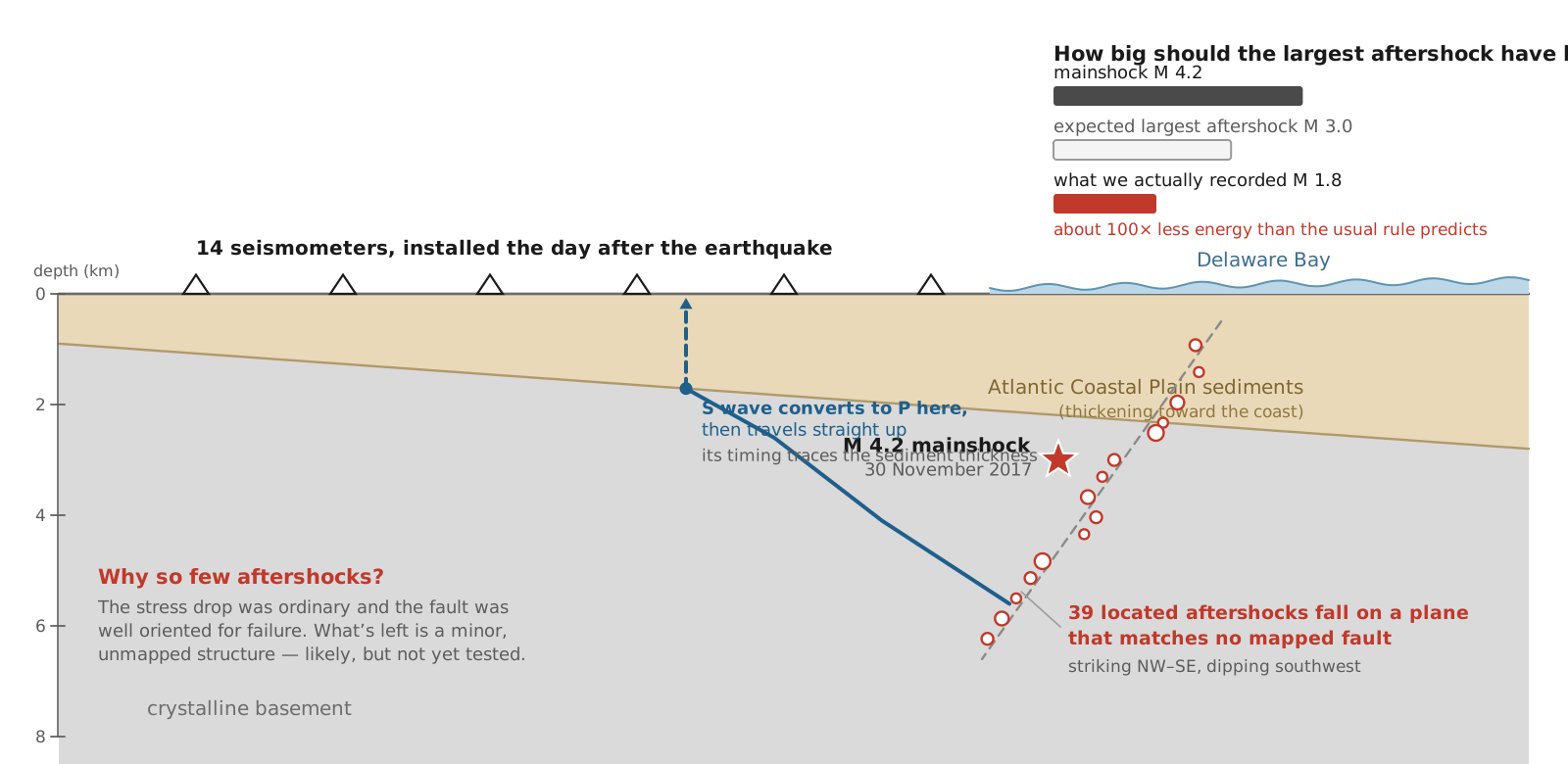
The temporary network — ten nodal geophones from Maryland and four broadband posthole sensors from Carnegie — recorded until 11 January 2018. Using template matching, we found 108 aftershocks, compared with the eight or nine identified from regional stations, lowering the magnitude of completeness by roughly a full magnitude unit. Locating them required building a velocity model from scratch, since none existed for central Delaware. We took the crustal model for the Coastal Plain and replaced its top two kilometers with the sediment velocity structure derived from receiver functions at the nearest Transportable Array station, work done in this lab by Erin Cunningham.
The sediments turned out to be more than a nuisance. The aftershock waveforms showed a strong secondary arrival on the vertical component, ahead of the S wave, which we interpret as an S wave converting to P at the base of the sedimentary section and then traveling essentially straight up through it. The delay between that converted arrival and the S wave tracks the thickening of the Coastal Plain sediment wedge toward the coast. The aftershocks are, therefore, located within the crystalline basement, sounding from below the overlying basin.
Thirty-nine aftershocks had enough picks to locate, and they fall on a plane striking northwest-southeast and dipping southwest, at depths from 0.5 to 6.5 km. That orientation is oblique to both nodal planes of the mainshock, oblique to the Taylorsville rift structures, and oblique to the terrane boundaries. No mapped geologic structure strikes parallel to it.
What we did not find is the usual number of aftershocks. The largest aftershock was 2.45 magnitude units below the mainshock, against the roughly 1.2 units expected from Båth’s law, and the Omori productivity parameter is substantially lower than the mean for stable continental regions. Meanwhile the shape of the sequence was entirely normal: the b value near 0.8 and the decay exponent p near 0.76-.90 are both typical. So the aftershock rate decayed in an unsurprising way, and their magnitudes followed a typical distribution. The only surprising thing was that there were simply far fewer events than there should have been.
We tested the two leading explanations. High stress drop suppressing aftershocks? We estimate a median of 35 MPa, high but unremarkable for eastern North America. A fault unfavorably oriented in the ambient stress field? The plane defined by the aftershocks is close to orthogonal to the northeast-southwest maximum compressive stress, which is about as favorable for thrust failure as one could ask. Neither explanation works, motivating future study. hat matters for hazard. Similar low-productivity sequences have now been reported after moderate earthquakes in South Carolina, Maine, and Michigan suggesting that aftershock forecasts for the central and eastern U.S. built from generic stable-continental parameters may be systematically over-predicting what actually follows.
You can read the paper here: Low Aftershock Productivity and Fault Geometry of the 2017 Delaware Earthquake | Seismological Research Letters