When we publish papers, we hope they can get read, cited, or even built upon. It’s rare that a paper gets argued with in print and at length, which is probably a sign that the paper was worth writing! A couple of years ago, Henri Samuel, at the Institut de Physique du Globe de Paris, led a paper in Nature proposing that a layer of molten rock sits at the very bottom of Mars’s mantle. Earlier this year, we had opportunity to further clarify our arguments in Icarus, motivated by a comment by Russell and colleagues. Having been fortunate enough to be part of both, I think the pair is worth describing together, because taken in sequence they illustrate rather well how planetary seismology proceeds when the entire observational basis for a claim consists of a handful of phases recorded at a single station.
The problem that prompted the original paper arose in 2021, when the InSight team first reported reflections of shear waves off what was interpreted as the Martian core-mantle boundary. These implied a core radius of 1830 ± 40 km, and a core that contained a great deal of light alloying material — sulfur, oxygen, carbon and hydrogen — in proportions that laboratory experiments on iron alloys at the relevant pressures find difficult to accommodate. Two years later, we revised the estimate ourselves, in work led by Jessica Irving at the University of Bristol. By observing SKS, a phase that traverses the core rather than reflecting off its top, we favored a somewhat smaller and denser core, with a median radius of 1780 to 1810 km and a density of 6.2 to 6.3 g cm⁻³. Even this smaller, denser core still required 20 to 22 wt% light alloying elements.
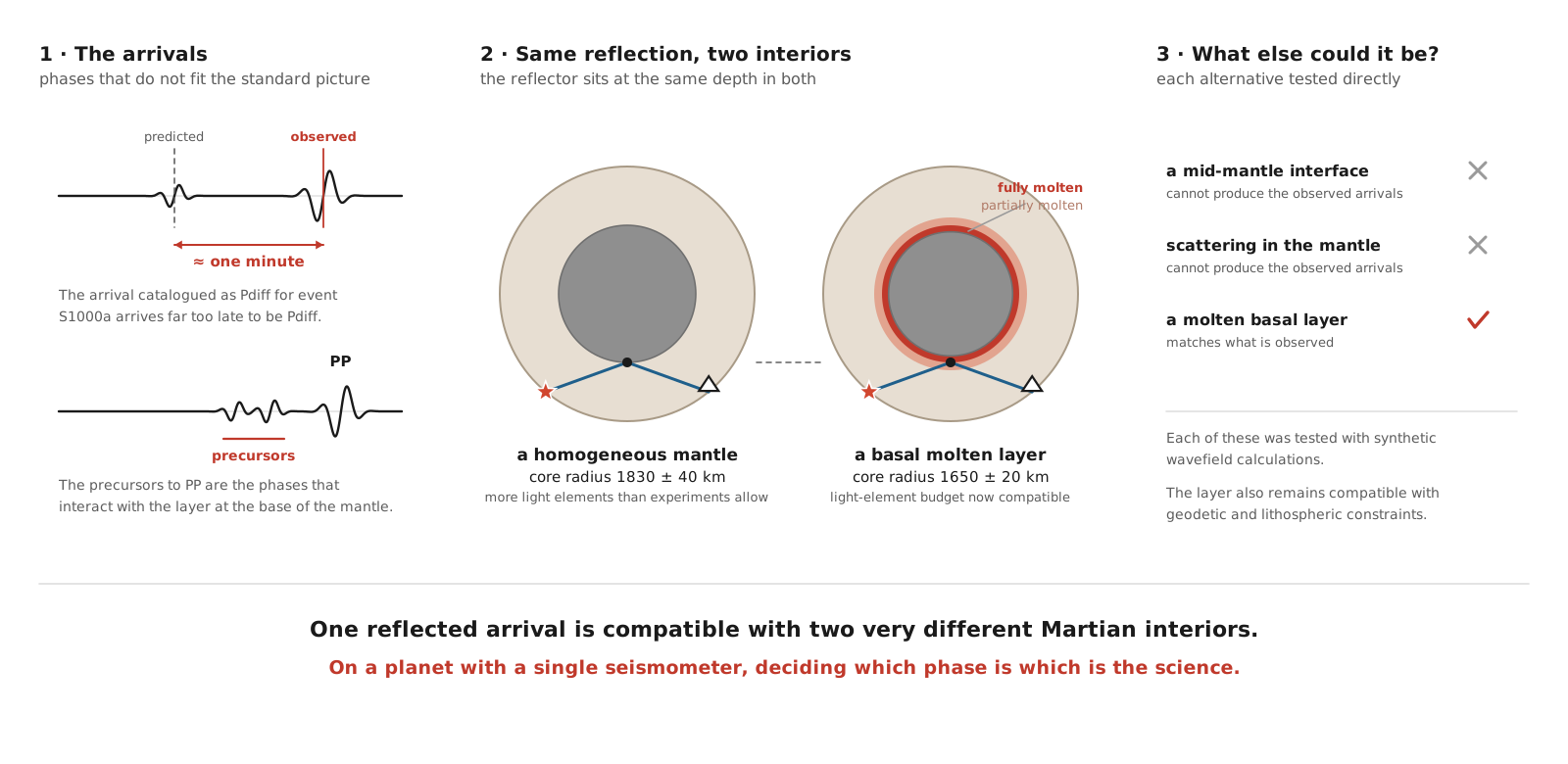
What Henri et al. (2023) proposed is that the reflector giving rise to those deep phases is not the core-mantle boundary at all. An early magma ocean solidifying from the top down would have left behind a basal layer enriched in iron and in heat-producing elements, and such enrichment produces a fully molten silicate layer directly above the core (i.e. a basal mantle layer, BML). The waves would then be reflecting off the top of that molten layer rather than off the core, so that the radius inferred from them is not the core radius but an apparent one, larger than the true value by the thickness of the molten layer. In this scenario, the core radius becomes 1650 ± 20 km, implying a density of 6.5 g cm⁻³, some 5-8% larger than previous seismic estimates, implying less abundant light alloying elements in amounts compatible with both experimental and cosmochemical constraints.
This proposal carried many implications for Mars’ early evolution as a planet. A molten layer rich in heat-producing elements acts as a thermal blanket over the core, slowing the escape of heat and making it considerably harder for the core to convect vigorously enough to sustain a dynamo. This can explain why Mars does not currently have a magnetic field, despite its molten, metallic core. However, Mars’s crust carries a strong magnetic imprint acquired during the planet’s first 500 to 800 million years, so a dynamo demonstrably operated at that time; if the core could not have driven it unaided, then something external must have, whether giant impacts or the stirring of the core by gravitational interaction with satellites that have since disappeared.
Naturally, a claim of this sort invites scrutiny, and Russell et al. (2026) published an argument against the BML layer and its physical feasibility. Their principal argument is that a present-day BML would imply a thermal and viscosity structure whose elastic lithosphere would be thinner than the limited available constraints appear to permit. Alongside this, they suggest that the seismic arrivals we attribute to the layer, which appear as precursors to PP, might instead be produced by scattering within a heterogeneous mantle. Unfortunately, this appeal to mantle scattering is raised as a possibility rather than demonstrated, and is not accompanied by any synthetic wavefield calculations, waveform modelling, or predictions of amplitude and timing that would be required to show that scattering can in fact generate arrivals resembling the ones we observe. We have carried out these kinds of tests and found that neither scattering within the mantle nor reflection from a mid-mantle interface can account for the observed phases.
The remainder of our reply (Samuel et al., 2026) addresses the observations themselves. The arrival reported as Pdiff for event S1000a comes in approximately one minute later than reasonable mantle models would predict. Because this discrepancy is far too large to be attributed to uncertainties in the source location or the velocity structure, we interpret it as evidence that the phase has been misidentified. Using polarization analysis together with sensitivity kernels, we show that the P-wave arrivals in S1000a do interact with the core-mantle boundary region rather than representing something shallower masquerading as a deep phase. We then show that basal mantle layer models remain compatible with Mars’s geodetic and lithospheric constraints, as well as with what is understood of the planet’s thermal evolution and its ancient dynamo.
Because on Mars we have only a single station and therefore cannot bring to bear the array methods that would ordinarily settle questions of this kind on Earth, we must instead analyze how the ground moves and whether that motion is consistent with a wave that has travelled down to the core and back. Unfortunately, the entire debate rests on the correct identification of a small number of seismic phases in a small number of events, and, as the misplaced Pdiff for S1000a illustrates, those identifications are not always right. That is precisely why we are now working back through the InSight catalog to re-examine which phase is which, since on a single-station planet phase identification is the foundation on which the science rests.
You can read the papers here:
- Geophysical evidence for an enriched molten silicate layer above Mars’s core | Nature
- Reply to Russell et al. (2026): Complementary analyses further support a molten Basal Mantle Layer on Mars | Icarus