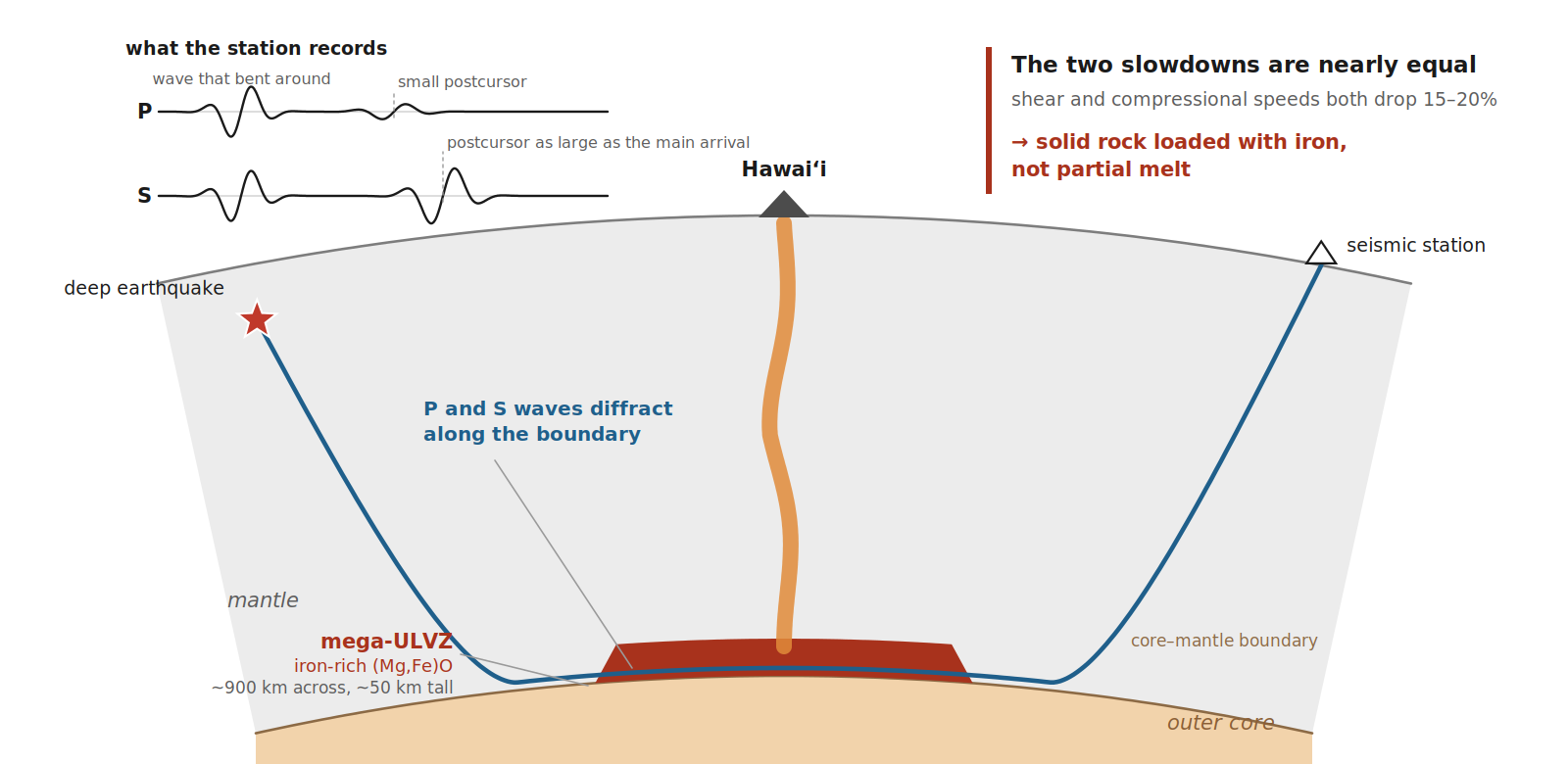
Sitting at the very base of the mantle, directly beneath Hawai’i, is a patch of rock where seismic waves slow down dramatically. Structures like this — ultralow-velocity zones, or ULVZs — are found in many places along the core-mantle boundary, but the ones beneath major hot spots are exceptionally large, and their origin has been debated for decades. Are they pockets of partial melt? Iron-rich solid rock? Leftovers of a basal magma ocean? Working with Doyeon Kim (now at Imperial College London, and a former member of this lab), Jung-Hun Song, and Vasilije Dobrosavljevic, we have made the first systematic observations of P waves scattered by the Hawaiian mega-ULVZ, and combined them with S waves to show that the structure is most likely solid rock enriched in iron — not melt.
The reason this question has been so hard to settle is that nearly everything we know about mega-ULVZs comes from shear waves. S waves diffracting along the core-mantle boundary produce dramatic postcursors — secondary arrivals that follow the main pulse — and their timing and amplitude tell us how much the shear velocity drops and how big the structure is. But shear velocity alone cannot distinguish a solid, iron-rich rock from a partially molten one. For that, you need the compressional wave speed too, and the P-wave postcursors are much harder to see: they are weaker, they arrive sooner, and they sit on top of a coda contaminated by conversions at the receiver.
Our solution was not to look harder, but to look differently. Rather than sorting seismograms by azimuth for one earthquake at a time — the traditional approach, in which the long-period Pdiff postcursors are essentially invisible — we ordered thousands of waveforms by their intrinsic similarity using the Sequencer, the manifold-learning algorithm we previously applied to Sdiff waveforms across the Pacific. Reordered this way, the postcursors emerge clearly. Plotted at the midpoints of their diffracted paths, they trace out the same geographic pattern northwest of Hawai’i that the S waves do, which tells us both datasets are seeing the same object. Combining the two actually pins down its location: the S-wave pattern alone suffers from a trade-off along the diffracted path that the P waves resolve.
We then modeled the observations with fully 3D spectral-element simulations. For a structure roughly 900 km across and 50 km tall, matching both the P and S postcursors requires the compressional velocity to be reduced by 15-20%, alongside a 20% reduction in shear velocity — a ratio of shear to compressional velocity reduction between 1 and 1.3. That is a strikingly low ratio. Partial melting of ordinary mantle rock, or of subducted oceanic crust, produces ratios near 3; infiltration of liquid from the core produces higher values still. What does fit, and fits regardless of the assumed thickness of the structure, is solid rock containing magnesiowüstite very close to the FeO end-member, coexisting with bridgmanite and CaSiO3.
The simulations also produced a satisfying explanation for something that had always seemed odd: why Sdiff postcursors beneath Hawai’i can be larger than the main arrival, while the Pdiff postcursors are so small. Watching the wavefield evolve, it becomes clear that what we routinely call the “main” diffracted phase is actually the healed wavefront that traveled around the anomaly, while the postcursor is the delayed, focused wavefront that went through it. Wavefront healing is far more effective for P waves, so the P-wave main arrival recovers and the postcursor stays weak. This is not captured by ray theory and interpreting the various waveform features in the diffracted and scattered/focused wavefield is not always obvious.
Iron-rich rock at the base of the mantle is interesting for reasons beyond bookkeeping. At core-mantle boundary conditions FeO behaves as a metal, with high electrical and, by extension, thermal conductivity. A mega-ULVZ made of such material would not be a passive marker sitting beneath a plume but may, instead, actively help generate and sustain one. It is also worth noting that ULVZs recently reported near subducting slabs have much higher shear-to-compressional ratios, closer to 3 or 4, which points to partial melting instead. ULVZs may not be a single class of object, and the diversity of the core-mantle boundary may be recording more than one process.
You can read the paper here: Seismic and mineralogical evidence for an iron-rich mega–ultralow-velocity zone beneath Hawai’i | Science Advances