
PI – Vedran (Ved) Lekić
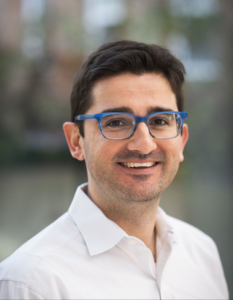
I am a Professor of Geological, Environmental, and Planetary Sciences at the University of Maryland, College Park, where I serve as Director of Graduate Studies. I received my A.B. from Harvard University (2004), where I completed my undergraduate thesis with Adam Dziewonski, and my Ph.D. from the University of California, Berkeley (2009) under Barbara Romanowicz, followed by postdoctoral training at Brown University with Karen Fischer.
My research is broad, spanning scientific targets from Earth’s inner core to the critical zone, and from the Martian interior to the icy moons of the outer solar system. On Earth, I have worked on lower mantle structure and large low-shear-velocity provinces, upper mantle tomography and tectonic regionalization, lithospheric structure and receiver functions, ice shelf seismicity, and near-surface characterization for humanitarian applications including landmine and unexploded ordnance detection. Beyond Earth, my work encompasses the crust, mantle, and core of Mars using InSight seismic data, lunar crustal structure, and the seismic exploration of planetary subsurfaces. Across all of these targets, I develop and apply Bayesian and transdimensional inverse methods, full-waveform modeling, cluster-based machine learning approaches, and multi-geophysics imaging techniques.
I am the recipient of a Packard Fellowship, an NSF CAREER Award, the Charles F. Richter Award from the Seismological Society of America, and the AAAS Newcomb Cleveland Prize. My students and postdocs have gone on to careers in industry, government, and hold faculty positions worldwide.
You can access my Google Scholar profile here and up-to-date CV here: Lekic_UMD_CV_current.
Postdoc – Ziqi Zhang
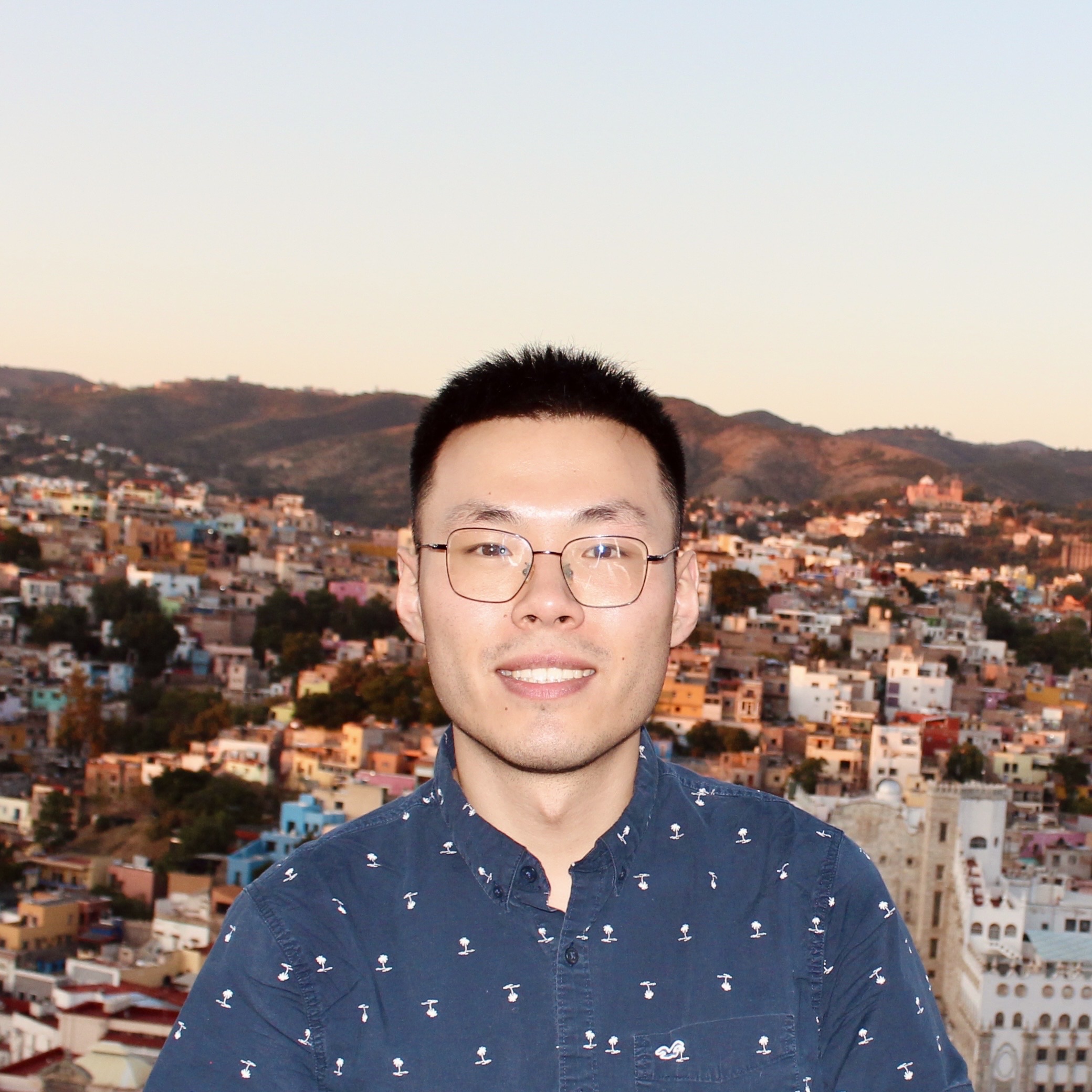 Dr. Ziqi Zhang joined our group as a postdoc in the fall of 2024 after completing a Ph.D. at the University of Rochester with Tolulope Olugboji — in a sense, he has returned to his roots. During his Ph.D., he developed signal-processing and inverse methods for high-resolution seismic imaging in the presence of noise and interfering wavefields. His research combined reverberation suppression, sparse-transform signal recovery, and probabilistic deconvolution to improve the detection and characterization of weak body-wave phases.
At Maryland, Ziqi leads the implementation of a NASA Mars Data Analysis Program project applying source-array methods to marsquake waveforms to identify seismic phases and constrain the thermal and compositional state of the Martian mantle. He has developed a new method for probabilistic analysis of seismic array data (TAPIR) and has extended his probabilistic body-wave deconvolution to PP and SS pecursors constraining Martian crust outside Elysium Planitia.
Ph.D. Student – Benjamin Moyer
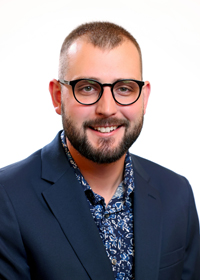 Ben develops computational methods for difficult geophysical inverse problems, with explicit characterization of the uncertainty in those inversions. His dissertation work at the University of Maryland centers on trans-dimensional Bayesian inference for joint gravity and magnetic inversion, rebuilt for GPU-accelerated hardware in a vendor-neutral way: a single source tree that runs across NVIDIA, AMD, and Intel GPUs and demonstrates billion-parameter sampling on a single consumer GPU, against a published state of the art for this problem class several orders of magnitude smaller. A related thread assesses sampler convergence against analytically computable exact posteriors, a check the literature in this area has largely gone without. Alongside this, two DOE CSGF practicums at Lawrence Livermore National Laboratory, advised by Dr. Souheil Ezzedine, have broadened Ben’s methods and domains: in 2025 he applied statistical and deep-learning methods to uncertainty quantification in seismic source characterization for nuclear explosion monitoring, and in 2026 he worked on GPU-accelerating a legacy Fortran multiphysics code for modern heterogeneous architectures. His dissertation, “The Delicate Balance of Error: The Stable and the Underdetermined in Geophysical Inference,” is co-advised by Drs. Vedran Lekić and Nicholas C. Schmerr.
Ph.D. Student – Ashley Hanna
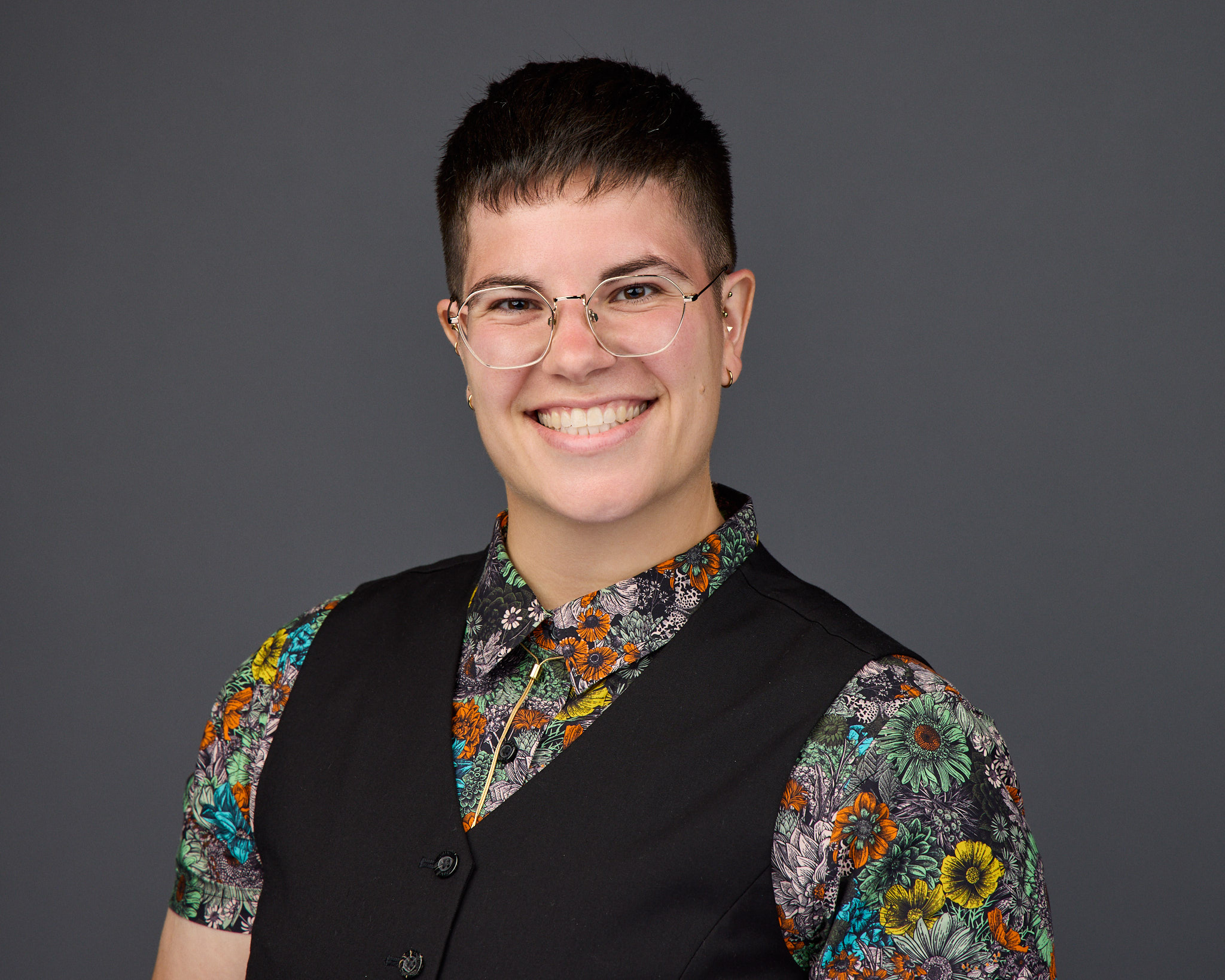 My PhD research focuses on developing methods to detect microbial signs of life on other worlds using laser desorption mass spectrometry (LDMS) and machine learning. I study how microbial and organic biosignatures can be identified under conditions relevant to future missions to Mars and ocean worlds such as Enceladus, with particular emphasis on understanding how instrument design and sample preparation affect detection. By combining analytical chemistry, microbiology, astrobiology, and machine learning, my work aims to improve how we interpret spaceflight mass spectrometry data and develop more reliable strategies for detecting life beyond Earth. Ash is co-advised by Prof. Ved Lekic at Maryland and Prof. Jill Mikucki at the University of Tennessee.