There are something like a hundred million unexploded landmines and pieces of ordnance in the ground worldwide, most of them small, shallow, and made of enough metal to have a magnetic signature. But reliably finding them with a magnetometer is far from easy. Heidi Myers, a former Ph.D. student co-advised by myself and Prof. Dan Lathrop, has published a paper in Geophysics showing that the mathematical assumptions underpinning magnetic gradiometry break down precisely in the regime where these targets live. The good news is that the way the assumptions break carries information one can use.
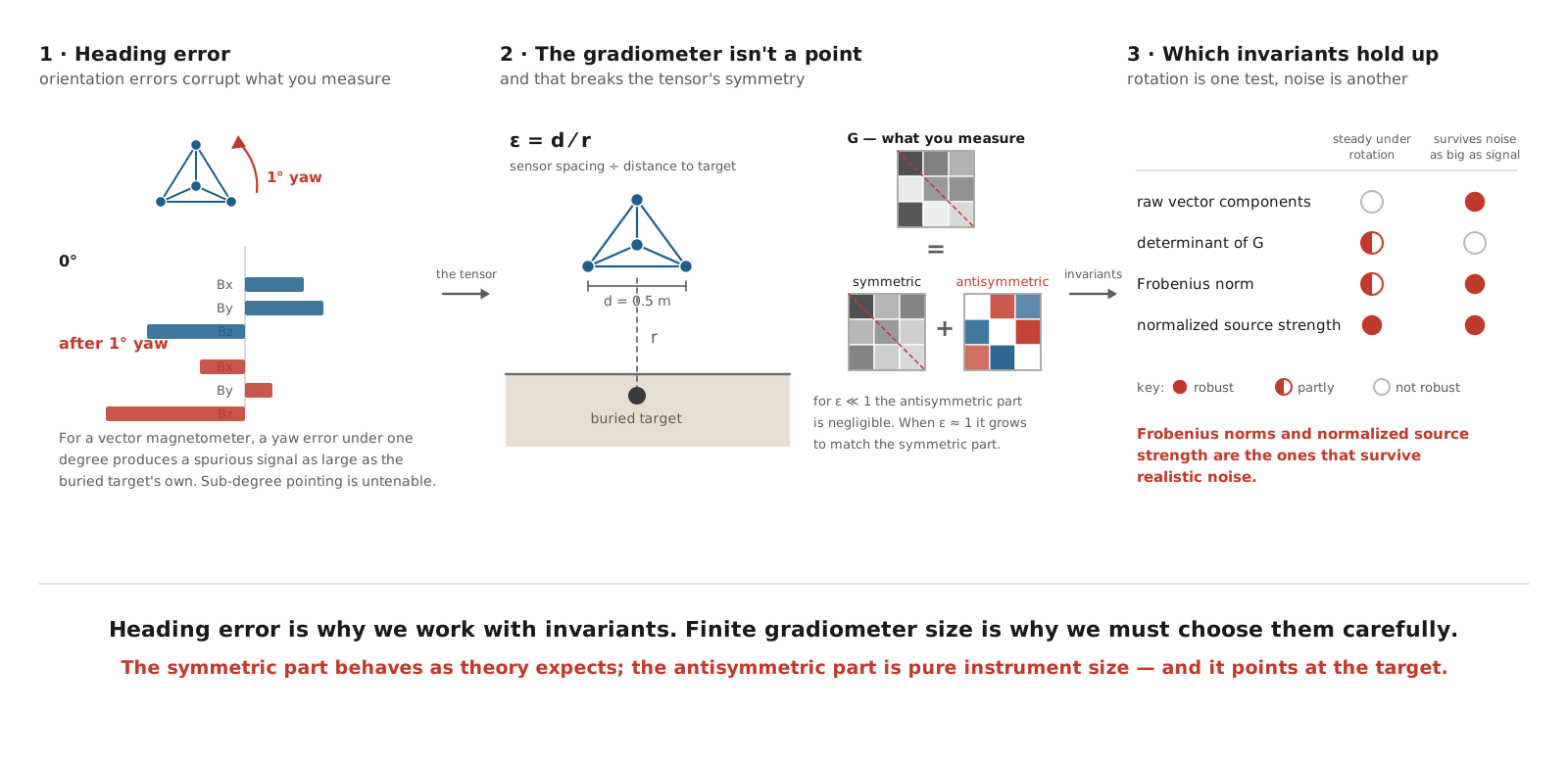
Let’s start with a concrete example. An antitank mine buried 15 cm down produces a magnetic anomaly of a few tens of nanotesla (nT) at the surface, and that signature falls off with the cube of distance. Lift the sensor half a meter and the signal will weaken so much that a geomagnetic storm, or the noise from a metro line a few kilometers away, can obfuscate it. That means that we have to be close to the target when using magnetometry. Ideally, we would use vector magnetometers, which measure the three components of the field and carry much more information about a buried object’s orientation and shape. But, these are extremely sensitive to pointing error, which can be a problem: a yaw error of less than one degree generates a spurious signal as large as the mine you are hunting. Sub-degree pointing accuracy is difficult with an instrument carried on a pole and essentially untenable on a drone. There is also an geometrical problem, which is that a geophysical survey measures different places at different times, so anything that varies in time can map into false structure in space.
Gradiometry answers the noise and temporal-to-spatial mapping by relying on the difference between the readings of two nearby magnetometers. Anything seen by both — space weather, the metro, distant sources generally — subtracts out, while the highly localized field of a nearby object does not. It also offers avenues of addressing the pointing problem: invariants of the magnetic gradient tensor are by construction invariant to the instrument’s orientation.
The theory of magnetic gradiometry is written for an infinitesimally small gradiometer. In this idealized case, the gradient tensor is symmetric and traceless — this follows directly from Maxwell’s equations outside a source — and its invariants really are invariant to rotation. But a real gradiometer has a finite size. Whether one can neglect this size depends on the ratio of the gradiometer size to the distance to the target. When studying geological anomalies gradiometry was developed for, this ratio is tiny and the infinitesimal approximation is appropriate. However, for a landmine 15 cm underground measured from half a metre up with sensors half a metre apart, the ratio is close to one. The higher-order terms that everyone drops are the same size as the terms everyone keeps. As a result, the measured tensor is not symmetric, it is not traceless, and its invariants are not invariant to rotation.
The most important insight of our paper is to stop treating this as an error. By splitting the measured tensor into its symmetric and antisymmetric parts, we can investigate the antisymmetric part on its own. Remember that this part should vanish in the idealized theory. But, with finite-size gradiometers, its size is a measure of how sharply the magnetic field lines are bending as they close in on their source. It is a curvature detector, and curvature is largest near a compact object. Its magnitude relative to the symmetric part grows with the square of the size-to-distance ratio, so it also encodes something about depth.
To test this insight in the field, we built TetraMag: four triaxial fluxgate magnetometers in 3D-printed housings at the vertices of a regular tetrahedron half a metre on a side, on carbon fiber tubes, sampling the full gradient tensor directly. The half-metre baseline was chosen so that the ratio stays near one at low survey heights while the target can still be treated as a dipole. We validated the method over a bar magnet buried 15 cm deep in a sand test bed at the Paint Branch Turfgrass Research Facility, lawnmower-style, from 55 cm up, with lidar tracking position and a Raspberry Pi keeping everything on a common clock.
We found that not all invariants are equally invariant: the normalized source strength and one of the eigenvalue combinations hold their patterns under rotation, while the determinants and Frobenius norms visibly shift. Under high noise conditions, the determinants stop showing recognizable patterns entirely while the Frobenius norms and normalized source strength survive. Because the discrepancies between real and idealized tensors live mostly in the antisymmetric part, working with the symmetric part sidesteps some of the laborious calibration that magnetic surveying usually demands. And if invariant patterns are stable enough under rotation, the instrument can be bolted rigidly to a drone rather than hung from a gimbal, with orientation recorded by an IMU and corrected later. That moves the hard problem from the field, where it is nearly unsolvable, to the desk, where it is merely difficult.
You can read the paper here: Enabling small anomaly detection using finite-difference magnetic gradiometry | Geophysics