Author name: finchmin

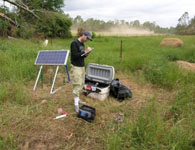
Photo of Vedran Lekic in the field

Ved Lekic

At the broadest level, I seek to understand the state, dynamics, and dominant processes of the solid Earth, as well as those of other planets and satellites. Accurate seismic imaging is a crucial first step toward this goal. I believe that we stand at a threshold of a transformation in seismology, one enabled by the

Ved Lekic Read More »

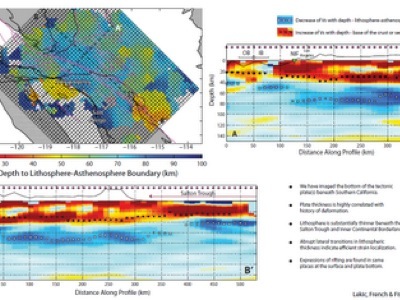
Lithospheric thinning beneath rifted regions of Southern California

Conversions of teleseismic shear (S) waves to compressional (P) waves across velocity interfaces (such as the Moho or the lithosphere-asthenosphere boundary) allow us to map out variations in plate thickness across Southern California. Anomalously thin lithosphere is observed beneath rifted regions, such as the Salton Trough. The stretching and break-up of lithosphere through a process

Lithospheric thinning beneath rifted regions of Southern California Read More »

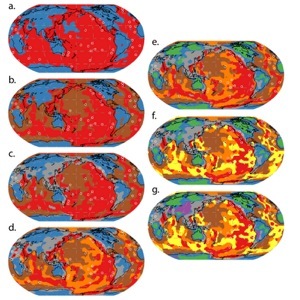
Full waveform tomography with the spectral element method

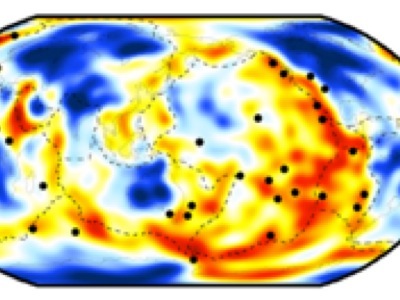
Map of lateral variations in the velocity of seismic shear waves (S-waves) at a depth of 125 km. Warm colors denote slower wavespeeds, and are thought to indicate warmer temperatures and/or the presence of melt or water. Cool colors denote faster wavespeeds, and indicate cool regions, such as the mantle beneath the ancient, stable portions

Full waveform tomography with the spectral element method Read More »

Frequency dependence of seismic attenuation

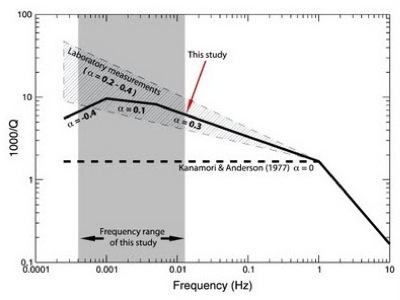
Preferred model (solid line) of frequency dependence of attenuation within the absorption band compared with constraints from laboratory studies (hachured region) and the frequency-independent assumption (dashed line). In our model, α is approximately 0.3 at periods shorter than 200 s, decreasing to 0.1 in the period range 300–800 s, and becoming negative (−0.4) at periods longer than

Frequency dependence of seismic attenuation Read More »

Scroll to Top